

Inside Fox 13 Seattle’s new downtown broadcast facility
Weekly insights on the technology, production and business decisions shaping media and broadcast. Free to access. Independent coverage. Unsubscribe anytime.
Fox 13 Seattle began broadcasting Nov. 7 from a single floor of a downtown office tower, leaving the station’s longtime studios near Lake Union.
“The new facility really emphasizes where this business is going,” said Jake Wiederrich, news director at Fox 13 Seattle.
“We are not in a standalone TV building with satellite dishes on the roof and a giant garage door for giant microwave and satellite trucks. That’s not us. We’re on the entire second floor of a high-rise building in downtown Seattle,” said Wiederrich.
He estimated the station cut its square footage roughly in half, though he said he did not know the exact figure. He described the smaller space as part of a broader shift in which “everything is a little more condensed and a little more centralized.”
“When I first started bringing people in here and they saw, quite frankly, the smaller space, these were some skeptical journalists. They looked at me and they said, ‘Oh, I get it. It makes sense. We had too much space in the old place,'” Wiederrich said.

Wiederrich noted that new studios, let alone a full facility move, are less common in local TV than they once were. Fox 13’s new space was planned around both a traditional broadcast studio and a full-time streaming operation.
“It speaks to the investment that Fox made, that Fox really believes in local news and live news and being in the communities and in the markets that we’re in,” said Wiederrich.
The station, part of Fox Television Stations, moved to 1800 9th Ave., in the redeveloped Axis9 tower in Seattle’s Denny Triangle neighborhood. Ilona McCauley and Taylor Winkel co-anchored the final broadcast from the Westlake Avenue North studios.

Two studios, two design processes
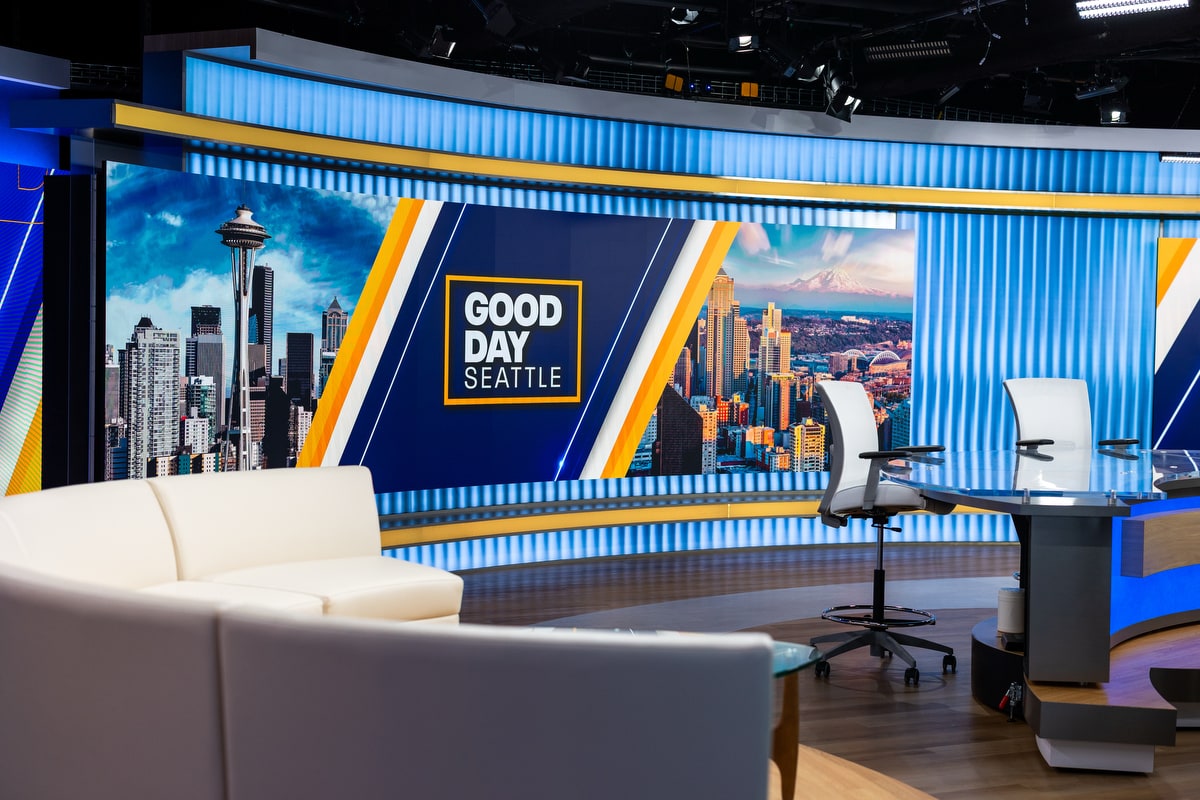
The facility has three studios. Studio A is the primary set for “Good Day Seattle,” “Seattle News Tonight” and “Washington Sports Wrap.” Studio B supports 24/7 digital livestreaming and breaking news for the station’s Fox Local streaming service. Studio C, called the Fox Den, is used for podcasts and long-form interviews.
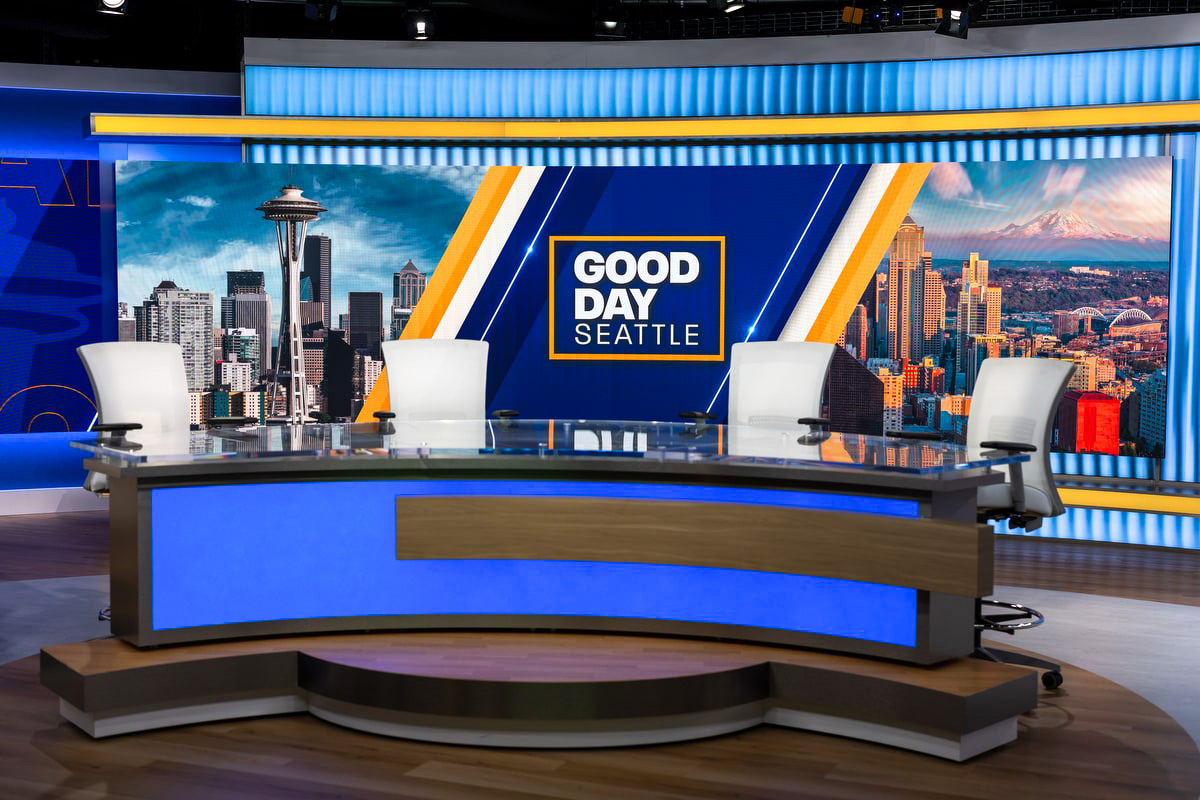
Devlin Design Group designed the studios, with LED technology from D LED Solutions.
Wiederrich, who came up through the ranks as a producer, said this was the first project of its size he had led. Studio A’s design was approved largely as first presented. It includes an anchor desk that seats four, a couch, a weather center that can double as a traffic center, a chroma key wall and an interview area.
“It has everything I need, right? Check the box, check the box, check the box,” said Wiederrich.
Studio B took longer. Wiederrich said the version that was built was about the sixth or seventh design.
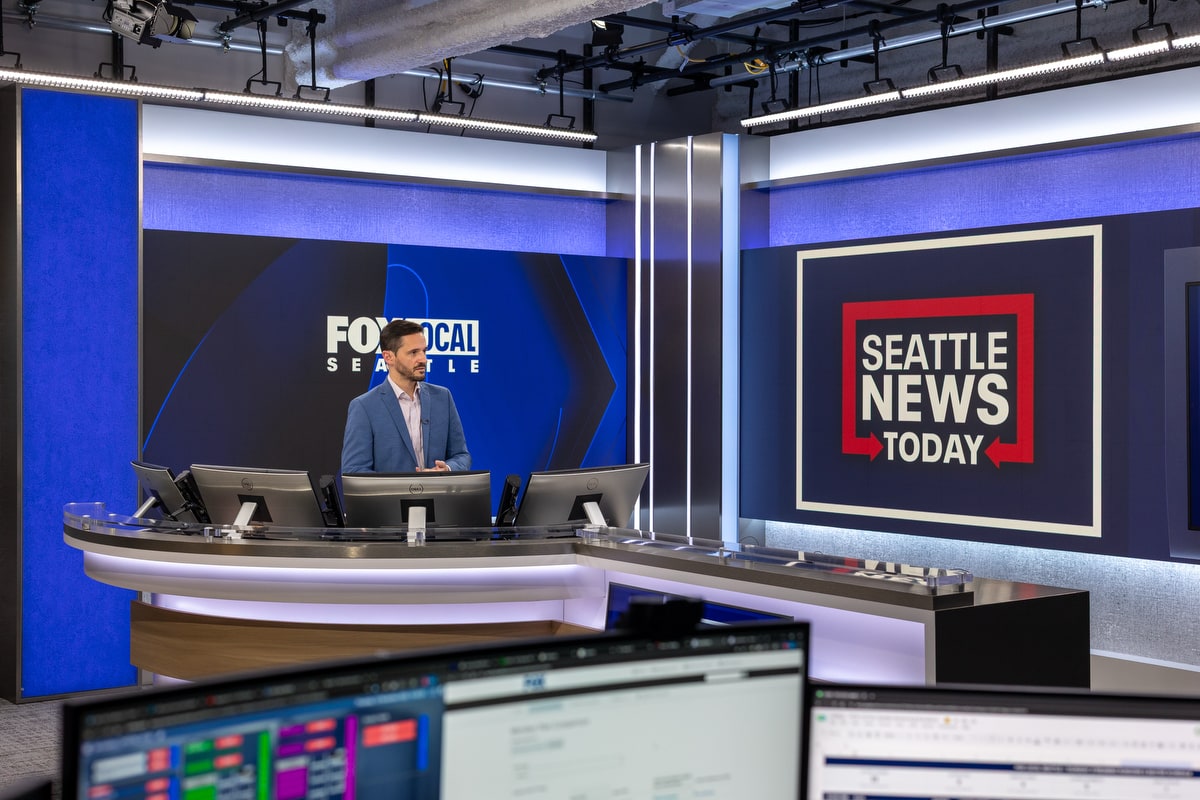
“I didn’t know exactly what we needed, but it wasn’t the first one, and it wasn’t the second one. And it was no fault of Devlin. They did a great job, but we were trial and erroring all of these designs until we finally landed on the one that we have,” he said. “I didn’t know it until I saw it, and then when I saw it, that was it.”
The final design lets a single host run a TriCaster, a live production system from Vizrt, to control cameras, remote feeds, graphics, on-screen text and video. The set also has room for reporters and other guests to join the host.
Contributor positions are wired at newsroom and weather center desks around the floor, so staff can appear on the stream without walking to the set.
Built around how the audience watches
Wiederrich said the station designed the facility around how viewers now consume news. He described morning news as a format that will remain in place for a long time.
“‘Good Day Seattle’ is my main show. I call it my marquee show. But appointment television, aside from morning routines, doesn’t exist that much anymore. And so people want to be able to access you, and if something’s going on, you better be covering it. And if something is going on and you’re not covering it, then you’ve lost people,” said Wiederrich.
The permanently staffed streaming set is the station’s answer to that.
“We don’t have to raise the whole crew to get on the air. We’re already there,” Wiederrich added.
The new production infrastructure supports those formats. Local production resolution moved from 720p to 1080p, with capacity for higher resolutions later.
BeckTV handled the infrastructure and control room build. The facility runs on one network: switches throughout the floor all connect up to central core switches.
That network carries several types of video and audio side by side. They include SMPTE ST 2110, the industry standard for sending uncompressed video, audio and data over IP networks, and compressed video in MPEG-4 and HEVC formats. NDI video streams and Dante audio also run across the facility.
SRT, a protocol for sending live video over less predictable networks, carries streams to and from the station over its wide-area network.
Wiederrich said more of the station’s software now runs in the cloud, which adds steps such as extra logins.
“There are a lot of workflows in this building that are different and more challenging than what we had before. I’ll admit it. But in the grand scheme of things, the challenges we left behind from the old place pale in comparison,” said Wiederrich.
A newsroom without a raised assignment desk
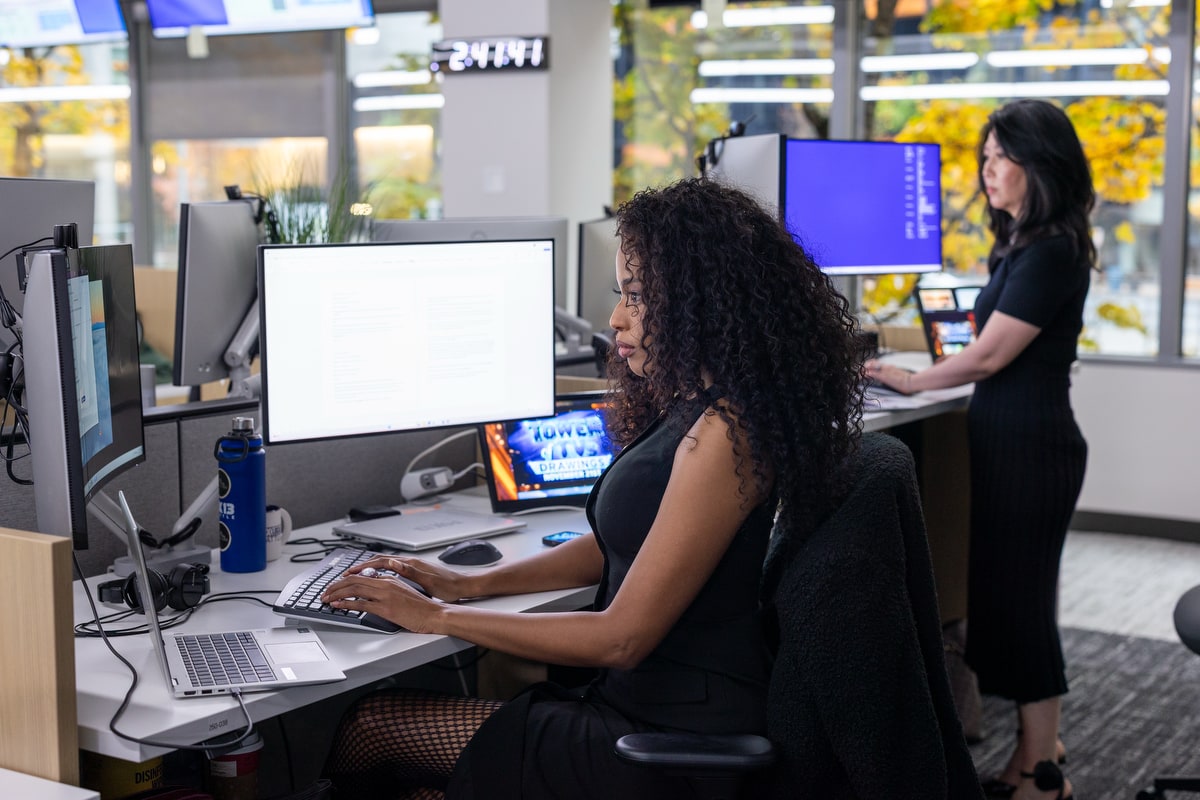
The newsroom uses an open layout that places reporters, producers, photographers, editors and assignment staff in one space. Workstations are height-adjustable, and computer monitors are mounted on arms to free up desk space.

The station did not build a traditional assignment desk, which in many newsrooms sits on a raised platform.
Instead, assignment editors work at two larger-than-standard workstations in the middle of the rows of desks, sized to hold police scanner equipment.
“We have a great assignment desk team, but it’s just the way news gathering is different today,” said Wiederrich. “So we still have all the tools we need, but they’ve been built out differently.”
Location and amenities
The new site is close to Interstate 5, which crews use to cover Western Washington. It is also closer to City Hall, police headquarters, the fire department and the stadiums where the Seahawks, Mariners and Sounders play.
Additional broadcast-ready spaces include a kitchen for cooking segments and a lobby set up for live news and weather reports.
The tower includes a basement pickleball court, a gym and a fourth-floor lounge open to all tenants, where photographers and reporters can edit stories.
The neighborhood also changed how staff eats. When department heads divided up topics for announcing the move to staff, Wiederrich was assigned lunch.
“I just put our new address in ChatGPT, and I said, ‘Find me all the lunch places in a half-mile radius.’ And it said conservatively between 40 and 70. So I think that was a big selling point for the staff right out of the gate,” said Wiederrich.
Wiederrich said a former full-time staffer, now a freelancer, told him on her first visit that she would have stayed full time had she known about the move.
“These kind of amenities and this kind of environment, it makes for happy journalists. And happy journalist is not always a phrase that is uttered,” said Wiederrich.
He credited Fox Television Stations’ corporate teams, including engineers and IT technicians who spent time working out of the station’s conference room during the transition.
“They turned it into a war room, and they did a great job,” Wiederrich said.

tags
BeckTV, Dante, Devlin Design Group, DLED Solutions, Fox Television Stations, kcpq, KZJO, NDI, newtek tricaster, seattle, SRT, tricaster, Vizrt
categories
Broadcast Facility, Broadcast Facility Technology, Heroes, IP Based Production, News Set Design, Set Design