

Corporate production moves from exception to expectation
Weekly insights on the technology, production and business decisions shaping media and broadcast. Free to access. Independent coverage. Unsubscribe anytime.
As organizations continued to invest in broadcast-quality facilities and workflows, corporate and enterprise video production increasingly resembles traditional broadcast operations in both scale and complexity. What was once limited to executive town halls or investor updates has expanded into ongoing content programs supporting communications, training, marketing and live events.
This shift placed corporate production squarely at the intersection of broadcast and Pro AV — a convergence that industry analysts increasingly describe as “Broadcast AV.”
According to AVIXA’s Industry Outlook and Trends Analysis, Broadcast AV accounted for $43 billion in 2025 and was projected to grow at a compound annual growth rate of 5.46% through 2029. The category reflects both the adoption of broadcast technologies by corporations and the growing use of AV-over-IP, media servers and software-driven infrastructure by media organizations.
That convergence framed much of the thinking behind the four-part Professional Essentials: Guide to Corporate Production series.
From facilities to workflows
The series opened by examining studio infrastructure and facility planning, where many organizations encountered broadcast-style challenges for the first time. Decisions around space allocation, acoustics, signal standards and future expansion increasingly mirrored those faced by local stations and regional production hubs.
As corporate studios matured, workflow design emerged as a defining factor.
Unlike traditional conference room AV, corporate production environments required repeatable processes, automation and integration with existing IT systems. Teams were often asked to deliver “broadcast quality” output with smaller staffs, simplified interfaces and limited production windows.
This expectation reflected a broader market reality. AVIXA’s analysis showed that Broadcast AV demand leaned heavily toward capture, production and content management technologies rather than display-centric systems. Media servers, storage platforms, control systems and production equipment accounted for a growing share of spending, alongside services tailored to live and hybrid workflows.

Technology decisions shaped by usability
Part three of the series focused on production technology, where ease of use became as important as raw capability. Corporate users often required tools that delivered professional results without the operational overhead common in traditional broadcast environments.
IP-based production, cloud services and AVoIP infrastructure played a central role in that evolution. Broadcasters adopted these technologies to improve flexibility and efficiency, while corporate teams used them to scale production without building fully staffed control rooms.
These shared technology choices highlighted the need for professionals who could bridge broadcast and Pro AV disciplines. AVIXA noted that many Pro AV practitioners were still adapting to broadcast workflows, just as corporate users continued to learn the realities of live production and media management.
Content strategy completes the equation
The final part of the series shifted the focus from systems to storytelling. As corporate production capabilities expanded, organizations faced growing pressure to justify investment through measurable outcomes.
Live streams, internal broadcasts, training programs and immersive presentations all competed for attention across multiple platforms. Success increasingly depended on aligning content strategy, distribution and measurement with business goals rather than production value alone.
This emphasis on outcomes reflected the broader Broadcast AV opportunity, which AVIXA estimated at $15 billion in Asia, $10 billion in Europe and $14.6 billion in North America. Across regions, end users sought broadcast-quality results paired with simplified operation and predictable costs — a balance that defined many corporate production decisions.
A connected production ecosystem
Taken together, the four guides illustrated how corporate production moved beyond isolated projects into an integrated production ecosystem. Infrastructure, workflows, technology and content strategy became interdependent decisions rather than standalone purchases.
For manufacturers, integrators and service providers, the growth of Broadcast AV underscored the importance of education and market alignment. For corporate teams, it reinforced the value of planning production capabilities with the same discipline long applied in broadcast environments.
As the boundaries between broadcast and corporate production continued to blur, the series showed that success depended less on replicating a TV studio and more on designing systems that supported consistent, scalable communication.
The Professional Essentials: Guide to Corporate Production series concluded with a clear takeaway: corporate production was no longer borrowing from broadcast — it was becoming part of the same operational conversation.
Ready to explore the full series?
Visit our Resources section to explore the full Guide to Corporate Production series and our webinar recording on building a corporate studio.
Download Now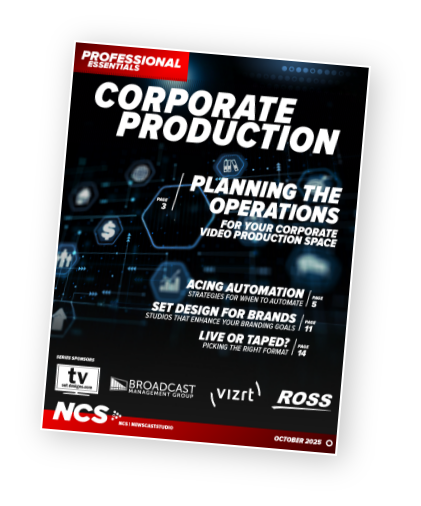

tags
AVIXA, Corporate Production
categories
Corporate and Enterprise Video Production