
FCC chairman warns broadcast power has shifted away from local TV stations to national networks
Weekly insights on the technology, production and business decisions shaping media and broadcast. Free to access. Independent coverage. Unsubscribe anytime.
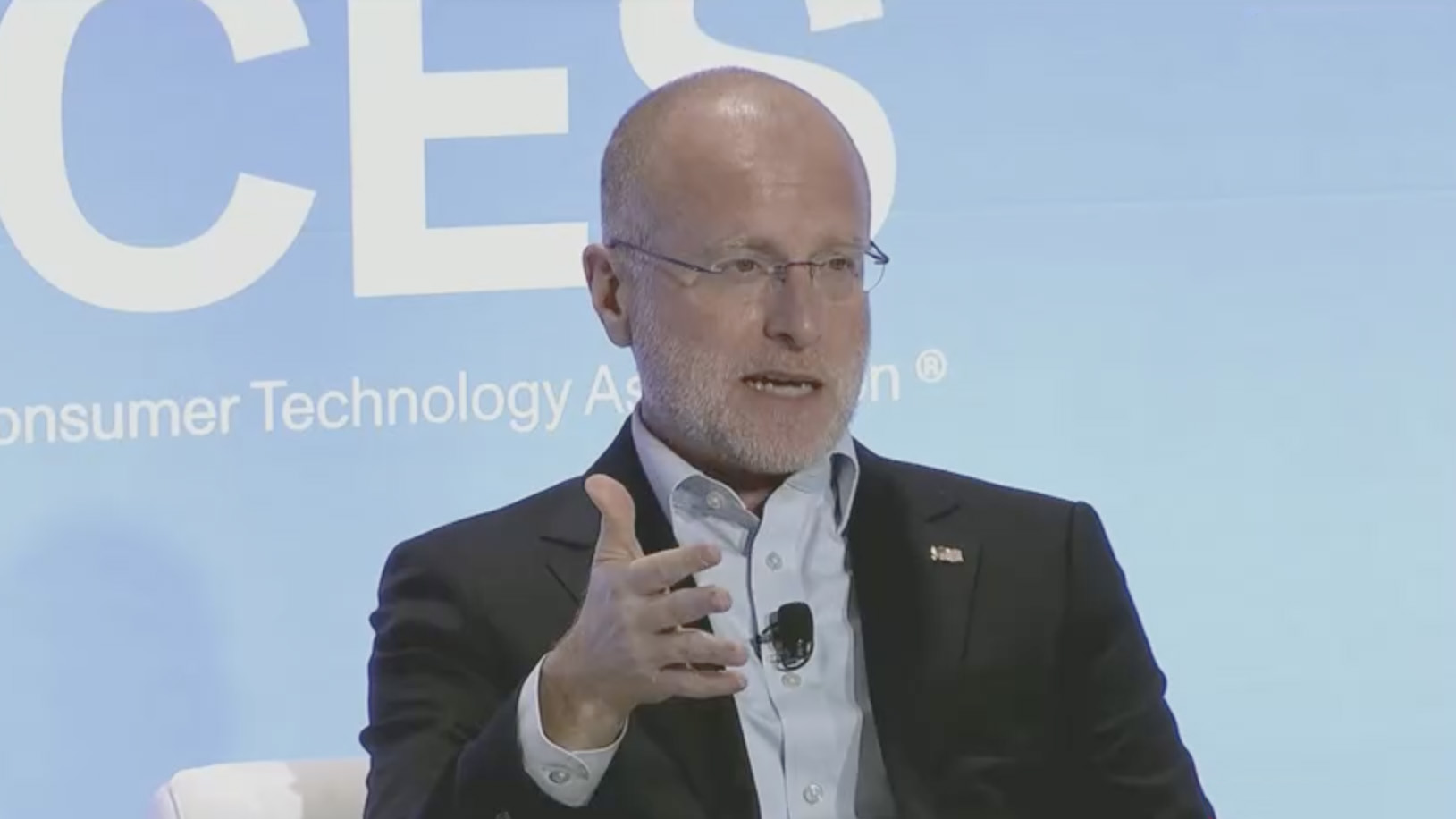
“I think over the years, the balance of power has shifted too far into the hands of the national programmers, and they’re effectively just using local TV stations as outlets for their own programming,” FCC Chairman Brendan Carr said Thursday during a fireside chat at CES in Las Vegas.
Carr, speaking with Gary Shapiro, executive chair and CEO of the Consumer Technology Association, said the current relationship between national broadcast networks and local affiliates does not align with the FCC’s original intent for the broadcast licensing system.
“In the broadcast space, you have the national programmers – Disney, Paramount, Fox, Comcast,” Carr said. “And on the other hand, you’ve got the actual licensed, individual local TV stations that distribute that content.”
The chairman said the FCC is examining ways to empower local broadcast stations to better serve their communities rather than function as distribution points for network content.
Carr framed the discussion around broadcasters’ public interest obligations, which he said he is working to reinvigorate at the FCC. He outlined the unique position of broadcast licensees compared to other content distributors.
“When it comes to broadcasters in particular, broadcasters are a very, very unique distribution medium that because the government is picking a winner and loser, you get a license, you get this microphone, you get to speak,” Carr said. “You don’t necessarily get to conduct yourself the same way you would if you were on a podcast or a soapbox or a cable channel.”
Carr said the FCC has articulated that broadcast licensees “don’t stand simply in your own shoes and you don’t simply speak for yourself. That you are effectively a representative of the entire community and a representative of the people that would have wanted that microphone but were denied by the government the ability to use it.”
The chairman acknowledged that some broadcasters have raised concerns about complying with public interest obligations.

He presented two alternatives for broadcasters who object to these requirements: return their licenses and distribute content through other platforms, or the FCC could auction the spectrum currently allocated to broadcasting.
“If you’re a broadcaster and don’t like the fact you have a public interest obligation, you can turn your license in,” Carr said. “There’s lots of different ways to distribute your content. You can become a cable channel. You can become a podcast. You can become a YouTube channel.”
He added: “Another option is we could take a look at that spectrum and say, why don’t we put that spectrum back up for auction?”
Carr’s framing positions local affiliates as independent voices overshadowed by national programmers, even though the stations he cites are predominantly owned by large broadcast groups. These companies are publicly traded with market capitalizations in the billions.
ATSC 3.0 transition and device mandates
Carr expressed support for the transition to ATSC 3.0, also known as NextGen TV, but did not commit to mandating that consumer devices include tuners capable of receiving the new broadcast standard.
“As a general matter, we’re really supportive of this transition to 3.0 because it can be not just better television, but it can also be used for data casting, which can be a new competitive service,” Carr said.
Shapiro asked Carr about device mandates in the context of changing consumer behavior, noting that more than three out of four homes rely on streaming services, 30% receive video through cable and 20% use TV antennas.
Carr acknowledged the questions raised about spectrum allocation for broadcasting but did not directly address whether the FCC would require ATSC 3.0 tuners in new devices. He said the FCC has asked questions about the issue and is examining the impacts on consumers.
Local news and broadcast’s future
Carr emphasized the role local broadcast stations play in news coverage, particularly as newspapers have closed across the country.
“If you care about local news and local reporting in this country, if you think that’s valuable as a public interest, as a national interest, right now, local broadcast television stations are the ones that are almost exclusively in many cases doing that,” Carr said. “Your local 5 o’clock, 6 o’clock TV news are sort of the last of the real local gumshoe report.”
He acknowledged competition from social media for local reporting but said institutional local broadcasters continue to play a significant role.
Carr said he spends considerable time thinking about what local broadcasting will look like in five, 10 and 15 years, noting that broadcast stations face declining advertising revenue and increased competition.
Shapiro raised the question of whether broadcasters need the amount of spectrum they currently hold to provide resilience and redundancy, particularly given the emergence of local news sources including websites like Nextdoor, local papers and online influencers.
The FCC is examining the broadcast sector and considering various approaches to ensure local stations can identify and serve the needs of their communities, Carr said.
Why it matters
Carr’s overall comments amount to content-based regulatory leverage: program what the FCC considers “public interest” content or face potential license challenges and spectrum reallocation.
The issue is that “public interest” becomes a standard defined by whichever administration controls the FCC. The current administration does not view the FCC as an independent regulatory body, which means the public interest standard can shift dramatically every four to eight years based on political priorities.
What Carr considers appropriate local programming today could be viewed differently by a future chairman. Broadcasters would face a regulatory environment where the definition of compliance changes with each election cycle, while their competitors in streaming and cable face no such content oversight.
The tension in Carr’s position is that he’s framing this as protecting independent local voices against powerful national networks, while ignoring that “local” stations are predominantly owned by publicly traded broadcast groups. When Carr talks about empowering the local station in Des Moines or Tampa, he’s actually talking about empowering a broadcast group – companies with billions in market capitalization that negotiate retransmission consent fees and programming agreements as corporate entities, not community representatives.
The real dynamic isn’t national programmers bullying independent local stations, forcing them to air programming they don’t want. It’s two large corporations negotiating commercial terms, with one side owning distribution rights and the other production rights. Carr’s appeal to localism obscures this market reality.
The FCC’s public interest standard has historically been justified by spectrum scarcity, but Carr is applying it at a time when video content is abundant and most Americans access it through platforms with no such obligations. This creates an uneven regulatory playing field where broadcasters face content scrutiny that their competitors don’t.
The question, of course, is whether Carr will follow through with enforcement actions or if this remains rhetorical positioning.

tags
Brendan Carr, CES 2026, Consumer Technology Association, FCC, NextGen TV ATSC 3.0, Retransmission
categories
Broadcast Business News, Heroes, NextGen TV, Policy