

Dak’s Take: The boring debate over whether YouTube is television
Weekly insights on the technology, production and business decisions shaping media and broadcast. Free to access. Independent coverage. Unsubscribe anytime.
Every few months, the same argument resurfaces across publications and LinkedIn: Is YouTube television?
The question returns with the persistence of a “Seinfeld” episode in syndication… Yet the entire debate rests on a premise the audience abandoned years ago.
Because viewers don’t care. They left the taxonomy behind. A long time ago.
The industry, however, keeps litigating a definition instead of confronting what actually changed. And frankly, the debate tells us more about industry insecurity than about audience behavior.
Everything fractured into ‘content’
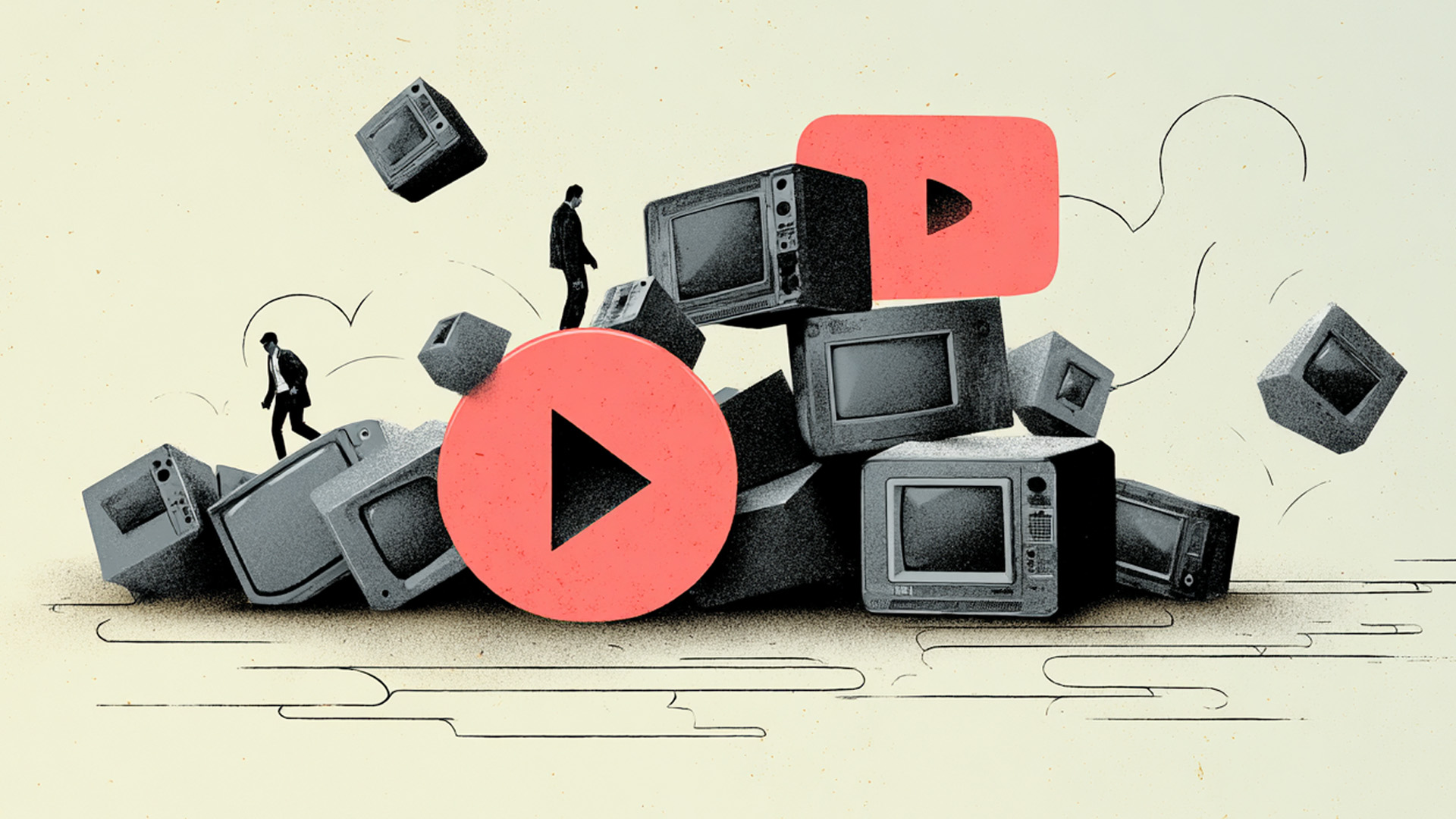
The fundamental shift happened quietly, then all at once. Content decoupled from its distribution system. What you watch is no longer defined by how it reaches you. A 90-second clip on TikTok, a 22-minute episodic on a FAST channel, a prestige drama on an ad-free streaming platform — it’s all simply content now, competing in the same attention economy with the same rules: Be findable. Be relevant. Be worth my time.
For audiences, the dividing lines collapsed. The industry keeps pretending distribution mediums matter because admitting otherwise would require uncomfortable operational changes and even more uncomfortable financial reckonings.
When was the last time a viewer cared whether something “qualified” as TV? When was the last time a viewer cared if Nielsen or Comscore properly measured them?
They don’t check whether their Friday night viewing meets the technical specifications outlined in some media buyer’s deck. They don’t pause before clicking to consider whether the content they’re about to consume has been blessed by the appropriate gatekeepers. They search. They click. They watch. The platform is incidental to the experience.
What the debate is really about: Control
Strip away the rhetorical posturing, the hyperbole, and the argument reveals its true nature. This isn’t about definitions. It’s about control.
Control of ad loads and the revenue they generate. Control of audience data — the actual lifeblood of modern media economics, the thing that determines whether you’re building an audience or renting one. Control of subscriber relationships, billing information, viewing habits, the entire direct connection that separates a platform from a mere distribution outlet.
On YouTube, broadcasters and networks have precisely none of it. Google owns the platform, the algorithm, the recommendation engine, the user interface, the data layer, the whole stack. On their own apps and AVOD/SVOD ecosystems, legacy players maintain that control, or at least the comforting illusion of it.
This is why major legacy players still systematically underutilize YouTube despite its scale.
It’s not ignorance. It’s not even stubbornness, exactly. It’s economic terror dressed up as strategic restraint. YouTube represents everything traditional media companies spent decades building monopolies to avoid: a platform they don’t control, where their content competes on equal footing with everyone else’s, where the algorithm doesn’t care about your Nielsen rating or your historic prime-time dominance.
When you don’t control the platform, you don’t control the business model.
Unified search beats siloed ecosystems
YouTube functions as a universal discovery engine — something no broadcaster or streaming service can match, no matter how much they spend on recommendation algorithms or personalization features.
The difference is structural.
Want to find cooking competition content through traditional television? You need to know which network airs which show, whether you have access to that network, whether the content is available on demand or requires a DVR and whether your subscription tier includes that particular offering. Want to find cooking competition content on YouTube? You type “cooking competition” into a search bar.
One query instantly surfaces millions of creators, formats, production values and approaches. Professional productions sit alongside passionate amateurs. Network content competes with independent creators who learned their craft by doing. The viewer gets choice without the homework.
Audiences are exhausted by fragmented apps, separate sign-ins, incompatible billing models, and UX experiments masquerading as innovation. Every streaming service wants to be a destination. Every broadcaster wants to be a platform. Everyone’s building walls while viewers are asking for doors.
YouTube isn’t replacing cable. It has already become the cable package; no one is ready to admit it yet.

Attention, not classification, is the real battleground
The frame is wrong. The question isn’t “Is YouTube TV?” The questions are:
Who wins the battle for attention? Who makes content easiest to find? Who meets the audience where they actually spend their time?
Viewers aren’t thinking in platform taxonomies. They’re not sorting their entertainment consumption into neat categories defined by distribution technology or corporate org charts. They’re looking for low-friction relevance: the thing they want to watch, available now, without obstacles.
This is the actual competition. Not TV versus YouTube. Not streaming versus linear. Not premium versus creator content. The competition is friction versus convenience, and convenience is winning.
Does the label matter when the audience has already voted with their time?
YouTube requires actual adaptation
It’s not enough to dump a 6 p.m. news package onto YouTube and call it a strategy. It’s not sufficient to clip highlights from last night’s broadcast and upload them with minimal metadata. That’s not participating in the platform — that’s treating it like a digital shelf where you store things you’ve already made for somewhere else.
YouTube has its own language, formats, rhythms and incentives.
The platform rewards consistency, engagement, direct audience relationships and content designed for its specific environment. Titles and thumbnails matter. Publishing cadence matters. Community interaction matters. The algorithm doesn’t care about your brand heritage or your production budget. It cares about whether viewers click and whether they stay.
Broadcasters that treat YouTube as an afterthought distribution channel instead of a primary attention platform miss the point entirely. Meeting audiences where they are means designing content for where their attention already lives, not repurposing what you made for a dying distribution system and hoping for the best.
YouTube didn’t steal TV — TV refused to evolve to fit the platform and the audience.
What the industry should actually debate
The tired question — “Is YouTube television?” — deserves retirement. It had a decent run. It generated countless panels, arguments, articles and social media posts. But it’s answered. YouTube is whatever viewers use it for, and they’re using it for everything.
Replace the worn-out debate with better ones:
How do traditional media companies participate meaningfully in the open attention economy? What does a YouTube-first or YouTube-native strategy look like for established news and entertainment brands? How should broadcasters rethink content, metadata, packaging, and publishing cadence to compete in a frictionless environment? What workflows, teams, and production models does that require?
These questions demand uncomfortable answers.
They require admitting that the old distribution monopolies aren’t coming back. They mean redesigning operations around platforms you don’t control. They involve competing directly with creators who have lower costs, higher velocity, and deeper audience connections.
But these are the questions that actually matter. These are the debates that might produce strategies worth executing.
The debate over whether YouTube is “television” was outdated years ago. The real question is which media companies acknowledge where attention has migrated — and which ones cling to a definition that no longer pays the bills.

Dak DillonDak Dillon is the Editor in Chief of NCS, where he has been covering broadcast technology, engineering and production for over 15 years. With practical industry experience, Dak's broadcast work has earned a Promax Gold Award and multiple regional Emmy nominations.
A journalism graduate from the Missouri School of Journalism, Dak has also been recognized by the Hearst Journalism Foundation.

tags
Content Distribution, Dak's Take, distribution, youtube
categories
Heroes, Online and Digital Production, Social Media Video Platforms, Streaming, Voices