

FCC commissioners face sharp questioning on broadcast ownership, First Amendment concerns
Weekly insights on the technology, production and business decisions shaping media and broadcast. Free to access. Independent coverage. Unsubscribe anytime.
Federal Communications Commission Chair Brendan Carr defended his agency’s broadcast investigations and deregulatory agenda during a House oversight hearing Wednesday, while fellow Commissioner Anna Gomez warned that the FCC has overstepped its authority in ways that threaten press freedom.
The three-hour hearing before the House Energy and Commerce Committee focused heavily on broadcast ownership caps, media consolidation and the FCC’s interpretation of public interest standards for licensed broadcasters. All three commissioners testified, with Carr and Gomez offering sharply contrasting views on the agency’s current direction.
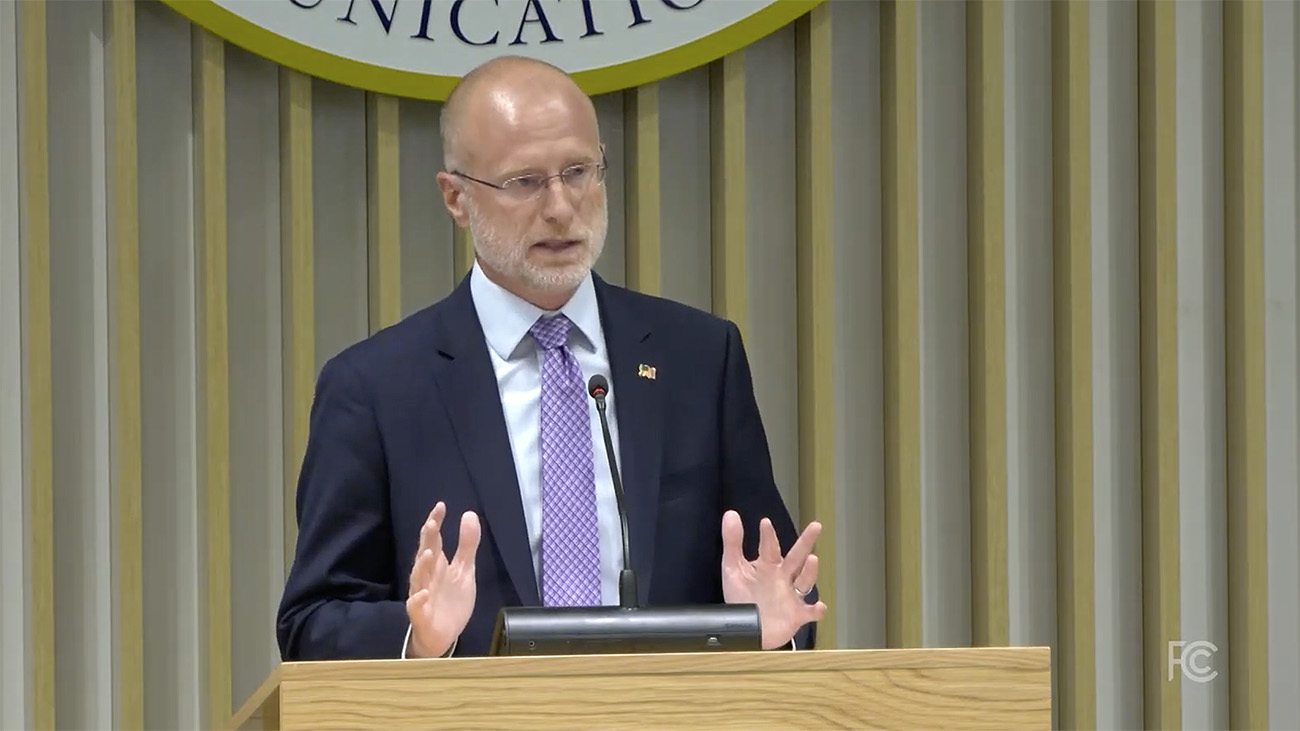
“The FCC has an obligation to make sure that broadcasters comply with their public interest obligations,” said Brendan Carr, chairman of the Federal Communications Commission, during testimony before the House Energy and Commerce Committee on Wednesday. “Licenses, broadcast licenses, are not property rights, and there’s things you can do to lose your broadcast license.”
Media ownership debate takes center stage
The hearing focused heavily on broadcast ownership caps and media consolidation.
Carr told committee members that “one of the main concerns I have with respect to media policy is you have, on the one hand, all these individual licensed local TV stations. On the other hand, you have these national programmers, Disney, Comcast, a handful of others.”
He argued that national programmers have “consolidated and amassed a massive amount of power” over local stations, which in some cases are “becoming just a mouthpiece for programming being produced by those national programmers.”
More than 70 members of Congress sent a letter to the commission last year requesting action on broadcast ownership caps. Current law sets the maximum reach for entities owning TV stations at 39 percent of national television audience households.
When asked directly whether only Congress has authority to raise that cap, Carr said the FCC is “looking at that right now,” noting that “the last four FCC chairs across Republican and Democrat, the FCC has consistently” maintained the position that the 39 percent cap is an FCC regulation rather than a statutory requirement.

Commissioner Anna Gomez disagreed.
“The 39 percent ownership cap is in fact in the statute,” she said. “The Congress amended the Communications Act when it imposed the 39 percent ownership cap. So I don’t think that we have the authority to waive that.”
Gomez expressed concern about further consolidation.
“What I fear is that this consolidation is going to enable behemoth corporate parents to take those local broadcasters and to create, quote, efficiencies that will, in fact, water down local news and then lead to less service for their communities, not more.”
First Amendment concerns and investigations
Democratic committee members questioned Carr extensively about FCC investigations into broadcast stations, including inquiries into CBS, ABC and local stations. Several pointed to the agency’s actions following editorial decisions or news coverage critical of the Trump administration.
“For months, this FCC has asserted an apparent roving mandate to police speech that this administration does not like, invoking an undefined and unchecked concept known as the Public Interest Standard,” Gomez said in her opening statement. “The FCC’s job is not to police content, root out media bias, or guarantee favorable coverage for any administration.”
Gomez said the commission is “using the news distortion policy to go after any content that we don’t like, and using that in conjunction with this vague public interest standard.”
The news distortion policy, Gomez explained, “covers local broadcasters broadcasting news about a significant event, but it requires intentionality to mislead about a significant event, not merely an incidental event. And it also cannot be used if you just simply disagree with the content and if it’s just an incidental mistake.”
Carr defended the agency’s approach, stating that “the Supreme Court has said on this issue is that, quote, no one has a First Amendment right to a license. So the FCC enforcing the public interest standard on broadcasters, according to the Supreme Court, doesn’t violate the First Amendment and doesn’t constitute censorship.”
Merger scrutiny and editorial concerns
Questions also focused on the FCC’s approval of the Skydance-Paramount merger, which some committee members suggested came only after the settling of legal disputes between the companies and President Trump, along with reported editorial concessions.
Gomez noted there are “four national networks: ABC, CBS, NBC, and Fox, not just two. And the local broadcasters that are seeking to merge are actually corporate behemoths, not small local broadcasters.”
Committee members also raised concerns about the proposed Nexstar-Tegna merger, which would give one company reach to a significant portion of U.S. households.

Retransmission consent and local news
Carr said the agency is examining affiliate agreements between local TV stations and national programmers as part of efforts to support local broadcasting.
“Retrans is a very complex issue,” he said. “On the one hand we’re seeing declining revenues at a lot of local TV stations. At the same time the national programmers will say they need to maintain scale themselves to continue to compete for expensive sports rights.”
He added that the FCC must “try to find a right balance between having the financial capability of local TV stations to invest in local news and reporting, but also making sure that they have the national sports rights that people expect and demand.”
Agency independence questioned
The hearing also addressed the FCC’s status as an independent agency.
Carr testified that “the FCC is not formally speaking an independent agency,” a position that drew criticism from Democratic members who noted his previous statements and writings had characterized the agency as independent.
Commissioner Olivia Trusty, who joined the FCC in 2025 after working as a staffer for the Energy and Commerce Committee, focused her testimony on spectrum policy, network resilience and broadband deployment. She did not directly address the First Amendment controversies during the hearing.
Carr reported that the FCC has “teed up for removal over 1,000 rules” as part of what he called “the largest deregulatory effort in the agency’s history.” He said prices for wireless plans are “down over 4 percent since last January.”

tags
Anna Gomez, Brendan Carr, FCC, Olivia Trusty
categories
Broadcast Business News, Heroes, Policy