

The trends and topics driving the conversation at the 2026 NAB Show

Weekly insights on the technology, production and business decisions shaping media and broadcast. Free to access. Independent coverage. Unsubscribe anytime.
The broadcast and media industry arrives in Las Vegas having largely answered the questions that dominated the previous decade. Cloud production works. IP distribution works. Remote workflows work. AI tools are here and growing. Streaming works as a business – or at least, it can. The proof-of-concept phase that defined much of the industry’s technology conversation since the mid-2010s is, for the most part, over.
What replaces it is a harder problem.
The work now is making all of it function reliably, efficiently and profitably at scale – simultaneously, under real operational conditions, with budgets and crew sizes that have not grown in proportion to the demands placed on them.
That is the frame for the 2026 NAB Show.
The efficiency imperative
Across every segment of the industry, the same pressure is visible: more content, more platforms, more simultaneous obligations, with the same or fewer resources to meet them. It is reshaping how tools are designed, how workflows are structured and what success looks like for production teams at every level.
“In 2026, creator-led entertainment is even more dominant and sought after, as traditional makers and output channels no longer rule the world. The media and entertainment industry is being challenged by audience trends demanding more diversity of content and stories. As the pipeline for creation and distribution continues to evolve, all sorts of creatives are reevaluating what works and what can be made independently with smaller budgets and teams — this new era is about true efficiency that lets creative vision guide everything,” said Meagan Keane, director of product marketing for pro video at Adobe.
That efficiency pressure is not limited to independent creators. It runs through sports production, corporate media, news operations and streaming platforms equally.
The tools on the NAB Show floor this year will be evaluated less on what they can do and more on how efficiently they fit into workflows that are already under strain.

The financial reality and the consolidation response
The growth phase of streaming has ended. The profitability phase, which turns out to be harder, has begun. Rights costs continue to escalate, subscriber acquisition has slowed across most major services and advertising revenue has shifted from supplementary to structural – meaning platforms can no longer treat it as upside. The result is an industry under margin pressure that is looking at scale as the primary answer.
“The streaming market is entering a more mature phase, where the focus has shifted toward long-term subscriber relationships. After years of rapid service launches and aggressive acquisition strategies, media companies are now concentrating on retention, engagement and sustainable revenue growth. Platforms increasingly manage a wide range of subscription tiers, partner bundles, promotional offers and ad-supported experiences across global markets. The challenge is making these options flexible enough for consumers while maintaining control over pricing, billing and entitlements behind the scenes,” said Sahil Dhar Hakim, chief business officer at Evergent.
“A defining theme heading into NAB 2026 is the continued convergence of broadcast and streaming within a unified delivery ecosystem. From the viewer’s perspective, the distinction between linear and IP delivery has largely disappeared, increasing the expectation of consistent performance across both,” said Rene van Koll, senior solutions architect, Big Blue Marble.
The ownership landscape arriving at NAB Show 2026 reflects that pressure in concrete terms.
The past year has produced a level of consolidation not seen in the broadcast industry for decades. Skydance Media, which completed its acquisition of Paramount and CBS, subsequently outbid (or outmaneuvered) Netflix to acquire Warner Bros. Discovery – giving a single company control of CBS, Paramount, Warner Bros., CNN, and a portfolio of cable networks. The full implications of that concentration for production investment, distribution deals and technology purchasing are still working through the industry.
At the station group level, Nexstar’s $6.2 billion acquisition of Tegna has received FCC approval, creating a combined operation of 265 stations covering approximately 80 percent of the country. The deal is proceeding with both companies operating separately while litigation works through the courts, California and several other states have filed suit arguing the merger will raise cable and satellite prices and harm local news, and major pay-TV distributors including DirecTV have mounted their own challenges. Gray Media, meanwhile, completed its acquisition of 10 local television stations from Allen Media Group following FCC approval.
For technology vendors, consolidation of this scale changes the sales environment.
Purchasing decisions that once sat with individual stations or network technology teams now escalate to corporate leadership operating across a much larger footprint. That can slow procurement cycles but it also creates opportunities for vendors who can demonstrate value at scale — solutions that work across hundreds of stations or multiple major networks simultaneously rather than optimizing for a single facility.
The financial and ownership pressures are connected. An industry consolidating around scale is also an industry asking vendors to help it do more with unified infrastructure, centralized operations and workflows that travel consistently across a much larger and more varied set of facilities than any single company managed before.
Infrastructure and business model converge
One of the shifts visible across the show’s themes is that infrastructure decisions have become business model decisions.
The choice between satellite and IP distribution is no longer purely a technology question, it carries direct cost and revenue implications. The choice between cloud and on-premises production affects what can be delivered and at what margin. AI deployment decisions affect compliance exposure as much as operational efficiency.
“The broadcast industry is embracing practical modernization through hybrid production models that combine the reliability of on-prem systems with the scalability of cloud and distributed workflows. This approach enables broadcasters to maximize existing infrastructure investments while increasing flexibility across live, remote, and multi-platform production. AI is also being integrated into core operations to streamline workflows, enhance metadata, and accelerate content creation,” said Simon Hawkings, director of sales strategy and business acceleration at Ross Video.
The interdependence runs deeper than hybrid architecture. As Hitomi Broadcast’s Anna Hurd framed it, decisions made in infrastructure affect what can be delivered, and what can be delivered shapes what business models are viable. That chain of consequence, from technical choice to commercial outcome, is increasingly where the most consequential conversations at NAB Show happen.
The advertiser’s perspective reflects the same convergence.
“We are seeing an emerging pattern of media companies embracing today’s multichannel reality to drive growth. Media companies are unifying their businesses around audiences and data, creating products for advertisers that put them where the action is. Brands want to create experiences that engage these audiences, and so media companies need to have the infrastructure and the offerings that brands are looking for to reach their audiences,” said Dave Dembowski, chief revenue officer at Operative.
A regulatory moment
Running alongside the technology and business shifts is an u nusually active regulatory environment.
Two FCC decisions are particularly consequential for broadcasters. The commission is currently weighing whether to set a mandatory sunset date for ATSC 1.0, which would force a defined timeline for the industry’s transition to ATSC 3.0, or NextGen TV. The National Association of Broadcasters has backed a hard cutoff, arguing it would accelerate adoption and give stations and device manufacturers the certainty needed to invest. A ruling has not yet been issued.
Separately, the FCC’s pending rules on the second C-band spectrum auction, expected this summer, will determine the pace of broadcast distribution infrastructure decisions for years to come.
The EU AI Act, phasing in through 2027, is imposing new obligations on organizations using AI in production and distribution workflows. And in the United States, new state legislation is extending broadcast standards into streaming advertising for the first time.
“Broadcast and streaming are increasingly operating under the same expectations from regulators and audiences alike. California’s new SB 576 law will be a key discussion point for many at the show, requiring ads in streaming content to match the loudness of the surrounding program and extending principles similar to the CALM Act into the streaming world. Fragmentation across the ad tech stack makes this a tricky issue to solve. Getting compliant and making this law really work for consumers will require much closer collaboration between content providers, ad tech players and audio partners,” said Costa Nikols, executive team strategy advisor for media and entertainment at Telos Alliance.
The CALM Act – the Commercial Advertisement Loudness Mitigation Act – has governed loudness standards in broadcast advertising since 2012. SB 576 extends comparable requirements to streaming advertising in California, a development that has implications for ad tech infrastructure well beyond the state’s borders given how streaming ad delivery is architected at a national level.
The next technical frontier
Beneath the operational and commercial pressures, a technical shift is also taking shape that will be visible in early deployments at NAB Show 2026, the move toward what some in the industry are beginning to call AI-native architectures.
“AI is becoming the bedrock for modern media businesses as it effectively drives and accelerates other trends, including an increased focus on personalization and monetization. Specifically, I expect many discussions around how agentic AI is transforming multi-step processes across the production chain for things such as metadata extraction, localization, captioning, summary generation, formatting, and more,” said Steph Lone, global leader for solutions architecture in media, entertainment, games and sports at Amazon Web Services.
That shift is also playing out at a deeper infrastructure level — not just in how AI is applied to workflows but in how the underlying data architecture is built to serve both human viewing and machine processing simultaneously.
“The most significant shift this year is the convergence of compression, delivery, and machine intelligence into unified workflows. Traditional formats were built for human perception, not machine analysis, and the cost of that mismatch is now measurable: accelerators sitting idle 30 to 60% of the time waiting for properly structured data, while pipelines decode entire frames only to discard over 99% of the pixels,” said Fabio Murra, senior vice president of product and marketing at V-Nova.
The industry arriving at NAB Show 2026 is not short of technology.
It is working through the harder questions of how to operate it at scale, sustain it financially and govern it responsibly. Those are the questions the exhibit floor, the education sessions and the conversations between buyers and vendors will be organized around – whether the agenda says so explicitly or not.
NAB Show 2026 Preview Guide: The trends, tools and strategies shaping what’s next
Get ahead of the industry’s biggest event with the NAB Show 2026 Preview Guide, a focused look at the ideas, technologies and conversations defining this year’s show. From AI-driven workflows and cloud production to streaming, adtech and monetization, the guide highlights the key themes to watch, along with insights and perspectives from vendors across the media and broadcast ecosystem.
Download Now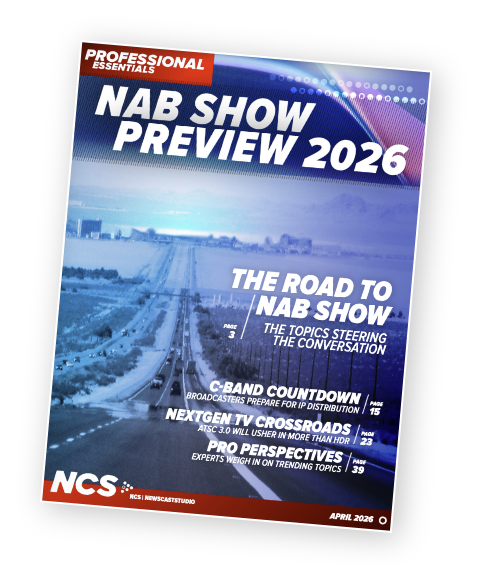

tags
Adobe, Amazon Web Services, Anna Hurd, AWS, Big Blue Marble, Costa Nikols, Dave Dembowski, Evergent, Fabio Murra, Hitomi Broadcast, Meagan Keane, NAB Show 2026, NAB Show News, Operative, Rene van Koll, Ross Video, Sahil Dhar Hakim, Simon Hawkings, Steph Lone, Telos Alliance, V-Nova
categories
Heroes, NAB Show