

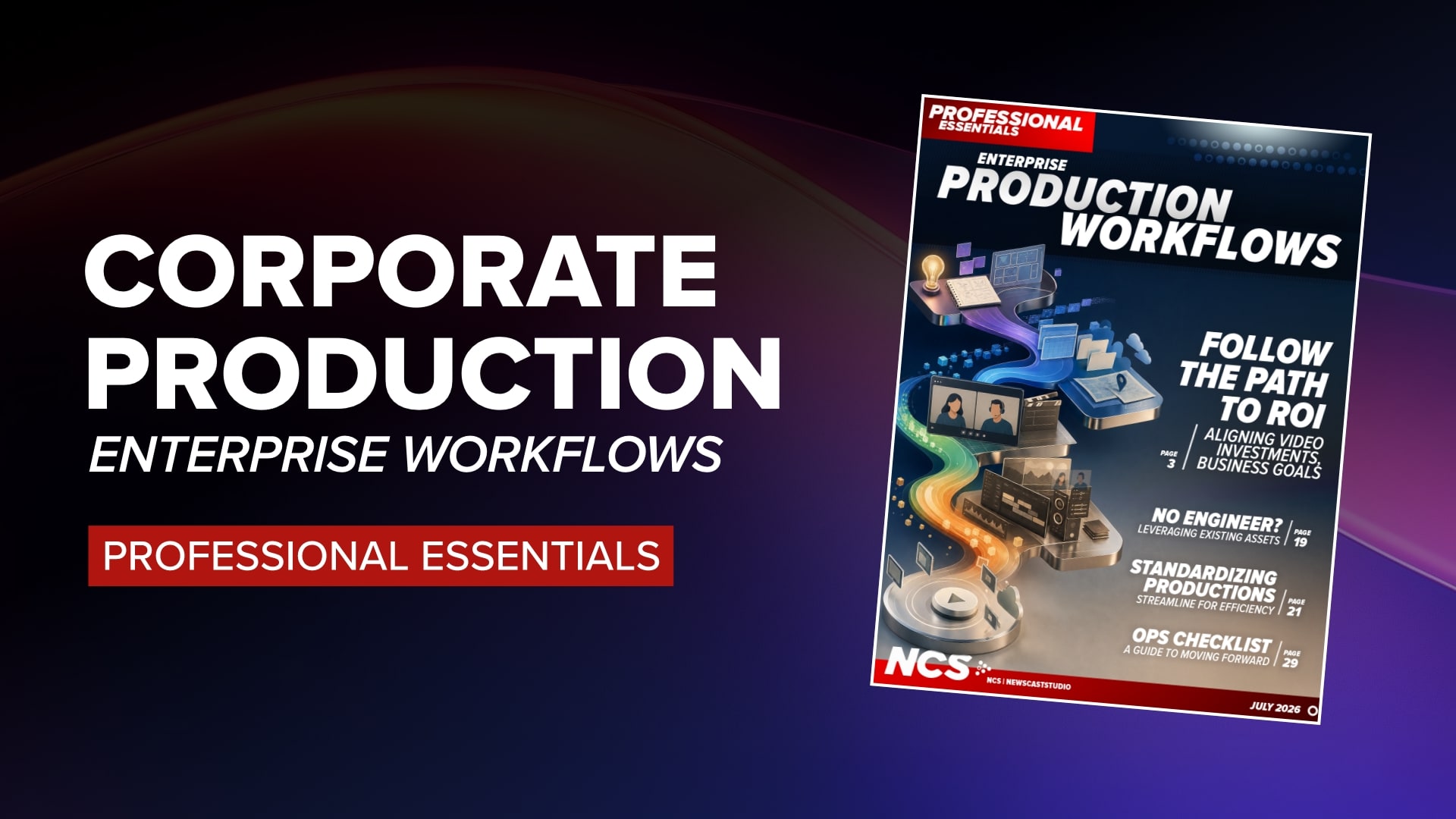
Building the workflow behind enterprise and corporate video production



As enterprise and corporate video production mature, success is no longer about producing a single polished event or broadcast — it’s about building an operation that can support recurring live, recorded and hybrid content with consistency and clear ownership.
The 2026 edition of Professional Essentials: Guide to Corporate Production looks at how enterprise media teams structure the people, processes and systems behind that work. How Communications, AV, IT and creative teams divide responsibility across centralized, hybrid and distributed models, and where outside partners and managed services fit in.
It also maps the workflow from request through planning, production, post, approval, distribution and archiving, showing how clear intake, defined responsibilities and production tiers cut delays and handoffs.
Inside: practical guidance on choosing live vs. recorded vs. hybrid formats, building reusable templates, and standardizing camera presets, graphics, recording profiles and file structures, without making every program look the same.
Expert perspectives from enterprise production leaders, system integrators and technology vendors, including insights from NCS’s InfoComm 2026 panel and our Industry Insights roundtables, ground the discussion in real operating models. The guide closes with a framework for measuring production maturity: turnaround time, utilization, reliability, revision cycles, content reuse and stakeholder satisfaction.
Download the guide now for a practical framework to turn your content production from a collection of projects into a repeatable enterprise capability.
Topics covered:
- Defining ownership across communications, AV, IT and creative teams
- Structuring internal teams, outside partnerships and distributed production models
- Creating clear intake, planning and approval processes
- Designing repeatable workflows for live, recorded and hybrid content
- Matching production effort and staffing to project complexity
- Using templates, presets and automation to reduce repetitive work
- Connecting production, post-production, distribution and archiving
- Measuring output, efficiency, reliability, utilization and content reuse
- Building an operation that can scale without becoming harder to manage