

Vizrt CEO Rohit Nagarajan on rebuilding live production around AI
Weekly insights on the technology, production and business decisions shaping media and broadcast. Free to access. Independent coverage. Unsubscribe anytime.
Rohit Nagarajan came to the 2026 NAB Show with a pointed message: Vizrt is more than a graphics and live production tools company. It is, he said, relaunching as an AI platform for live production, with a portfolio aimed at practical workflows.
“This isn’t just a marketing relaunch,” said Nagarajan, chief executive officer of Vizrt. “We’ve completely taken a fresh look at our portfolio to look at how AI impacts workflows at a very fundamental level.”
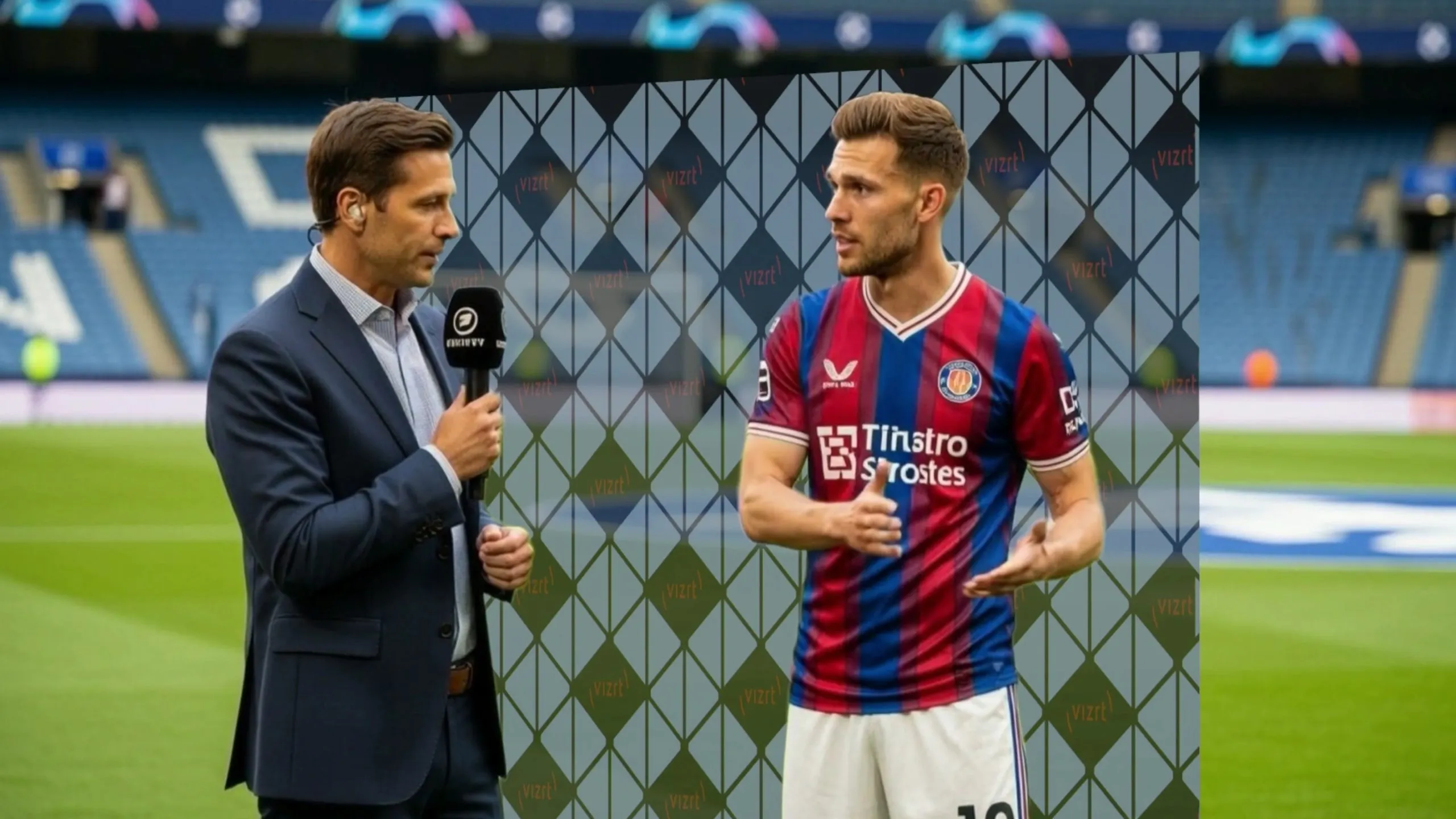
That fresh look produced the company’s most visible announcement at the show, the Vizrt AI Keyer, a tool that allows production teams to create virtual and augmented reality environments without green screens, dedicated cycs or the specialized lighting setups those workflows typically require.
The system uses AI trained on real-world footage to identify foreground subjects and separate them from backgrounds in real time, across indoor and outdoor environments and under varying lighting conditions.

The practical applications span a range of production contexts. A news presenter can be placed in a virtual set without a purpose-built studio. A remote guest can be inserted into a live broadcast environment. A sponsored backdrop can be placed behind a sports interviewee in a locker room or on a sideline. Vizrt said the tool is designed to make those capabilities accessible to productions that cannot support the infrastructure costs traditionally associated with XR workflows.
Built in, not bolted on
For Nagarajan, the AI Keyer is one product in a larger argument about how AI should be integrated into production tools. He drew a clear line between adding AI features to existing products and rethinking workflows from the ground up with AI as a starting assumption.
“What is important is re-looking at the workflow with an AI lens,” he said. “Not just looking at AI as something which is a bolt-on to a product or a workflow, but built into the product or workflow. Because that’s the capability that actually drives the differentiated outcome for a customer.”

That distinction has practical consequences.
Nagarajan said the company has applied that thinking across its graphics pipeline, its asset management tools and its show and director workflow products, with further developments across those areas expected in the coming months and quarters.
The goal in each case, he said, is the same: abstract the technology so that the people running a production can focus on editorial and creative decisions rather than operational complexity.
“Humans tell stories,” Nagarajan said. “Making sure that what we do is tell the story, define the way the story wants to be told, and abstracting the technology behind it — abstracting the technology so you just become the director and the storyteller in place.”
Broadcast and enterprise, a two-way street
Nagarajan also described what he called an enterprise-broadcast convergence, a dynamic in which the two markets are increasingly informing each other rather than developing in parallel.
On the enterprise side, organizations across industries are investing in internal broadcast-quality production infrastructure for employee communications, customer engagement and partner events. They want professional-grade output without professional broadcast operations teams. Vizrt’s answer for that market, Nagarajan said, is software-defined tools built with AI that allow non-specialist users to operate sophisticated production environments.
“We are enabling those enterprises to deliver those kinds of immersive experiences,” he said, “converting every meeting room into a studio, allowing end users to become operators of the actual environment they’re in.”
The lessons from that work, he said, flow back into broadcast.The simplification that makes tools accessible to enterprise users also addresses what broadcasters increasingly need: the ability to do more with smaller teams, to scale output without proportionally scaling headcount.
“Broadcasters want the same simplification, but for a different purpose,” Nagarajan said. “They want to do more. They want to scale, they want to drive cloud live production.”
Early stages, clear direction
Nagarajan was measured about where AI currently stands in the production workflow, describing the industry as still in early stages even as results become visible. He said the company’s approach has been to evaluate each product without making assumptions about how it has historically worked.
“We need to have no sacred cows and unbox our products,” he said, “and look at what it is that we could do if we started in an age of AI.”


tags
NAB Show 2026, NAB Show News, Rohit Nagarajan, Vizrt
categories
Augmented Reality, Virtual Production and Virtual Sets, NAB Show