
David Ross on efficiency, floating licenses and why corporate AV is a serious market
Weekly insights on the technology, production and business decisions shaping media and broadcast. Free to access. Independent coverage. Unsubscribe anytime.
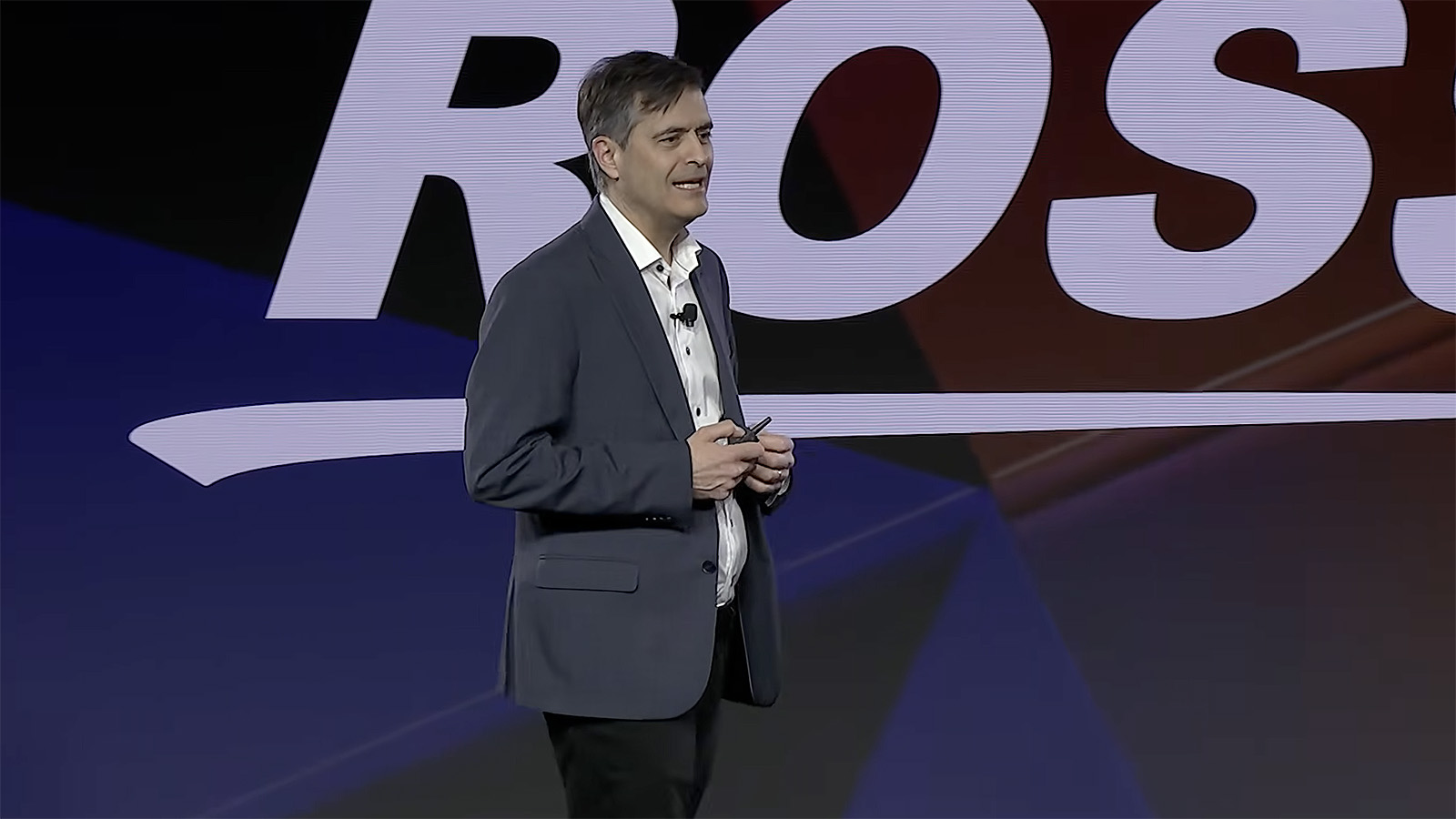
David Ross has been making the case for efficiency in broadcast production for three decades. At the 2026 NAB Show, he said the industry is finally in a place where that argument lands without much persuasion.
“We’ve been saying that for 30 years,” Ross, CEO of Ross Video, said with some amusement when asked about the efficiency and scale themes dominating conversations at the show this year.
The difference now, he suggested, is that broadcasters are not just interested in the concept, they are actively restructuring their operations around it.
Ross Video’s keynote at the show, which ran 70 minutes and covered roughly one significant announcement per minute by Ross’s own count, reflected that shift. The thread running through many of the announcements was not new capability for its own sake but increased utilization of what customers already own.
Floating licenses and shared resources
The most direct expression of that philosophy was the announcement of floating software licenses for the Ultrix router.
The Ultrix platform, which combines routing, processing, multiviewing and audio in a single frame, has accumulated more than 5,000 deployments globally. Many of those customers operate multiple frames across multiple facilities. Previously, software options such as frame synchronizers, color correctors, up-down-cross converters and ProCam processing were locked to a specific frame.
The new licensing model allows those options to be drawn from a corporate pool and assigned wherever they are needed.
“When somebody has multiple frames or multiple television stations, it’s great to be able to have a corporate pool of those and be able to move them anywhere,” Ross said. “We’ll probably make a little less money that way, but it is recognition of some of the challenges some of our customers are having and it was something we could do to help.”
A parallel approach was applied to the Carbonite production switcher line.
Ross announced that any control panel surface can now control any mix-effects bank in any switcher in the facility, including one running in the cloud. The practical result is that a customer does not need to buy a switcher scaled to their maximum production requirement. They can share resources across productions and locations, pulling in additional mix-effects capacity from wherever it exists in their infrastructure.
“You don’t have to buy a switcher that’s quite as big,” Ross said. “You’ve got ME1 and ME2 in the first two stripes of your control panel and suddenly ME3 is on the other side of the world, or it’s in another control room, and you’re just dealing with that.”
Produce once, render twice
The other theme Ross returned to repeatedly was the pressure broadcasters face to produce content for multiple platforms simultaneously without doubling the workload.
He said nearly every CTO conversation he has involves some version of the same question: how do I make the digital side of our output a meaningful part of our revenue without rebuilding everything?
Ross Video’s answer on the graphics side is what the company is calling produce once, render twice.
The XPression graphics platform can now output the same graphic simultaneously as a broadcast-grade SDI or SMPTE 2110 stream and as an HTML5 render for digital platforms. The data source, the brand elements and the workflow are shared. The outputs are formatted for their respective destinations without requiring operators to enter information twice or maintain parallel systems.
Ross noted that in many broadcast facilities, this often meant data entry in two locations to enable the two outputs.
“They often have a parallel track,” Ross said. “What we’ve been showing with our XPression side of things is the fact that you produce once and render twice.”
He also made a broader point about what distinguishes television from other forms of video content, one that framed the graphics push as more than a workflow convenience.
“What is the difference between film and television? Television has graphics,” he said. “You’ve got scores, names, L-bars, tickers, coming up next. It’s all about the graphics.”
A new acquisition and the audio angle
Consistent with a pattern Ross Video has established over many NAB Shows, the company arrived in Las Vegas with a recently completed acquisition. The company acquired Lean and Mean Audio, known as LAMA, and introduced the product at the show. The LAMA auto-mix technology goes beyond traditional gain-riding by addressing how different audio sources, crowd noise versus announcer microphones, for example, should be treated differently, rather than simply adjusted for level.

Ross noted the acquisition fits the company’s broader push into sports and live event production, where managing complex audio environments in real time is a persistent operational challenge.
Corporate AV as a growth market
Ross was direct about where he sees meaningful capital spending happening as traditional broadcast groups tighten their budgets.
Corporate media departments are, in many cases, spending more on production technology than local television stations.
“If you’re a bank, a financial institution, a major brand, and you need to get your message out and leverage that brand, you may be spending more money than a television station,” he said.
That observation aligns with the show’s broader attendance data, which showed corporate enterprise registrations nearly doubling year over year.
For Ross Video, which has long served that market alongside broadcast, it represents a customer segment in which the efficiency and flexibility arguments resonate as strongly as they do with traditional broadcasters, and where budget constraints are often less severe.

tags
David Ross, NAB Show 2026, NAB Show News, Ross Video
categories
Broadcast Equipment, IP Based Production, NAB Show