

One arena, two networks, 30 performances: Inside the back-to-back build of the ACMs and AMAs
Weekly insights on the technology, production and business decisions shaping media and broadcast. Free to access. Independent coverage. Unsubscribe anytime.
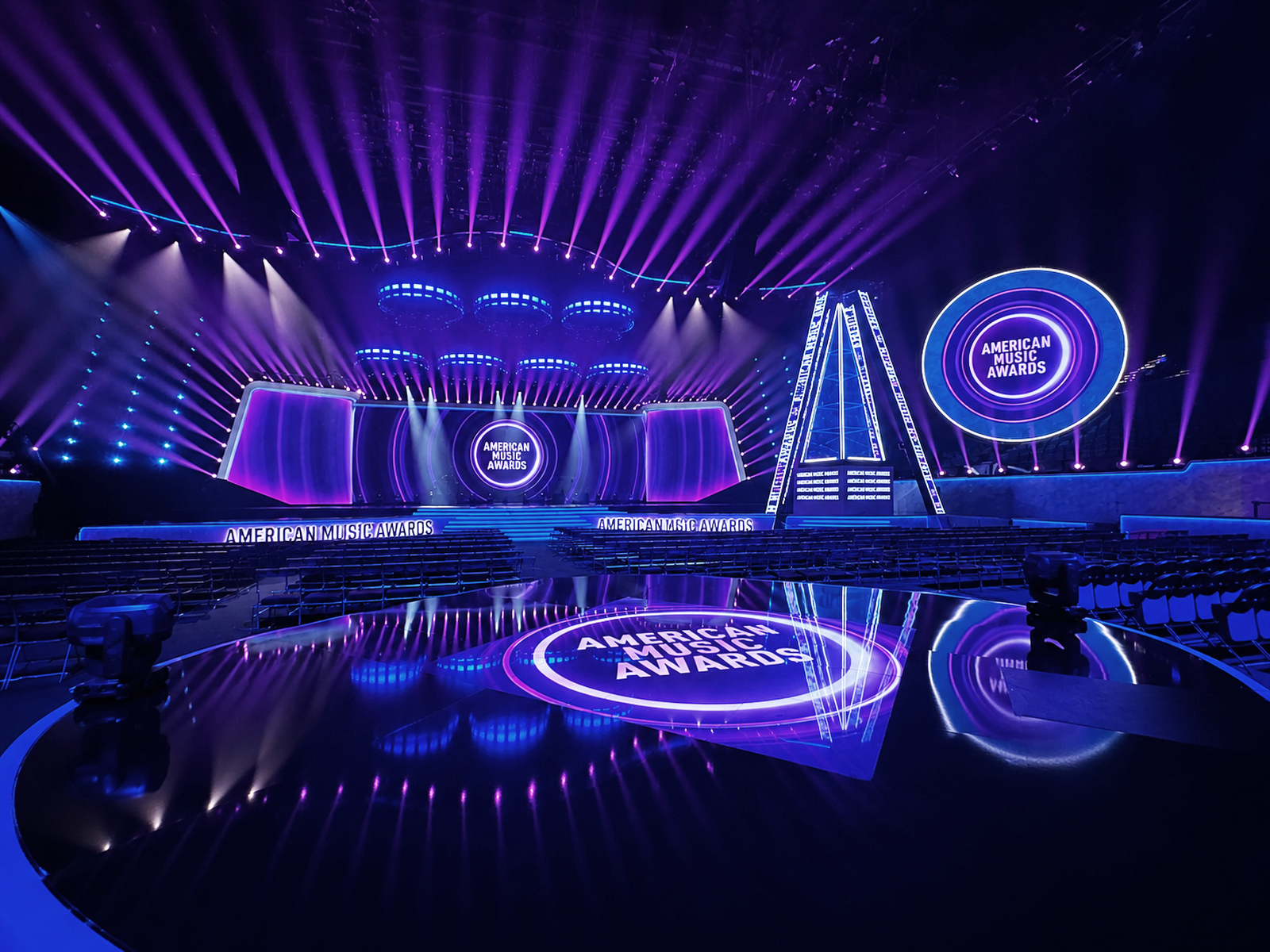
The Academy of Country Music Awards aired live on a Sunday from the MGM Grand Garden Arena in Las Vegas on Amazon Prime Video. The set started coming down that night. By Monday morning, in the same arena, a different show for a different network was going up: the American Music Awards, bound for CBS the following Monday.
Two broadcasters, two separate producing and directing teams, seven days between live shows, and one creative throughline.
Production designer Andy Walmsley designed both, alongside lighting director Tom Sutherland of DX7.
The arrangement, Walmsley said, has no precedent. But the schedule, demanding as it was, is not really the part of the job that occupies him. The harder problem is a creative one: how do you make an arena feel designed rather than empty, and how do you build 30 distinct performance worlds in the weeks before the doors open?
Rethinking the room, not just the stage
Walmsley’s first decision was about the space itself.
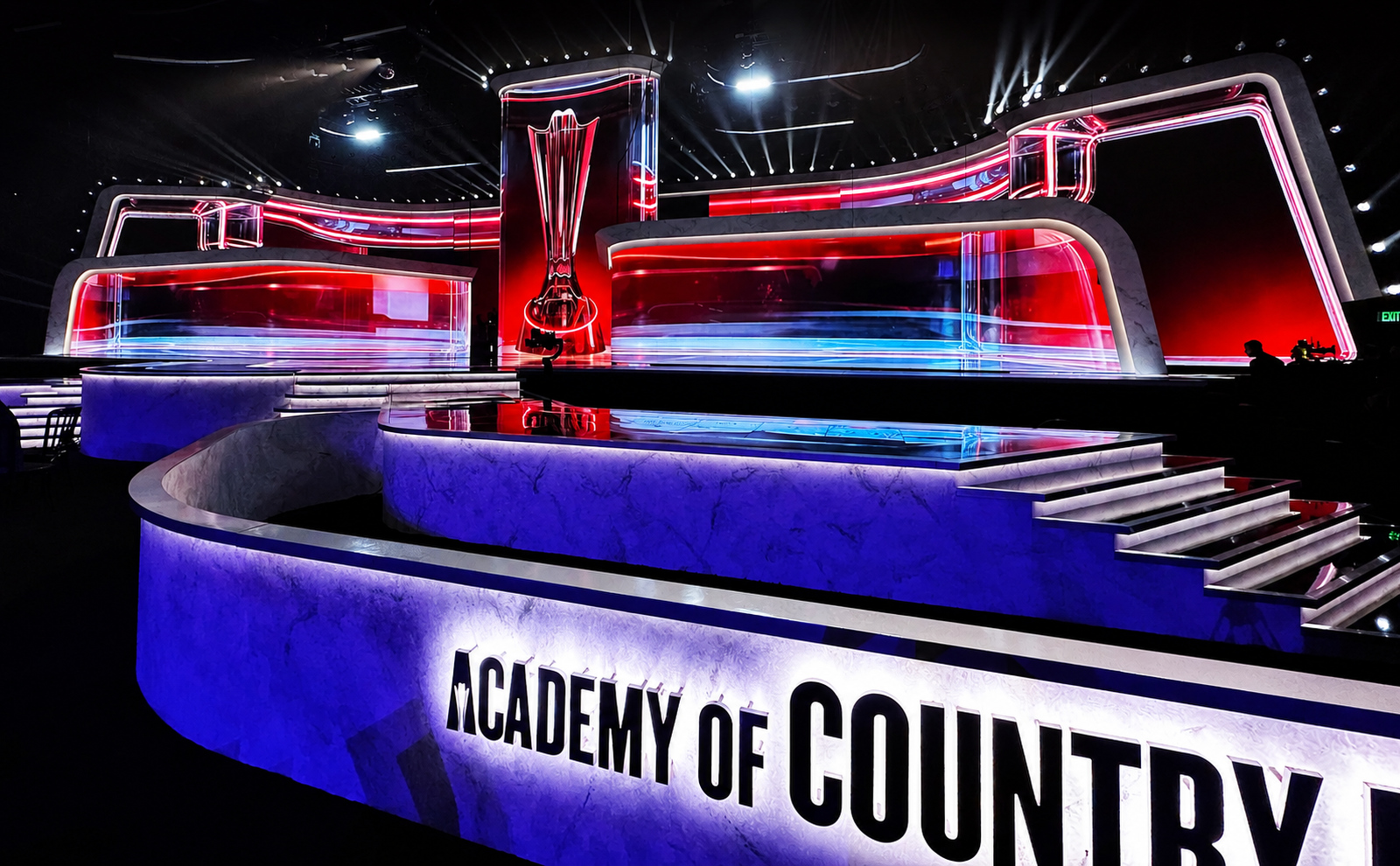
Award shows in arenas have traditionally concentrated the design at one end, leaving the rest of the bowl dark. For the ACM Awards, he argued for treating the entire room as the set.
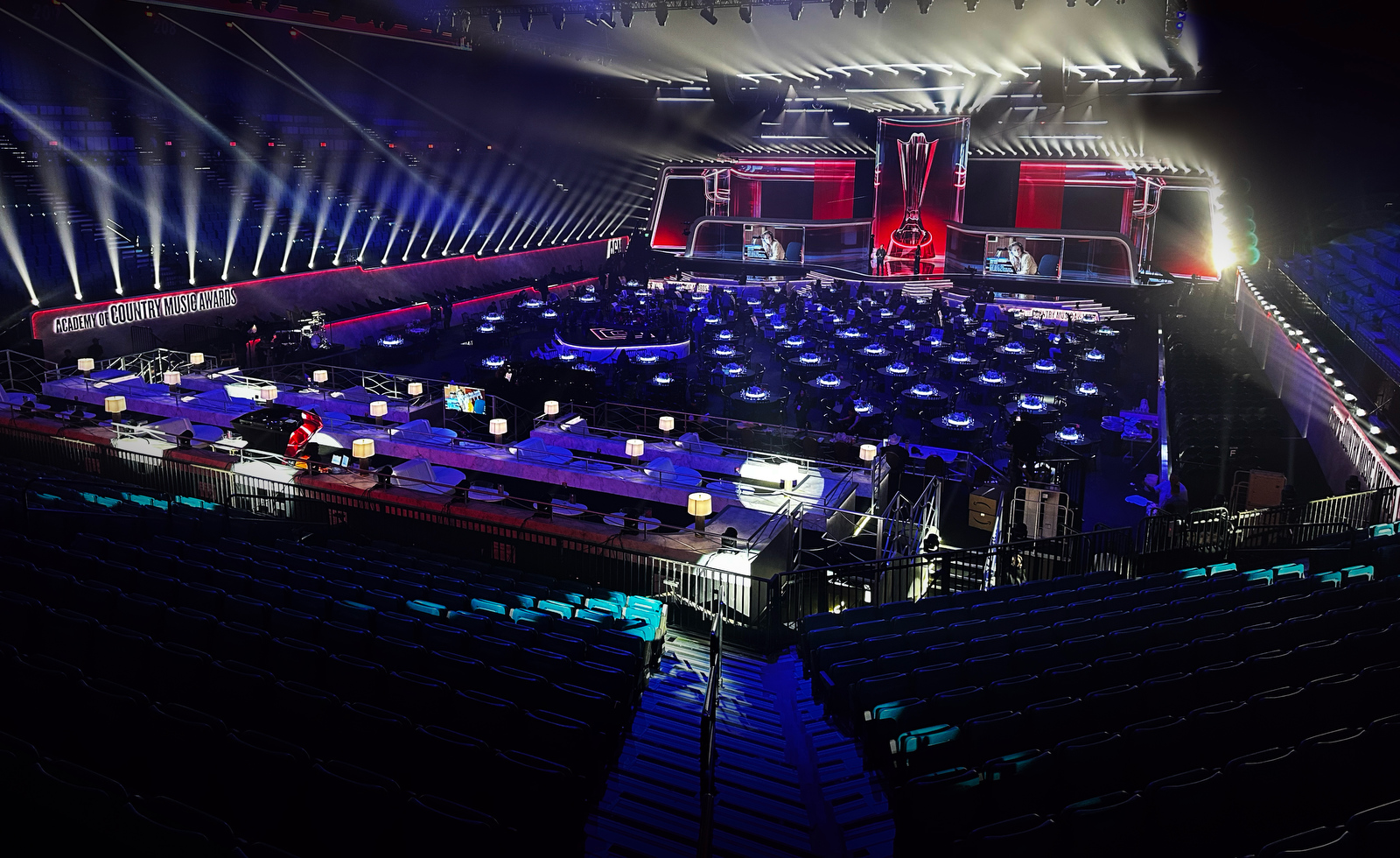
“These arenas are so vast. To just put a lovely looking set at one end and then every wide shot show a black arena with a postage stamp set at the end, it looks dull. It’s not exciting when you see it from Cable Cam aerial shots,” said Walmsley.
He pitched Jay Penske, owner of Dick Clark Productions, on a 360-degree environment: side walls, elevated flanking areas, and at the far end of the arena, opposite the main stage, an elevated VIP club with custom railings, banquettes, LED tape, table lamps and bottle service. The concept grew from a request for a VIP table section into a full nightclub built inside the broadcast.
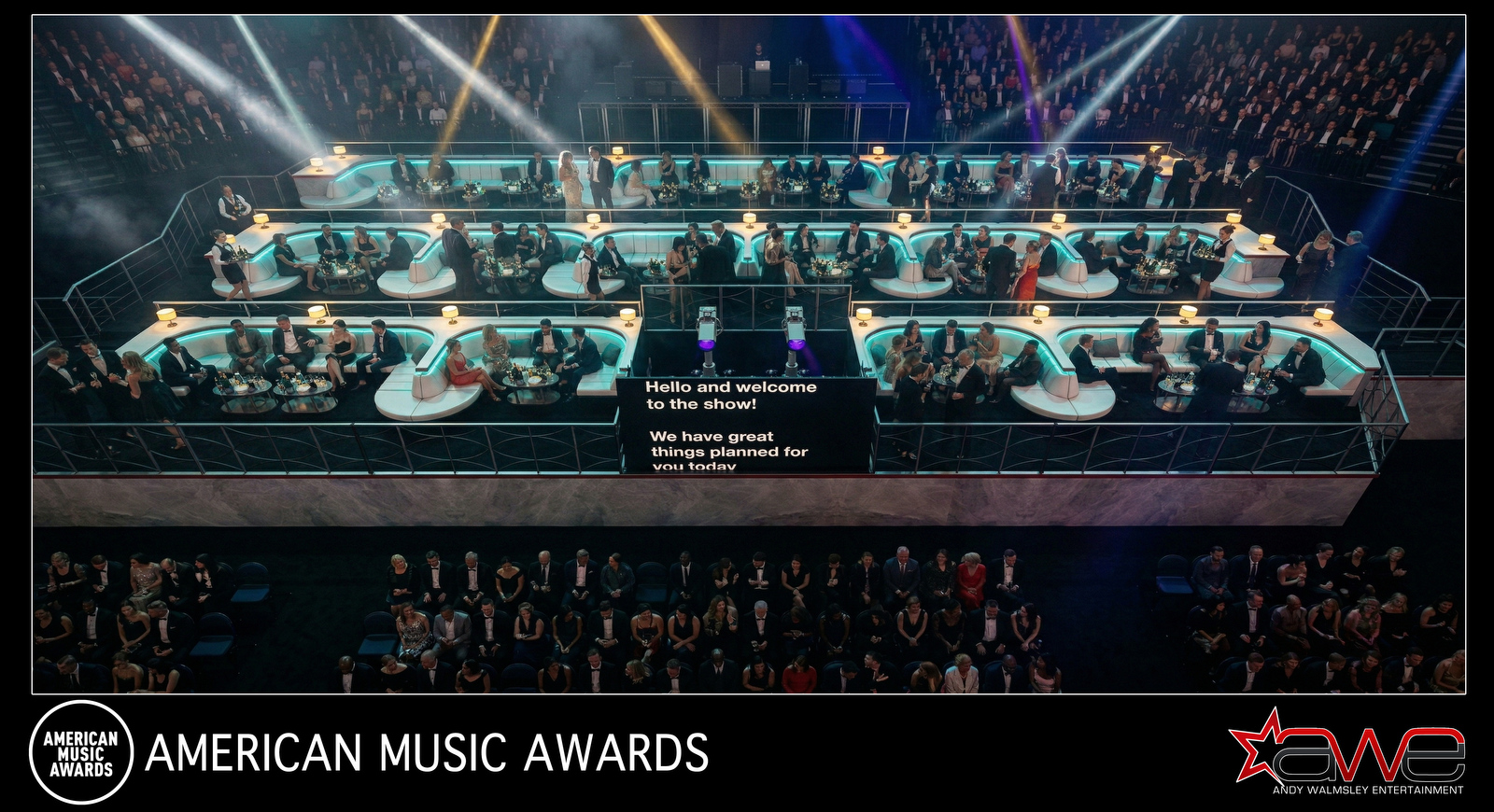
Walmsley said Penske wants it expanded for next year’s show.
The floor was its own design exercise. The country awards seat nominees and label executives at tables, and the layout had to read well on camera while functioning as a room people actually enjoy sitting in.
“Jay is very picky about those tables,” Walmsley said. He revised the plan 19 times, working directly with Penske and accounting for camera movement, the satellite stage and the paths needed to move drum kits and pianos through the crowd, all of it cleared with the venue and the fire department.
The tables also became a lighting fixture.
Scenic Express built circular centerpieces that held the wine and champagne service while casting a controllable LED glow onto the nominees’ faces. Wiring 70 tables meant running cable across the arena floor with controllers under each one, covering the runs with black carpet laid by Bright Event Rentals, then fishing cable ends up through holes cut in both the tables and the tablecloths.
A template inherited, then loaded up
Walmsley is direct about what is and isn’t invented in this work. The structural grammar of the award show, he said, was set decades ago, and he is building on it rather than around it.
“Designing the set is easy. It’s formulaic,” he said. “The A and B stage, the satellite stage, the closedowns, the steps up for award winners, it’s all a template, and those of us who design these shows are standing on the shoulders of Bill Ross, Bob Checchi, E. Jay Krause, Ray Klausen, Bob Keene, Joe Stewart and Roy Christopher. They are the designers who invented it all.”
The template puts an A stage on one side of the arena and a B stage on the other, divided by closedowns, scenic walls that fly in and out on high-speed motors. With one stage hidden behind a closedown, crews reset it while a performance runs on the other. On a streaming broadcast with few commercial breaks, that mechanism is what keeps the show in continuous motion. It is the same framework Ray Klausen used across 27 AMAs.
Where the real design hours go
If the set is a known quantity, the performances are not.
Between the two shows, Walmsley designed 30 of them, 16 for the ACMs and 14 for the AMAs, and each is effectively its own small production.
The range is wide.
Some performances are a single artist on an empty stage, which Walmsley said he welcomes. Others are bands needing risers sized to their instruments, sometimes with LED faces, sometimes themed to the song, sometimes finished in black so they disappear. One number put a 30-piece choir on risers. That, he said, is the manageable end.
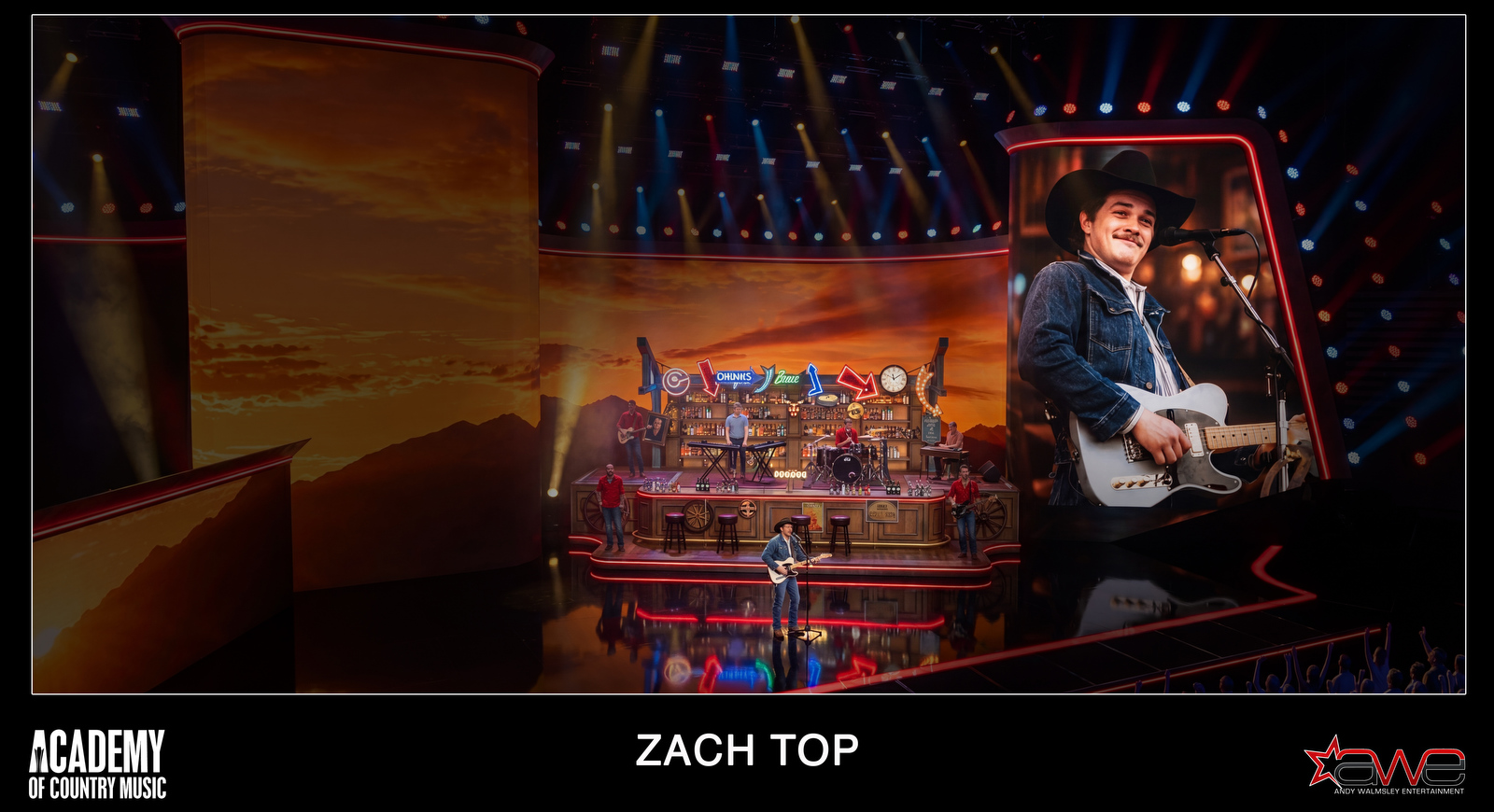
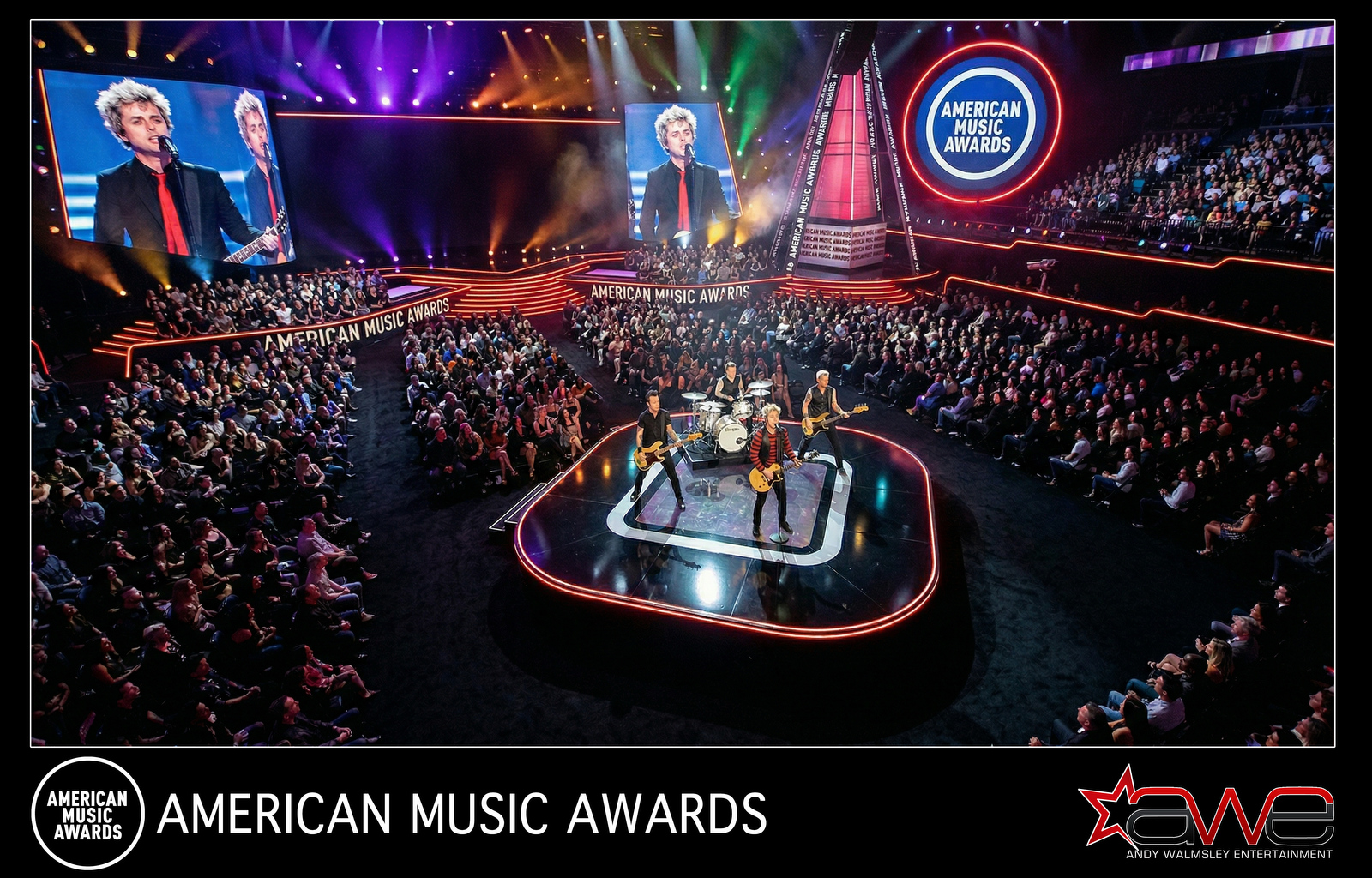
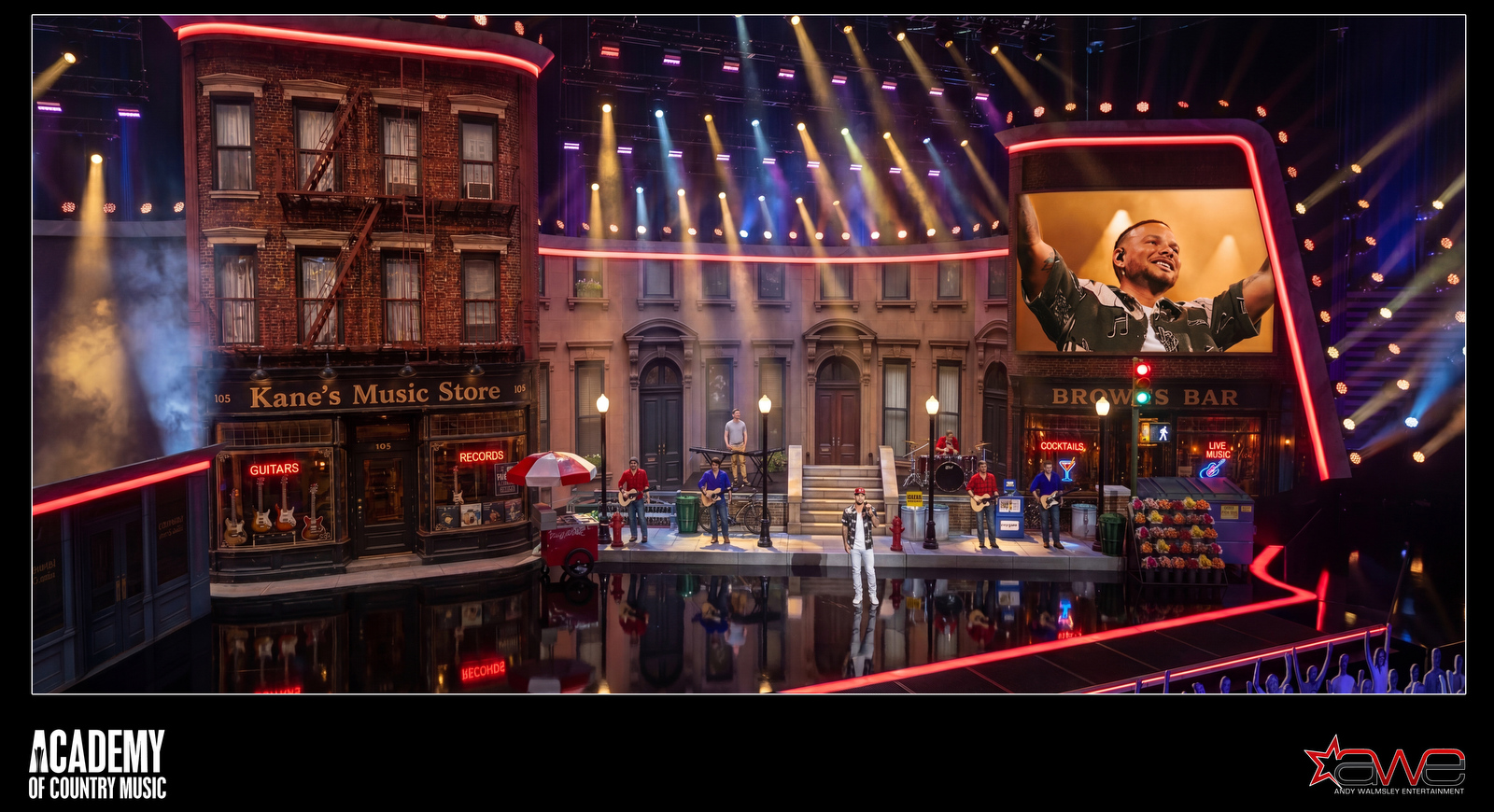
The other end is driven by artists who want fully realized environments, a shift Walmsley attributes in part to one performer raising the bar.
“Sabrina loves scenery. She has always leaned into physical themed sets, but this year she did an amazing show at Coachella crammed with scenery, and so she is almost single-handedly upping the game for other artists to keep up,” Walmsley said, referring to Sabrina Carpenter.
The examples show the design range he had to cover.
Kacey Musgraves performed inside a full supermarket, requiring shelving, refrigerators, a butcher counter and band carts disguised as produce displays, most of it custom-built by SRS in Las Vegas. Kane Brown wanted a New York street with brownstone steps. The group Katseye requested a 20-foot teddy bear the members would emerge from; it was built by Center Line Scenery in Los Angeles, carved on a five-axis machine, covered in fur, fitted with the reveal effect and delivered to Vegas three hours before rehearsal. The AMAs also featured Teyana Taylor’s science-fiction egg and a warehouse environment for Teddy Swims.

Each of these arrives late and through a crowd of stakeholders. Walmsley said the performance designs move through managers, labels, tour managers, choreographers, stylists, creative directors and sometimes the artists themselves, mostly in the final two weeks before load-in.
“This is all happening in the last two weeks before load-in. I’m on Zooms from 8 a.m. till 7 p.m., then have to design all night, then find a shop to build all this in the remaining 10 days or so,” he said.
Designing within the building’s limits
The creative choices were shaped throughout by the arena’s physical constraints, which Walmsley treats as part of the design brief rather than an afterthought.
Hanging most of the rigging at one end of the bowl runs into weight restrictions, and on these shows the overhead capacity was maxed out. That ruled out flying scenery away between acts, so every performance environment had to roll instead. The two shows used more than 90 band risers and carts on wheels.
That decision rippled out to logistics most viewers never see. Scenery was stored in the bottom floor of a parking structure across the street. One crew rolled the next three acts out of that structure, across a parking lot and past the satellite trucks feeding the broadcast, handing off at the arena doors to a second crew that moved it up a ramp to stage level.
What the second show kept, and what it didn’t
The changeover between the two productions reflected the same split between fixed structure and reinvented surface.
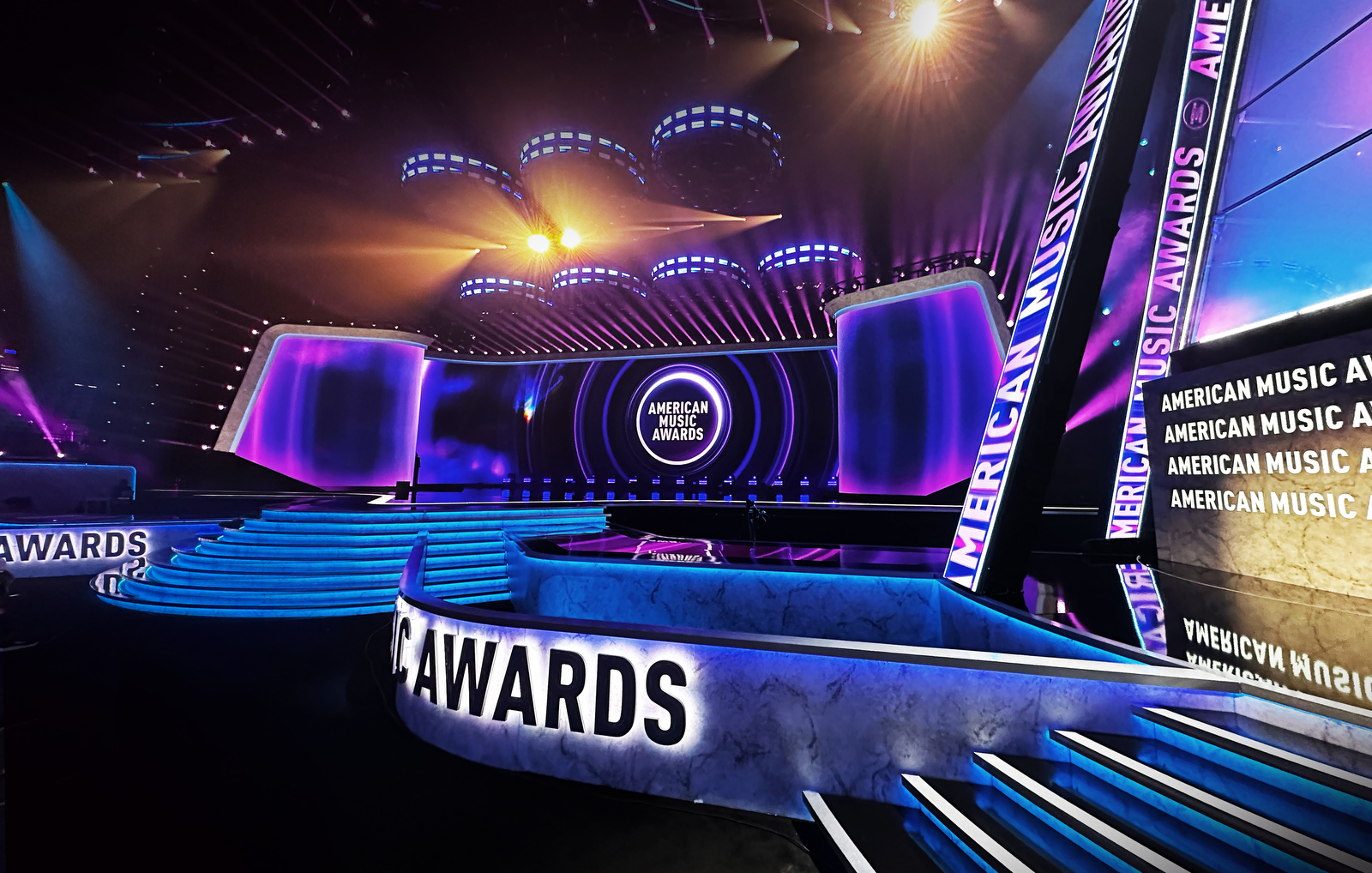

The basic stage stayed. The forestage was rebuilt and a side stage added.
The full lighting rig came down and was replaced with Sutherland’s kinetic lighting pods. LED tiles were repositioned, and new scenery came in, including a 30-foot pyramid replica of the AMA trophy on a turntable. The 16 country band looks were struck and 14 new ones loaded in.
Walmsley frames the larger trend in production design reverberating through the shows: the design problem keeps growing because the shows themselves have shifted closer to concert production.
“The music-based award shows are the toughest to design. They are 25% awards and 75% live concert with 16 different acts all competing and wanting the best for their three minutes,” he said. “A regular award show that’s just actors coming up and giving a speech is honestly a cakewalk compared to these music performance-based award shows.”

tags
Academy of Country Music Awards, American Music Awards, Andy Walmsley, Award Show, Awards, Scenic Express, Tom Sutherland
categories
Awards Shows Production Design, Heroes, Set Design