

The U.S. Men’s National Team’s opening match had advertisers cheering

Weekly insights on the technology, production and business decisions shaping media and broadcast. Free to access. Independent coverage. Unsubscribe anytime.
The 2026 FIFA World Cup is underway and is already breaking viewing records.
Peak viewership reached 18.86 million for the USA’s opening match against Paraguay, the highest ever for the opening game. With more teams in this edition than ever before, there are also set to be more matches (48, up from 32) and more ad breaks. WARC predicted that the 2026 tournament will inject $10.5 billion into the global advertising market.
Yospace is collecting streaming and advertising data from at least 14 OTT rights-holders worldwide to highlight viewing and advertising trends throughout the tournament. These will show how in-match events affect streaming audiences and advertising opportunities, and highlight the demands placed on the streaming and advertising technologies behind the scenes. In this article, we’re analyzing the USA’s opening match against Paraguay.
The match
As co-hosts, the pressure was on the USA to win its opener. The team delivered by turning on the style and comfortably defeating Paraguay by four goals to one. They were 3–0 up by half-time through an own goal and two goals from striker Folarin Balogun, who became the first American to score two World Cup goals in a match for almost 100 years. Paraguay scored in the 73rd minute but there was only going to be one winner. Gio Reyna scored a stunning fourth in injury time to secure a record-breaking victory.
Viewing trends
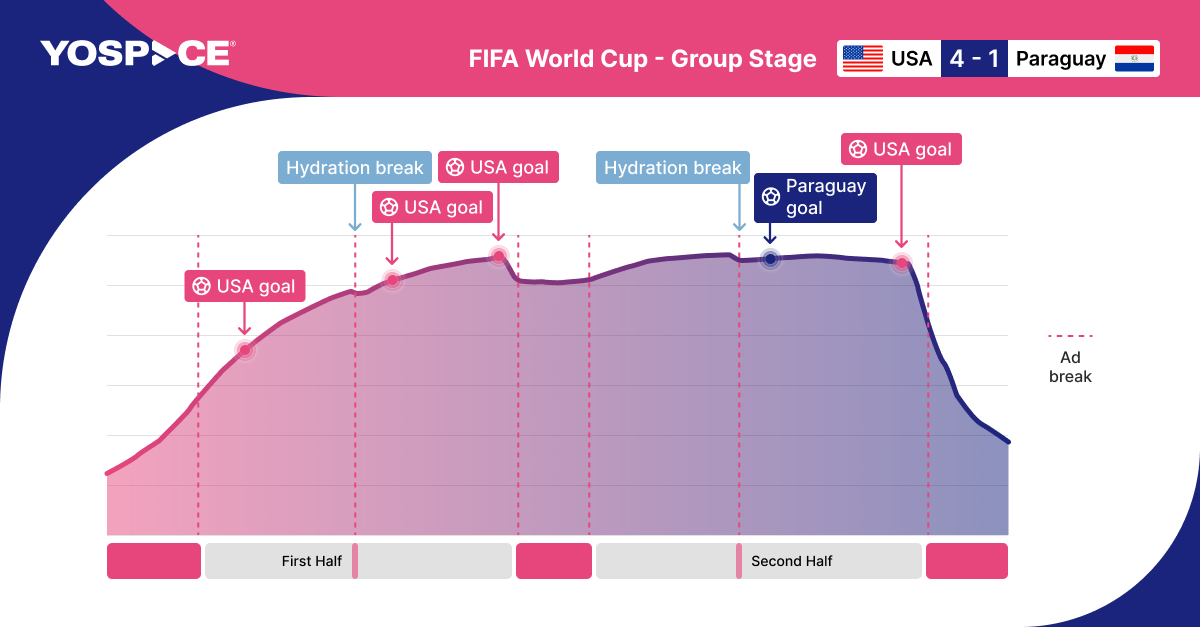
As you can see from the trend graph, the audience grew steadily across the first half. This is usual for a soccer game, though fans who missed the first USA goal after 7 minutes will be kicking themselves. The number of viewers dipped slightly during the hydration break, before resuming its upward trend towards half-time. Balogun’s second goal was the peak moment of the match.
Data courtesy of Yospace
The audience dropped off at half-time, as is typical in soccer, before hitting peak traffic again a few minutes into the second half. An interesting trend in this match was how the peak audience was sustained throughout the second half until full-time. This was probably influenced by the timing of Paraguay’s goal, which brought an element of jeopardy to the game. Without it, we may have seen viewing numbers start to drop over the last 20 minutes. Instead, fans were fixed to their screens to the last minute, and were rewarded with an amazing fourth goal in the final seconds. When the win was confirmed with the full-time whistle, viewers were quick to switch off.
Impact on advertising
The third USA goal came at a great time for advertisers, because it came right before the referee blew the whistle for half-time, which triggered an ad break. The goal marked the high point in audience for the entire game, and the following ad break had more viewers as a result.
A feature of the 2026 FIFA World Cup is hydration breaks, which effectively split the games into quarters. They also create an opportunity for an extra ad break. We estimate that hydration ad breaks will help create almost double the amount of ad breaks in this tournament compared to previous editions. The hydration breaks are only three minutes long, which limits the audience drop-off. With viewers glued to their screens during the second half, the hydration break at 62 minutes drove the most-watched ad break of the match.

The dramatic fourth goal at full-time preceded a sharp drop-off in viewers. This is expected in a soccer match, so the ad break that follows soon after tends to have fewer viewers. In this case, because of the high attention levels right to the final seconds, that ad break probably had more viewers than it would have had if that goal, and the Paraguay goal a bit earlier, had not happened. Had it been 3-0 going into the final 10 minutes then a portion of viewers would have concluded that the result was secure. But at 3-1, a second Paraguay goal could have transformed the momentum of the match.
Impact on the adtech
Supporting quick fluctuations in demand is a critical requirement of any dynamic ad insertion (DAI) system during high-stakes sports events. In many ways, the act of making millions of ad calls and stitching ads simultaneously is the easiest part, though, to be clear, it’s not an easy part! This is the case for both iterations of the technology: Server-side ad insertion (SSAI) and server-guided ad insertion (SGAI).
It’s one thing to stitch an ad, but the real requirement here is to maximize ad revenue. To do that, the adtech ecosystem needs sufficient time to respond to ad requests with the correct decision about which ads to place where. Then, the DAI system must be able to feedback accurate measurement data, with all of the elements that advertisers value, such as viewing quartiles, screen size, audio levels, and so on.
Achieving these objectives becomes harder in cases like the one seen in this match, where the USA’s third goal comes so close to an ad break, creating a peak in viewers. There was also no way of knowing how the second half would play out. A dominant USA performance almost certainly kept viewers tuned in and created a sustained peak audience throughout the second half.
Advanced prefetch solutions are critical in addressing these peaks. By pacing ad requests slightly ahead of a break, rights-holders give the adtech ecosystem more time to respond, enabling demand partners to compete without being overwhelmed by sudden traffic spikes. This helps deliver the highest technical fill rates and maximize the value of each ad opportunity, all while functioning within a seamless viewing experience.
However, prefetch alone does not unlock the full revenue opportunity. Advertisers also need confidence that ads have been delivered, viewed, and measured consistently. That is where the true value of OTT advertising lies. It is not enough to deliver at scale; measurement must build trust, support attribution, and enable optimization.
The opening match of the USA’s campaign did not disappoint in drama or talking points. This is great news for fans and rights-holders alike. The combination of dynamic ad insertion with advanced prefetch helps make it a win for advertising, too.

Paul Davies, YospacePaul Davies is head of marketing for Yospace.

tags
2026 FIFA World Cup, Adtech, Advertising, dynamic ad insertion, OTT, Paul Davies, Server-Guided Ad Insertion (SGAI), Server-Side Ad Insertion (SSAI), Yospace
categories
Advertising, Case Study, Featured, Sports Broadcasting & Production, Voices