

Americans still watch the networks, but they no longer trust the same ones

Weekly insights on the technology, production and business decisions shaping media and broadcast. Free to access. Independent coverage. Unsubscribe anytime.
American viewers have not abandoned the networks. They have just stopped agreeing on which ones to believe.
That is the short version of YouGov’s 2026 “Trust in Media” survey, released June 24, which measured how Americans view 48 news outlets and where they go to stay informed. The poll reached 2,102 U.S. adults on May 25 and 26, with a margin of error of about 3 percentage points.
For a broadcast audience, the usage figures are the place to start, and they are encouraging on their face.
Television brands still command the largest single-outlet audiences in the country. Among the 48 outlets tested, Fox News led on past-month use at 36%, followed by CNN at 32%, ABC at 29%, NBC at 28% and CBS at 26%. No print or online-first outlet came close at the brand level. The New York Times, the most-used source with a print component, sat at 23%.
The catch is that those audiences are increasingly sorted, and the trust beneath them is thinning. This is a more polarized and more fragile picture than the one Pollara found north of the border this spring, and the contrast is worth holding onto as the story unfolds.
Television holds its place as a format
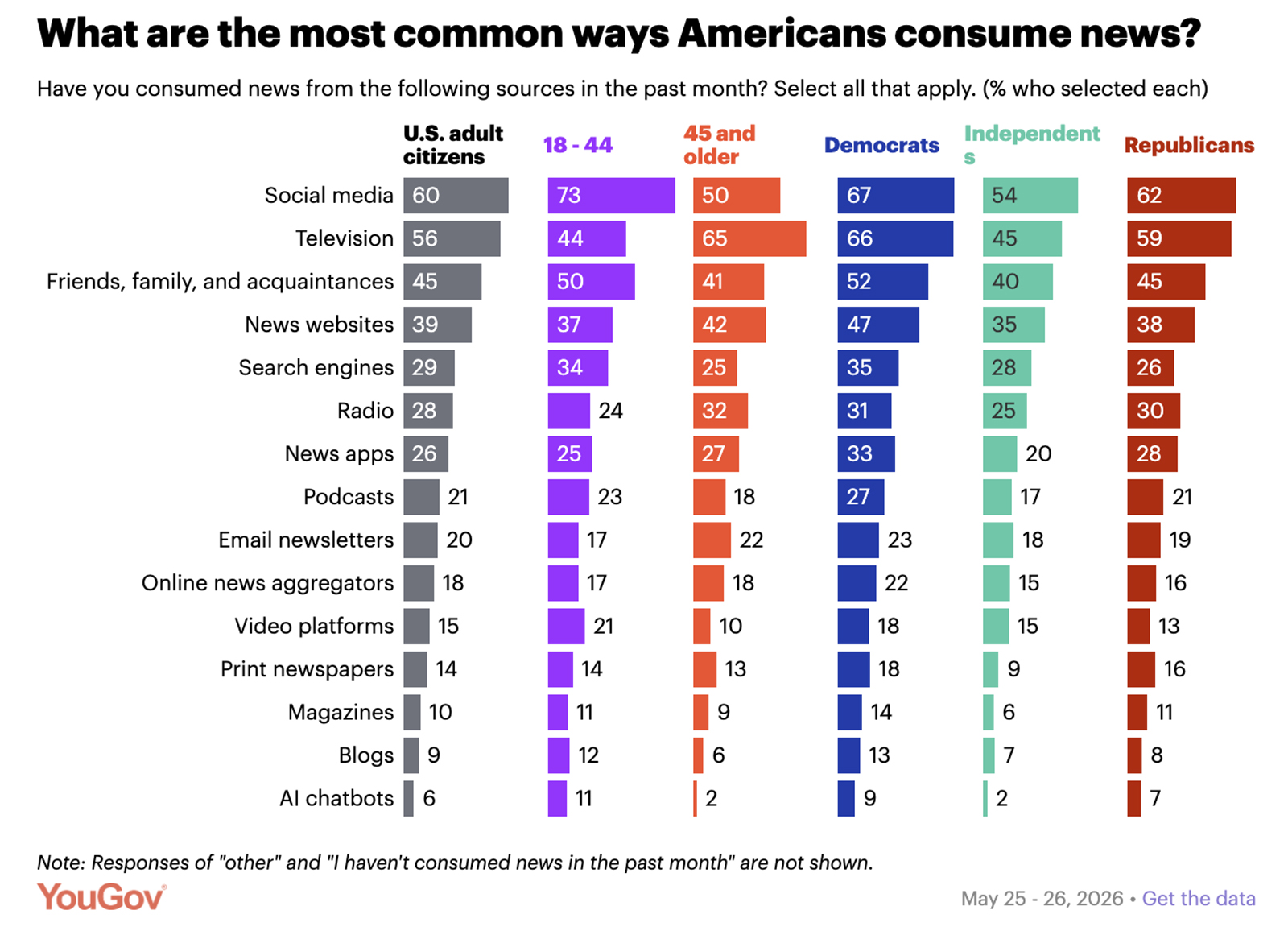
Asked where they had gotten news in the past month, Americans named social media most often, at 60%, with television close behind at 56%. The split runs along age, as it does in most markets now. Adults under 45 leaned on social platforms, while older adults leaned on television.
That pattern should be familiar to anyone who read the Canadian data.

Pollara found Canadians more reliant on traditional media than Americans, with total social media use as a news source at 51% in Canada against 59% in the United States. The direction is the same in both countries. The slope is steeper in the U.S.

There is also a reach gap that broadcasters cannot ignore.
More Americans said they got news from Facebook (40%) or YouTube (39%) than from any single news outlet, including the network leaders. Some of that social traffic carries network journalism inside it, but the distribution layer increasingly belongs to platforms the networks do not control.
Trust slipped, and the floor is partisan
The clearer warning sign is trust. YouGov calculates a net trust score for each outlet, the share calling it trustworthy minus the share calling it untrustworthy. Average net trust across outlets fell to plus 6 this year from plus 9 in 2025. The decline was modest, but the broader environment is harsh, and it is defined by party.
Democrats remained far more likely than Republicans to trust the news in general and most specific outlets. A greater share of Democrats trusted than distrusted 42 of the 48 outlets tested. For Republicans, that held for only 15. The two sides barely overlapped at the top: just 10 outlets earned positive net trust from both parties, and several of those were financial brands such as Forbes, The Wall Street Journal, the Financial Times and the Economist. Money news, it seems, remains one of the few neutral grounds left.
Two cable names anchor the divide. CNN and Fox News were the most polarizing outlets in the survey, each carrying an 85-point gap in net trust between the parties. Democrats placed heavy trust in PBS, NBC and the Times, while Republicans concentrated theirs in Fox News, Fox Business Channel and Newsmax. For programmers, the practical reading is blunt: a network’s trust ceiling is now capped by which half of the country is watching.
The Canadian comparison puts the scale in perspective. Pollara flagged a widening partisan trust gap as a notable finding, with a 54-point spread between Liberal and Conservative voters. In the U.S., the gap on a single cable brand runs 85 points. Polarization is a cross-border trend, but the American version operates at a different magnitude.
A rebrand offers a cautionary tale
One result deserves a flag for anyone weighing a brand refresh. MS NOW, the network formerly known as MSNBC, saw net trust fall 12 points over the year. Part of that appears to be a recognition problem rather than a verdict on the journalism.
The share of Americans who said they did not know how trustworthy MS NOW is reached 34%, double the 17% who said the same about MSNBC a year earlier. Usage told a similar story, with a 13-point drop among Democrats in the share who said they had gotten news from the outlet in the past month.
Rebranding an established broadcast property is sometimes necessary, but the data is a reminder that name equity is hard-won and easy to misplace. When a third of the audience no longer knows what to make of a channel it used to recognize, the cost shows up in both trust and tune-in.
The Weather Channel leads again, on both sides of the border
For the fifth consecutive survey, the most trusted news source in America was not a newsroom in the usual sense. The Weather Channel topped the list at plus 50 net trust, ahead of PBS at plus 26 and The Wall Street Journal at plus 22. The least trusted were Breitbart News at minus 12, One America News at minus 10 and Fox News at minus 10.
The weather result is not a fluke, and it is not only an American one.
Pollara found the same dynamic in Canada, where The Weather Network has been the most trusted media organization for four years running. Forecasts are verifiable, useful and free of political charge, which describes the qualities audiences keep saying they want and rarely find. Two countries reached the same conclusion independently.
The broader cross-border read is consistent with the spring Canadian numbers. Canadians reported higher trust in the news media overall, at 51%, than Americans did at 45%. The American market is larger, louder and more divided, and the trust data reflects all three.
Synthetic media moves into the feed
A final thread should concern anyone responsible for what reaches the screen.
The share of Americans who said they see AI-generated information online every day jumped to 46% this year from 36%. Only 11% said they were very confident they could tell people-generated news from the AI-generated kind. Direct news consumption from chatbots remained small but is rising, with 10% saying they had used ChatGPT for news in the past month, climbing to 16% among adults under 45.
For broadcasters, the trust advantage here is real and worth defending. A network feed carries provenance that an unlabeled social clip does not. As synthetic media spreads and audiences admit they cannot reliably spot it, verifiable sourcing becomes a competitive asset rather than a compliance footnote.
What broadcasters take from this
The American picture is not one of collapse. Networks still pull the largest single-outlet audiences, and YouGov noted that net trust tends to run higher for outlets with larger audiences.
The harder truths sit underneath. Those audiences are sorting by party, the under-45 cohort is migrating to platforms the networks do not own, and brand equity proved fragile enough that a rename cost a major channel both recognition and trust in a single year.
The Canadian data offers a steadier version of the same forces, which makes it a useful control case rather than a separate story. In both countries the structural challenge is identical: carry hard-won credibility onto the platforms where the next audience already lives, and prove, in an environment thick with synthetic media, that what viewers are watching is real.
YouGov conducted the survey May 25 and 26 among 2,102 U.S. adult citizens drawn from its opt-in panel, with results weighted to be representative of the adult citizen population. The margin of error for the overall sample is approximately 3 percentage points.


tags
YouGov
categories
Featured, Journalism, Local News, Market Research Reports & Industry Analysis