

Dak’s Take: The local television career ladder is disappearing

Weekly insights on the technology, production and business decisions shaping media and broadcast. Free to access. Independent coverage. Unsubscribe anytime.
The past few weeks brought another round of the bad news local television has grown almost numb to: layoffs, hubbing and a fresh wave of AI tools designed to assemble a newscast with less human involvement than at any point in the medium’s history.
Taken individually, none of it looked like a turning point. Taken together, it’s a pattern.
That pattern points toward a version of local television that requires remarkably few people to run it. And it raises a question that matters more to the people building careers in this industry than any ownership-cap debate or affiliate dispute: If the traditional broadcast career path is disappearing, what replaces it?
This is not really a story about whether local television survives. It almost certainly will, in some form. It’s a story about whether the job someone holds today, and the career plan built around it, still make sense in the industry that’s emerging.
For anyone working in local broadcasting, or thinking about entering it, that question deserves a plan, not just a shrug.
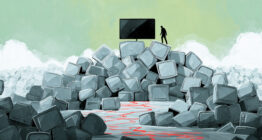
The bad news is becoming a pattern
Any single headline from the past several months could be waved off as routine restructuring. Broadcast groups consolidating management across markets. AI tools entering script writing and newscast assembly. Experiments with synthetic or automated voiceover. Additional rounds of layoffs (after additional rounds just months ago).
Broadcasters have run experiments like these for decades. What’s different now is the direction they’re all pointing. The significant change isn’t that broadcasters are testing automation. It’s that the experiments increasingly point toward a local television station that requires very few people to operate.
Local television has a recent precedent for what that looks like. It’s the newspaper business.

Newspapers have already shown us this movie
The newspaper industry’s contraction did not arrive as one catastrophic event. It happened in stages, over roughly two decades, and most of those stages had a rational explanation attached.
Centralized design hubs sounded sensible because page layout didn’t need to happen inside every newsroom. Copy desks were combined because the work looked duplicative. Printing moved elsewhere. Corporate functions were centralized. Each decision, evaluated on its own, could be defended as efficiency. The cumulative effect was an industry with considerably less local reporting capacity than the one it replaced.
Local television isn’t identical to newspapers, but the mechanism, death by a thousand individually rational decisions, is already visible in broadcast.
The idea of running multiple stations through centralized hubs isn’t new either; Sinclair Broadcast Group proposed a hubbed model back in the 2000s that drew enough pushback to stall. What’s changed is the technology and the economics underneath it. What once required an elaborate remote-production build-out can now be handled through software, IP workflows and cloud systems.
Functions that stayed local because moving them was hard are becoming movable because the friction is gone, and the financial incentive to move them has only gotten stronger.
What does the local station actually need?
Picture the lean version of a local station broadcast groups appear to be building toward.
It may include a news director or newsroom manager, a small number of multimedia journalists, limited local sales staff, some weather or sports talent, and someone responsible for making sure the output looks coherent.
Everything else can potentially live somewhere else.
Production can be automated. Graphics can be centralized. Engineering can become regional. Weather can be shared across a group. Management can span several markets. Newscast assembly can become software-assisted.
Not every station will reach that exact configuration, but the staffing floor keeps dropping, and that trend line matters more than any individual station’s current headcount.
Not every job is equally exposed
Some roles remain genuinely difficult to centralize, at least for now.
Someone still has to attend the city council meeting, knock on the door, work sources and stand at the scene. Local meteorologists retain clear value when severe weather and audience trust are on the line, even as routine day-part forecasting increasingly gets centralized. Sports coverage tied to local relationships and event access holds up better than coverage that can be packaged remotely.

None of those categories are immune, though.
A station that once staffed eight reporters may decide it needs three. A weather department built around four meteorologists may shrink to one, backed by a regional hub, the way Nexstar has already piloted using its weather hub to cover staffing gaps.
Roles built mainly around turning existing content into a scheduled TV product face more structural exposure: producers, directors, technical operators, some engineering functions, graphics, editing, routine weather presentation and, in some configurations, anchors.
The reason isn’t that any individual in those roles is replaceable. It’s that the job exists largely because assembling a newscast has historically required a person to perform that specific step, and that’s precisely the step automation is being built to handle.
The automated newscast is not science fiction anymore
Automation isn’t likely to arrive first in the 6 or 10 p.m. newscast. It’s more likely to show up in the dayparts stations added mainly because news is comparatively cheap inventory: 2 p.m., 3 p.m., streaming updates, overnight blocks. A broadcaster combines real reporter packages with AI-assisted scripts, synthetic narration, centralized weather and an automatically assembled rundown.
Scripps is already testing versions of this approach at a handful of smaller-market stations.
That’s exactly why the low-stakes version matters. If it works at 3 p.m., the next question inside a broadcast group is whether elements of it can work at noon. Then in the morning. Then which parts of the flagship newscast genuinely require a person at all.
None of that is inevitable, but it’s the direction the incentives point.
When the product becomes a commodity
Stations have spent years filling schedules with additional hours of local news partly because news inventory is cheap relative to syndicated programming, and automation makes it possible to produce even more of it for even less money. That doesn’t automatically translate into more journalism. An industry can produce more local news programming while simultaneously producing less local journalism.
It also erodes what made the product distinctive in the first place.


The traditional local newscast had real differentiators: recognizable anchors, meteorologists audiences trusted, reporters viewers knew by name, a distinct station personality. Some of that differentiation was already thinning before automation entered the picture, as research and consulting firms encouraged common formats, common pacing and standardized story treatments across markets, producing newscasts that increasingly looked alike from one market to the next.
Automation is the next logical step in that same direction: if the same reporter package runs everywhere, synthetic narration bridges the segments and centralized weather fills the rest of the block, the audience has less reason to care which station produced it. At that point, viewers can get the same information from Google, Facebook, YouTube, an aggregator or a competing station just as easily.
In cutting the expensive things that make a local newscast distinctive, broadcasters risk turning their own product into the commodity they say they can’t compete against. And each round of consolidation carries a quieter cost: institutional knowledge.
The producer who knows how a market reacts to a tornado warning, the engineer who understands why an aging transmitter behaves strangely in freezing weather, the reporter who has covered the same school board for six years. Automation can preserve a workflow. It doesn’t automatically preserve that kind of knowledge, and once it’s gone, rebuilding it takes years, not budget cycles.
So what should someone working in television do?
None of this is an argument for leaving the industry. It’s an argument for thinking about the job differently than the industry has traditionally encouraged people to think about it.
Start with transferable value rather than job title. A reporter’s real skill isn’t “being on television.”
It’s finding information, interviewing sources, telling stories and building trust. A producer’s skill is editorial judgment and structuring information under deadline. A director or technical operator’s skill translates into live production, corporate video, events and streaming. For talent, it’s audience connection and presentation. The useful question isn’t “is my job safe.”
It’s where else the market values the thing a person is actually good at.
The exits are wider than they used to be: corporate and enterprise video, sports and live events, digital-native publishers, nonprofit newsrooms, independent journalism, YouTube and creator-led media, newsletters and podcasts, streaming production.
There’s a specific opportunity worth noting inside that list. Many digital-native local newsrooms, including nonprofit outlets affiliated with groups like Lion Publishers, remain text-first, often because their founders came from newspapers or because written reporting is cheaper to produce than video. That leaves a real video gap, and a broadcast journalist who understands concise scripting and how to compress a complicated story into 60 or 90 seconds has a skill set that’s genuinely scarce in that world.
The traditional ladder ran from small market to medium market to major market to network. It still exists, but with fewer rungs and fewer jobs on each one.
A different version of that career might look like this instead: cover a community, build expertise, develop an audience, establish a direct distribution channel, then monetize that audience or fold it into a larger digital publication. Journalism doesn’t require a television station to validate that someone is a journalist.
Build your own audience carefully
Station groups have historically discouraged employees from building independent audiences, on the logic that a personal following gives an employee leverage the company would rather it not have.
That instinct is understandable from a management standpoint. It’s also increasingly out of step with where career risk actually sits. A portable audience is starting to function as career insurance, not a threat to it.
That doesn’t mean every reporter needs to become an influencer. It means a journalist’s career capital now includes reputation, subject expertise, community relationships, audience and distribution skills, not just a station logo. Talent can become interchangeable fast when a budget needs cutting, and a professional identity that lives entirely inside an employer’s brand is a vulnerable one.
For anyone entering the field now, that’s worth learning early: report, shoot, edit, understand audience development and how platforms work without depending on any single one, and don’t assume the career path an older colleague followed will still be there in 10 years.
The company is not your career plan
Broadcast groups often talk about culture, family, and internal mobility, and some of that is genuine. But corporations have obligations to their businesses, their investors and their balance sheets. When the economics demand headcount reduction, culture doesn’t protect positions.
That means individuals have to take a longer view than employers do. Caring about a station, a newsroom and the institution of local television is not in conflict with clearly seeing what’s happening around it.
The question for people working in local television isn’t whether the industry looks different in 10 years. It’s whether the job they have today still exists in five, and whether they’ve built a career capable of surviving when it doesn’t.

tags
Dak's Take
categories
Heroes, Journalism, Local News