

ESPN’s Studio W debuts with LED volume and full 2110 rebuild ahead of NFL season
Weekly insights on the technology, production and business decisions shaping media and broadcast. Free to access. Independent coverage. Unsubscribe anytime.
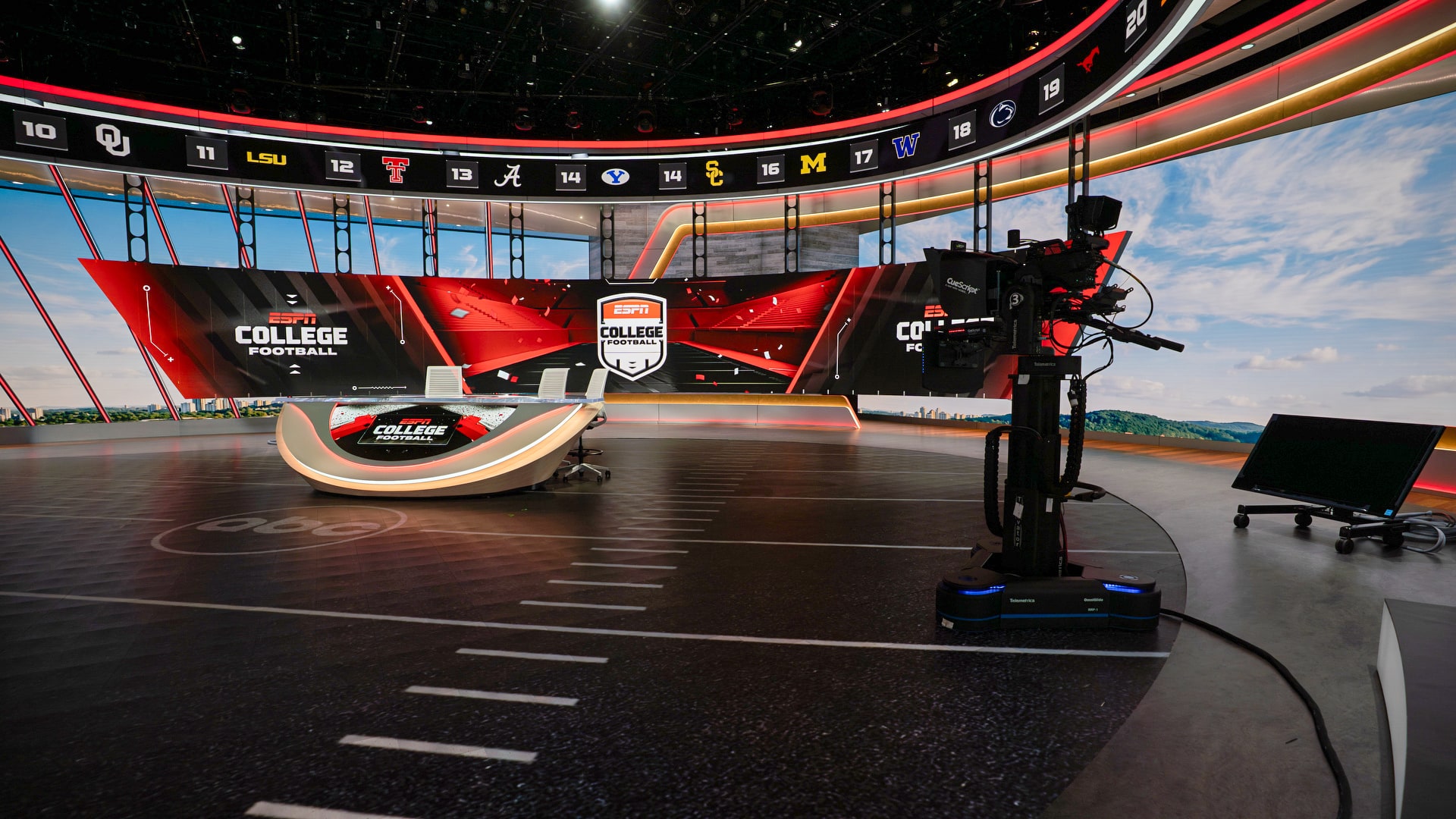
Studio W, ESPN’s rebuilt flagship studio in Bristol, Connecticut, made its on-air debut Aug. 29 during ABC college football coverage and became the permanent home of “NFL Live” on Sept. 9.
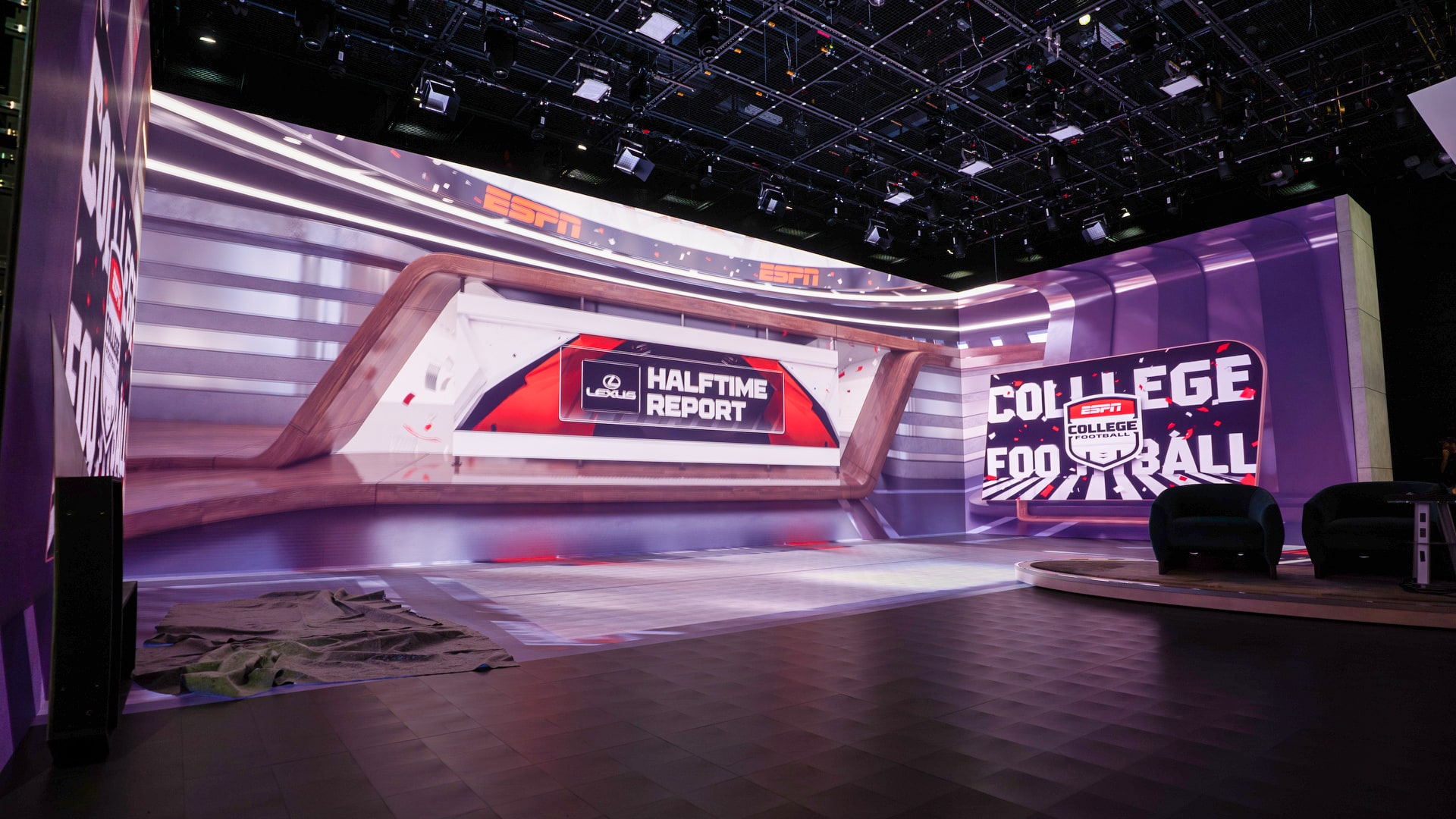
The studio, built from the ground up over eight months, adds an extended reality (XR) volume, a wireless Steadicam that can shoot inside that volume and Bristol’s first production infrastructure built natively on SMPTE ST 2110.
Tony Lacaprucia, senior director of studio operations at ESPN, and Christiaan Cokas, director of the network’s Applied AIX (AI Experiences) group, discussed the build in an interview ahead of the studio’s launch.
A larger XR volume and a wireless Steadicam
Asked what feature on their wish list finally made it into the new studio, Cokas pointed first to the scale of the new XR volume itself.
“This is a massive step for us in the XR realm. It’s a much larger space. I think you’re going to see and feel that,” Cokas said. “From a technological standpoint, that’s our big move as far as what my team does with virtual production.”
That larger footprint is also what makes the studio’s new wireless Steadicam useful, since operators can now move through the XR volume rather than shoot it from fixed positions.
“I think the wireless Steadicam moving across the floor into that space is going to be the real wow factor,” Cokas said.
Lacaprucia agreed, framing the camera upgrade in operational terms.

“From an operational standpoint, the wireless Steadicam that is now capable of XR is by far what I’m most excited about,” Lacaprucia said.
ESPN has operated XR studios in Bristol for several years. Cokas said the technology behind Studio W builds on lessons learned from those earlier builds, including the network’s Catalyst Stage.
“With our Studio C stuff, we did a lot of different things, but it took us a long time to go live and trust that and feel comfortable,” Cokas said. That process, he said, gave the team confidence to treat XR as part of everyday live production rather than a special-event tool.
Design built around graphics and flexibility
Studio W will support NFL, college football and NHL coverage, along with various kinds of daily programming, meaning the space had to accommodate multiple sets of graphics packages and show formats.
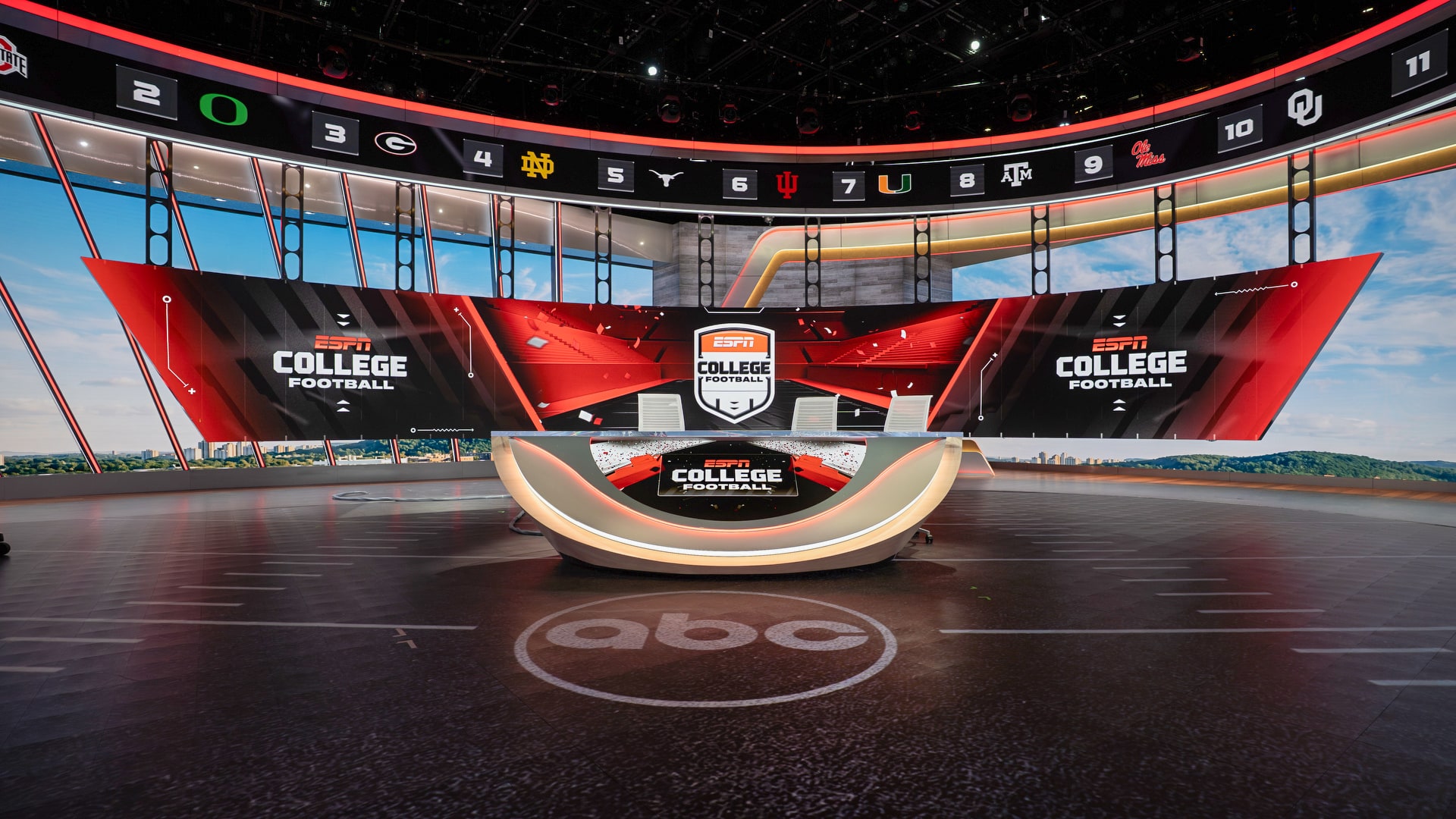
“A lot of it, with over 9,000 square feet of LEDs in that space, is going to be driven by the graphics,” Lacaprucia said. “That’s where a lot of the design comes in, trying to figure out where you can display stats that’s going to work on camera, not get covered up by the talent.”
The studio includes a 55-foot LED wall with automated, moving panels. One section remains fixed while three others can travel across the floor, allowing operators to combine or separate them for different shows.
“Not only can we get creative and flexible with the graphics themselves, but also the physical layout of some of the displays in the space,” Lacaprucia said.
The studio also includes a 146-inch touchscreen mounted on a floor track — which can be positioned to the side for wide shots or moved to center stage for talent segments — along with a massive floor LED.
The design of the space was overseen by ESPN Studio Design & Development, with Jack Morton handling the scenic design. ESPN Creative Studio designed the virtual backgrounds for the volume, and lighting design was done by ESPN’s internal team.
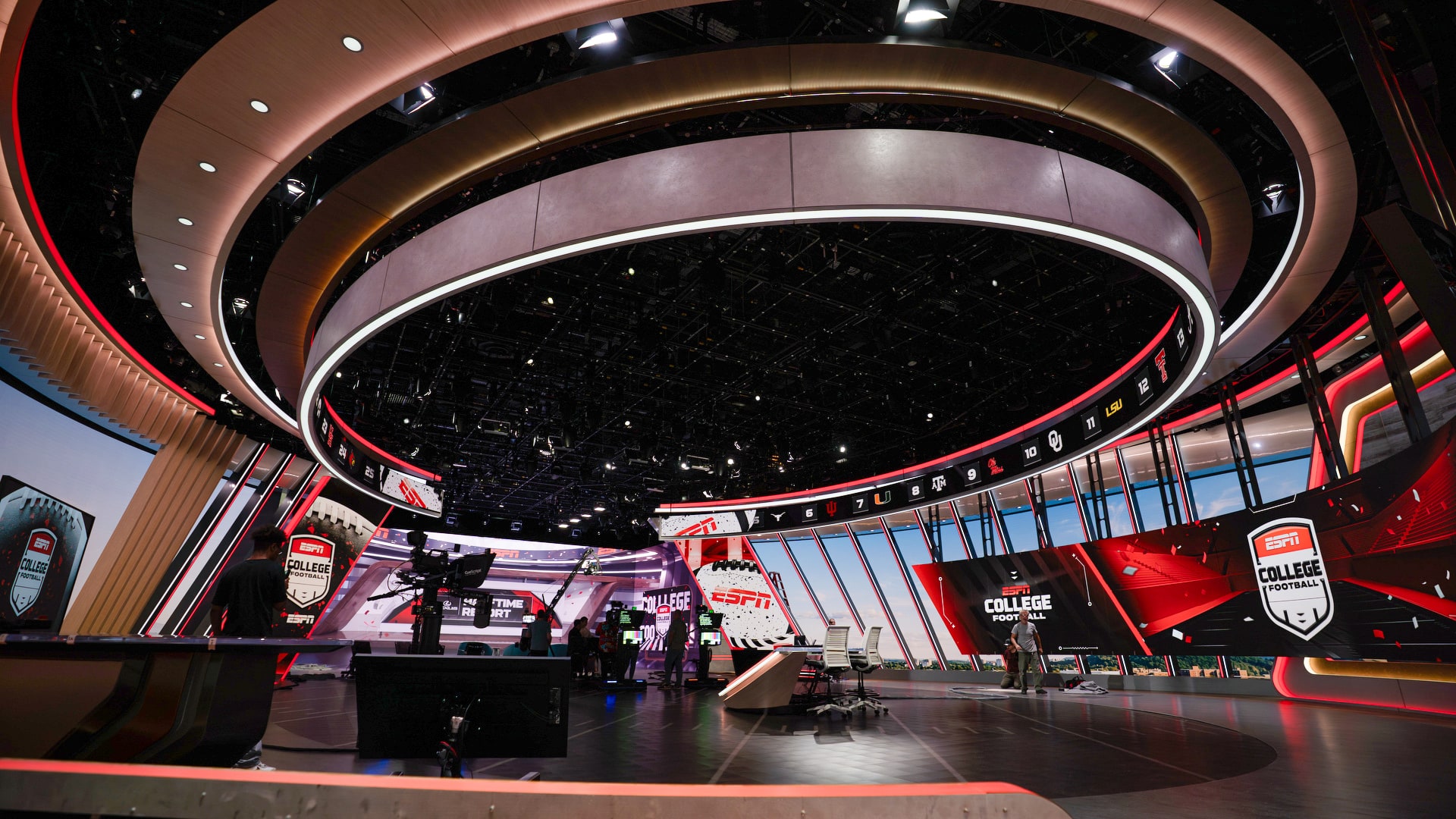
The overall design is anchored by an overhead halo ring, which has become common in many NFL stadiums, with nods to modern stadium architecture throughout the studio. The expansive LED walls provide a window into a featured location or stadium, with various looks driven by particular shows or sports properties.
Wrap-around NFL programming, for example, uses faux textures and abstract stadium imagery, while college football inserts beauty shots of key games and cities.
First native ST 2110 build in Bristol
To make the studio possible and support the move to UHD and HDR, ESPN needed new infrastructure across the board.
According to Lacaprucia, ESPN built its first SD2110 (ST 2110) system for the space, replacing legacy equipment with IP-based infrastructure throughout.
“We had to build our first 2110 infrastructure. So everything in the studio is new to be native 2110, whether it’s the cameras, it’s all new display technology,” Lacaprucia said. “We took the studio down to the studs and built it up from scratch.”
This includes new Sony HDC 5500 cameras with a custom integration developed for ESPN, along with new lighting instruments throughout the space.
ESPN also built a dedicated native 2110 production control room (PCR) for Studio W, while retaining the ability to pair the studio with the network’s existing SDR control rooms, and vice versa.
“We compare that HDR PCR with any of our SDR studios,” Lacaprucia said.
Because only a limited number of ESPN spaces currently support end-to-end HDR production, Lacaprucia said the network expects to reserve the format primarily for marquee events, though he did not rule out broader use.
Studio W also had to maintain compatibility with ESPN’s existing distribution infrastructure. Lacaprucia noted the studio can send content between its new 2110 router and the network’s legacy J2K router.
“We’re able to seamlessly send content from our 2110 router to our J2K router — our legacy J2K router — back and forth,” Lacaprucia said. “That’s no small task.”

Building the volume and upgrading studio tech
Inside the volume, ESPN refined its approach from its earlier Catalyst Stage build.
“We’ve changed processors, we’ve changed LED tiles, so it’s a completely reimagined XR workflow,” said Cokas.
The volume uses a custom integration of Pixotope, powered by Unreal Engine, for rendering and is designed to support future tools and customizations that are unique to ESPN’s needs.
The studio uses frame remapping — commonly referred to industry-wide as “ghost frame” or frame multiplication — to allow multiple cameras to capture different slices of the same virtual environment.
Cokas said the underlying technique has become standard across the industry since ESPN’s Catalyst Stage launched with an early version of the approach in 2023.
At launch, Studio W is using a single camera inside the volume, with the option to scale up to as many as nine cameras capturing different slices for a given show.
“It will be step by step,” Cokas said. “They’ll basically pick their complement for each show, and I think we will build over time.”
Lacaprucia said the studio’s new platform also lets operators change camera configurations between shows without engineering support.
“It’s very easy for the operator to go, ‘We’re going to use Jimmy Jib, Steadicam and camera one and two for today.’ But now for the next show, we want to transition to using cameras three and four along with the Jib and Steadicam,” Lacaprucia said. “We now have a way of doing that that we can put in the hands of the video operator.”
Cokas described the studio’s design as shifting creative responsibility onto ESPN’s directors.
“The challenge is now in the director’s hands because you have the ability to do anything and everything,” Cokas said. “It’s really a matter of setting up the graphics correctly, using your AR, and showcasing desks and talent in the way that the directors dream.”
Studio W’s debut coincides with the start of ESPN’s NFL and college football coverage and precedes the network’s Super Bowl LXI production later in the season.
“This is the full kickoff to UHD and the Super Bowl season,” Cokas said. “I think you’re going to see the magic in the picture.”

tags
2110, Christiaan Cokas, Epic Games Unreal Engine, ESPN, espn studio w, Extended Reality, hdr, Jack Morton, Jack Morton Worldwide, LED Volumes, NFL, Pixotope, SMPTE ST 2110, Sony, Tony Lacaprucia, UHD, Unreal Engine
categories
Augmented Reality, Virtual Production and Virtual Sets, Heroes, Set Design, Sports Broadcasting & Production, Sports Set Design