
Inside Telemundo’s election night studio: AR explainers, virtual screens and nine cameras
Weekly insights on the technology, production and business decisions shaping media and broadcast. Free to access. Independent coverage. Unsubscribe anytime.
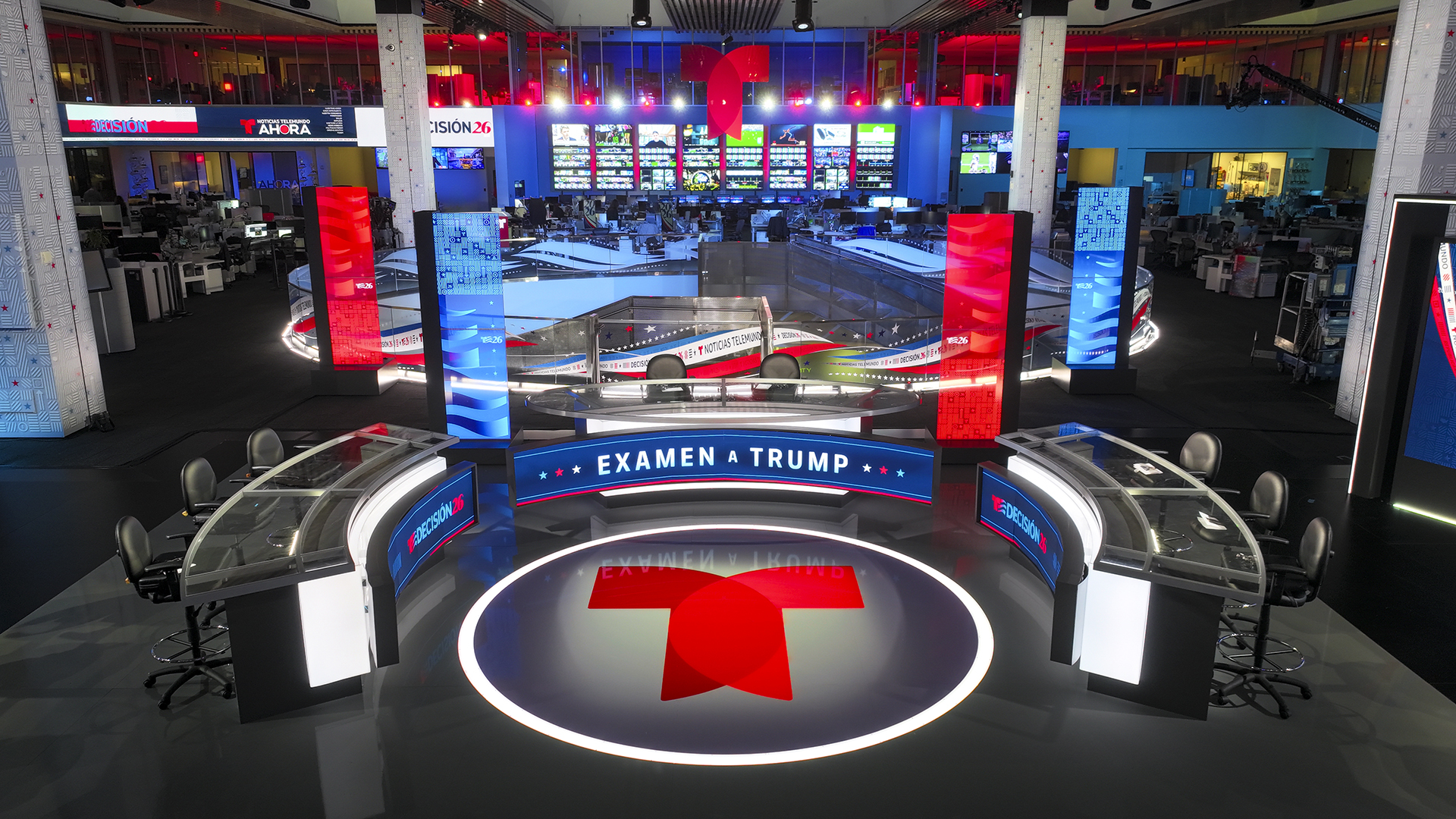
When Telemundo’s anchors and pundits break down the Nov. 3 midterm elections, the graphics will rise from the studio floor around them.
The Spanish-language network will present issue explainers, race results and balance-of-power graphics in augmented reality, replacing physical displays and screens from previous election nights. A large, virtual screen built by Telemundo’s in-house real-time graphics team, will anchor the space in place of a single LED display.
The preparations and upgrades are for an election the network expects its audience to follow closely.
“It’s very important for the Latino community. All eyes are on these elections,” said Raul Gutierrez, director of news studio operations and real-time graphics at Telemundo. “Our viewers are very much in tune with what’s happening.”
Expanding augmented reality usage
Gutierrez noted that going into 2026, the network wanted to rely more on visual explanation of the issues it covers.
“In the past, we talked about statistics, and we talked about the economy and immigration and whatnot. And this year we thought it was important to explain it,” said Gutierrez.
In previous elections, that information appeared as full-screen graphics or was delivered verbally by anchors. This year, Telemundo built augmented reality explainers on six topics, including fuel, the economy, immigration, groceries and affordability.
The graphics, built with Zero Density’s real-time graphics platform and Epic Games’ Unreal Engine 5, will appear along the ring created by the desks in the studio space.
“They go up about a foot off the ground, and then all the graphs explode,” said Gutierrez.
The balance of power, head-to-head races, scorecards, state maps, a U.S. map and a 3D map of contested states will also be presented in AR.
Camera left, an area home to a large LED wall in previous elections, has been rethought as an AR stage.
“Now we have a huge augmented reality area,” said Gutierrez.
Removing the monitor opened the area, and the crew dressed the background behind it to serve as the backdrop for the AR graphics.
Telemundo will also use its atrium for AR graphics, with a 30-foot jib for sweeping shots. Similar to past elections, the atrium will include an animated AR Capitol dome to highlight key governors’ races and control of the House and Senate.
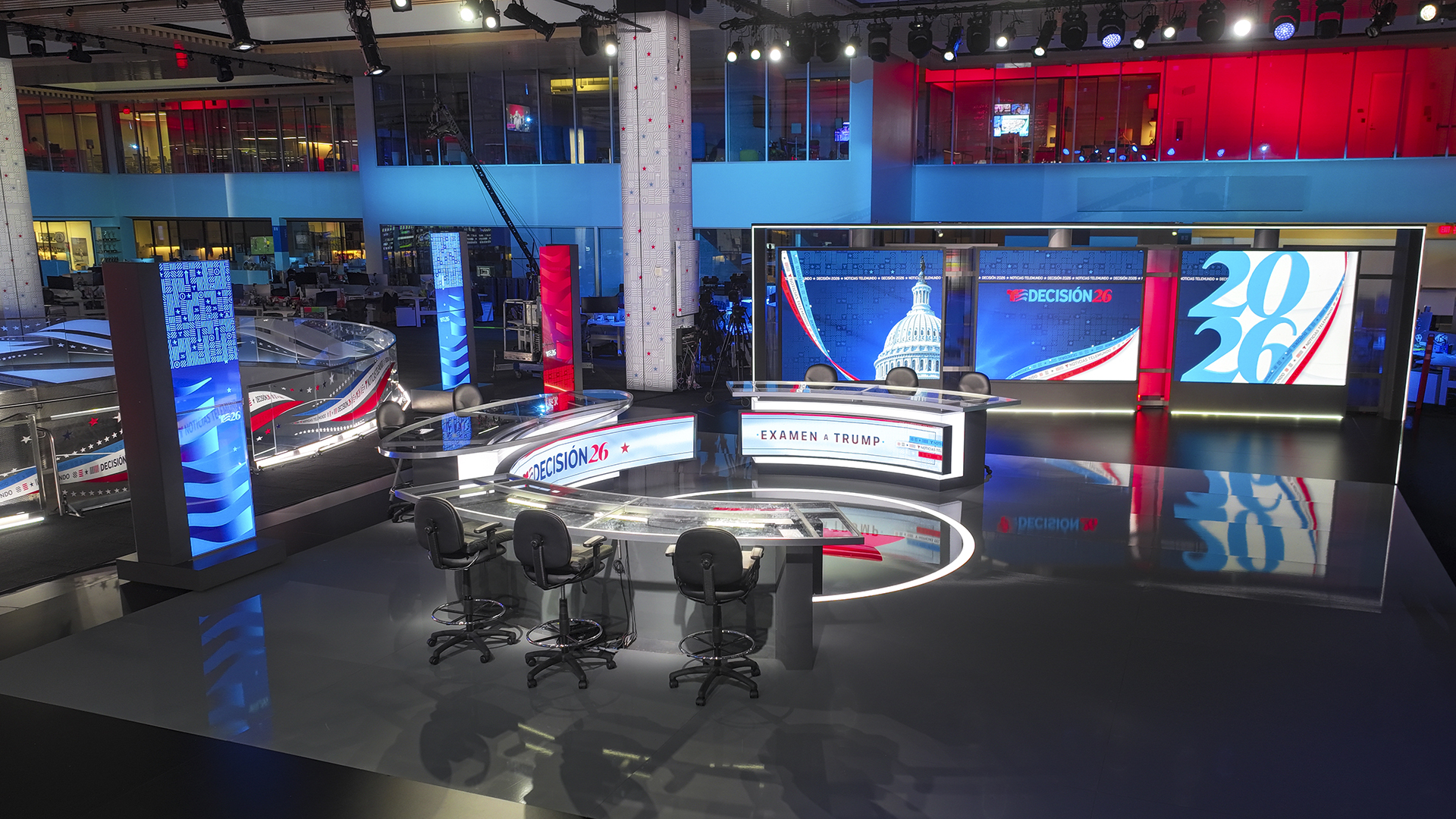
Telemundo’s 2026 election night studio. Images courtesy of Telemundo.
One virtual screen in two positions
Telemundo also replaced its physical results screen with a virtual one. The single virtual screen appears in two places on set, each set up for a different purpose.
“The nice thing is that with one screen, we have it in multiple positions. So there’s a screen for talent and there is a screen for results,” said Gutierrez.
In the talent position, the screen is shot from a reverse angle, a setup the network introduced this year, with the set visible behind it. In the results position, it appears against a different background with no talent in the shot, scaled up to match that background.
The same approach replaced the LED header Telemundo used in 2024. That year, the network wanted a curved header, but the design leaned forward under its own weight.
The crew added about 1,000 pounds of counterweight, which kept the installation just within the load limit of the building’s cantilevered floor. This year’s header is a curved virtual screen that runs from column to column.
“There’s no way you can tell it’s fake. No weight limits and no size limits,” said Gutierrez.
Overall, the use of virtual screens not only added flexibility to the broadcast, but also resulted in cost savings.
“I have a real-time graphics team, which is full-time, so the screens are basically free,” said Gutierrez.
Cameras, tracking and displays
Nine cameras cover the studio, including a jib and a Steadicam on the main set, both using camera tracking from Stype. A separate pre-show area, which will host a three-hour broadcast, uses mechanical tracking from Stype.
Three 4K displays line the back of the set. The center display doubles as a touchscreen, using a PQ Labs infrared touch overlay on top of 4K LED panels. In the atrium, four towers carry animated graphics rather than stills, and a video wall and look-through monitors complete the space.
Because the AR elements, real-time graphics and virtual screens all run through the same production pipeline, producers can deploy any of them as results come in on election night.
“The graphic producer has control over the graphics. We provide the graphics, we provide the interface, and then it’s producer-driven,” said Gutierrez.
That producer-driven workflow, Gutierrez said, is in service of something he returned to throughout the interview: using the technology to tell stories, not just display data. Telemundo already uses AR explainers on its 6:30 p.m. flagship newscast, and he said viewers have responded.
“My feeling from what I’ve gathered and feedback that I’ve seen is that the Latino market enjoys that kind of extra touch, that visual touch, being able to see it and not just hear about it,” said Gutierrez. “There’s something important about an anchor in a physical set with virtual elements, but it’s still presenting in a physical set.”

tags
2026 Election, Epic Games Unreal Engine, November 2026 Midterm Elections, Raul Gutierrez, Stype, telemundo, Unreal Engine, Zero Density
categories
Elections, Heroes, Networks, News Set Design, Set Design