

Watch: Anchor produces and directs her own ‘incredibly stressful’ streaming newscast
Weekly insights on the technology, production and business decisions shaping media and broadcast. Free to access. Independent coverage. Unsubscribe anytime.
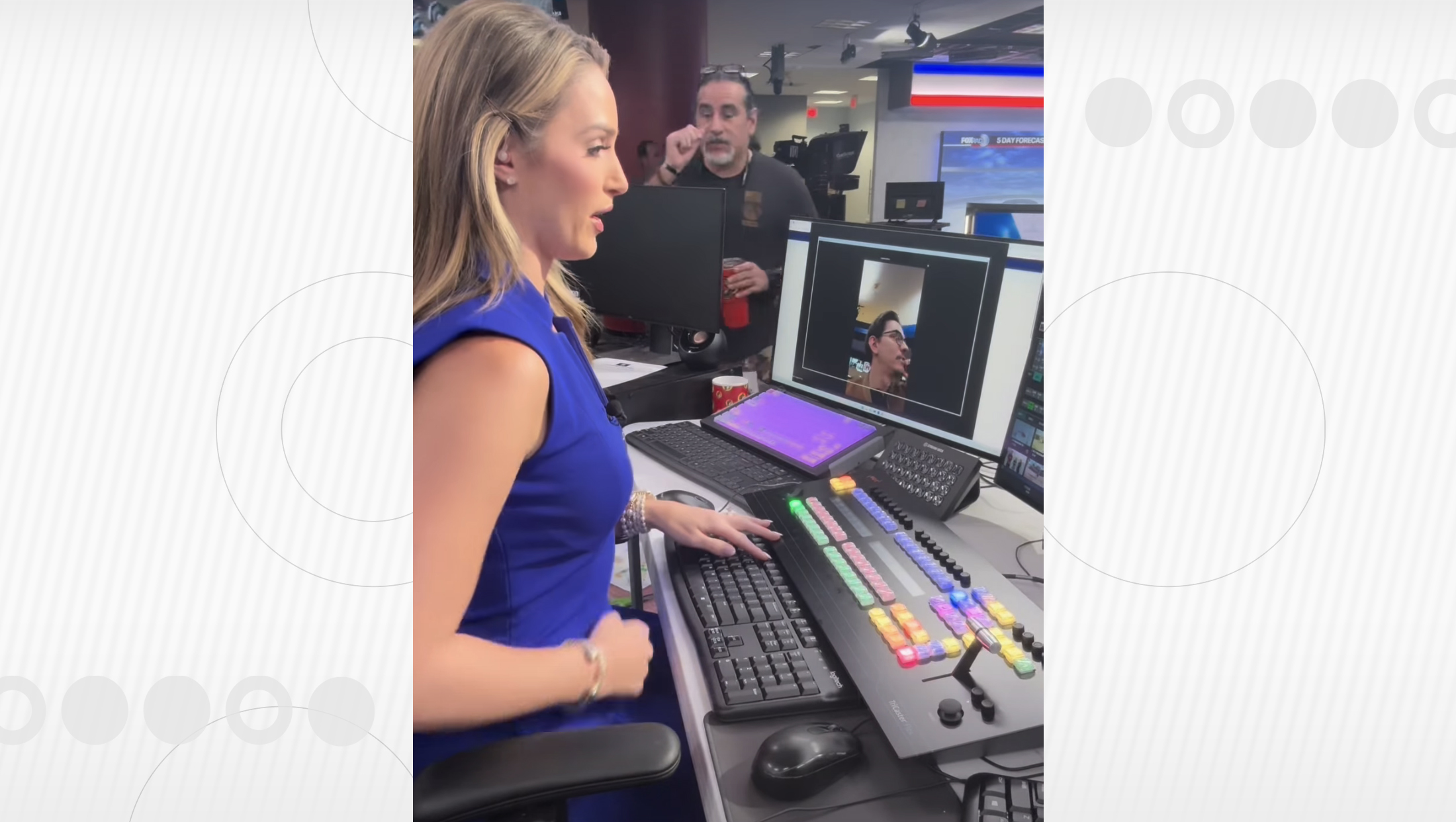
Caroline Collins, a reporter and anchor at KRIV, has gone viral thanks to a series of reels showcasing a behind-the-scenes look at how she anchors and directs streaming newscasts for the Fox-owned station in Houston, Texas.
Collins first posted a clip showing her learning the ropes of the new setup her station installed in the newsroom.
Billed as a “new set,” the station has created a desk-like area that means anchors are not only facing a camera, but also an array of computer screens and control panels that allow them to control various aspects of the newscast — including punching cameras, graphics, audio and switching between video sources.
Collins posted her first video of the setup Sept. 16, 2026.
Collins later clarified by noting that the station still produces its 10 p.m. newscast from a traditional studio where the anchor isn’t also handling the full slate of technical duties.
Right now, the newscasts she’s anchoring and directing herself are for the station’s streaming offering, but she noted that the setup will also start appearing on the network’s linear channel in late mornings and early afternoons, though an exact date wasn’t specified.

Anchors face a single locked down PTZ camera that frames them in a head-and-shoulders shot. Based on the setup, it’s likely that framing talent any wider could some of the computer monitors and other equipment to show up in shot.
Collins has called the process “incredibly stressful.”
During some of her postings, she is shown tossing to a weather segment that, while it appears she is still responsible for switching to the forecast segment, relies less on her since the station’s weather computer system is likely designed to run through the forecasters’ pre-stacked selection of graphics.
During some clips, there are “support” team members were on hand to help Collins out — but they seemed mainly focused on helping her learn the system as opposed to actively punching the show.
In at least one of the clips, there is what appears to be a live feed from a handheld device or smart phone on one monitor in a sort of preview state. On it, the camera’s view jumbles around, showing blurred views of the floor and other elements nearby whoever’s holding the device.
While it’s not clear if that was a live shot being handled completely by a single person, many stations have been sending journalists into the field alone where they are also expected to lock down a camera and handle their own live hits.
The pandemic-era use of video conferencing and mobile devices showed many stations that even consumer-grade devices are more than adequate to produce live shots and other video reports.
The use of technology to reduce the number of staffers needed to produce a newscast is hardly new to the broadcast journalism world.

The increasing use of automation systems has reduced the headcount in many control rooms across the country to as little as one person. Software can now handle many of the duties that were once performed by multiple, separate people: switching, audio, graphics and more.
In many cases, this automation is made possible by having other staffers, such as producers, increase the amount of information they input into the station’s computer systems — including determining what camera will be used and locating and linking graphics and video footage to each segment.
Many stations also have small setups that can be used by one or two people to produce a broadcast — but these had been reserved for breaking news and weather situations and typically were only used to create brief updates.
Along with Collins, another KRIV anchor, Rashi Vats, has also been documenting her journey learning the ropes of the new system.

For television station owners, increasingly sophisticated broadcast automation offers an obvious financial incentive.
The trade-off is that automation does not simply replace buttons being pushed.
It can also remove experienced people who once served as additional sets of eyes and ears during a live broadcast.
Directors and other control room employees routinely identify mistakes, question inconsistencies and adjust when breaking news changes a rundown seconds before airtime.
Automated systems can execute a programmed sequence efficiently, but they cannot always replicate the judgment of an experienced production team when something unexpected happens.
There also can be editorial consequences when newsrooms operate with fewer employees.
Although directors traditionally work on the production side, their role often intersects with editorial decision-making, particularly during breaking news and other rapidly changing coverage.
A director might recognize that a reporter is ready to go live, notice that an important visual is available or recommend staying with a developing scene rather than moving to the next scheduled story.
Removing those voices can leave fewer people participating in the decisions that ultimately shape what viewers see.
Automation itself does not necessarily result in a lower-quality newscast.
Stations can use technology to streamline repetitive tasks while continuing to invest in journalists, producers and experienced production employees. However, the concern comes when automation becomes primarily a vehicle for reducing headcount and the industrywide trend has been less about reallocating technical human resources to editorial operations and more about reducing payroll.
A newscast may still make air with fewer people behind it, but there is less redundancy when something goes wrong and potentially less human judgment influencing how the news is presented.

tags
Caroline Collins, PTZ camera
categories
Broadcast Automation, Broadcast Industry News, Local News