

Have the networks broken the term ‘breaking news’ as CNN exec looks to scale back its use?
Weekly insights on the technology, production and business decisions shaping media and broadcast. Free to access. Independent coverage. Unsubscribe anytime.
Going back to the early days of TV broadcasting, it wasn’t always technically possible to break into the network feed within just a few moments’ notice — cameras and lighting often needed to be, quite literally, warmed up, meaning no one could appear on screen in the event of breaking news for 15 or more minutes at a minimum. Some big stories at the time were initially delivered with audio only for this reason — and often stories had to be “big enough” to warrant the comparatively complex task of breaking into programming to justify even being produced.
Many of these early special reports were labeled as “bulletins” — a term derived from teletype and wire services — a label that could both emphasize much broader breaking news.
The networks continued using the term “bulletin” into the end of the late 20th century, though more sporadically, with the term “special report” or “breaking news” coming more into favor.

NBC briefly came under fire in the 1990s for starting to use the “bulletin” branding more often than its counterparts and for stories that some did not feel warranted that label.
In 2008, NBC also found itself in hot water when it broke in with a special report announcing the death of then-“Meet the Press” moderator Tim Russert. After the fact, even some within NBC admitted that, with all due respect to Russert, taking network air was a bit much.
Back in the early days of TV, some networks would maintain a so-called “hot” or “flash” studio, which was an often pared-down version of the main one, that was left powered on, or at least partially so, 24 hours a day, 7 days a week, as a workaround to these technical limitations.
As technology improved, at least some networks began doubling their main news studio, typically the one used for the signature evening newscast, as the hot studio, often leaving it in a state of at least somewhat-readiness all the time.

Some networks and stations still maintain hot studios or an alternative known as a flashcam, to make it easier to produce breaking news reports. These facilities are often a single camera with a simple background that’s easy to activate — positioning it in a newsroom or near the assignment desk are also common to make them easier to access by talent and put them closer to the newsgathering operation itself.
It’s also not uncommon at the local TV level for there to be news and weather flashcam setups that don’t even require the assistance of a production control room to broadcast an update — whether it be over the air or for digital platforms.
These often include a small console placed within easy reach of where the talent stands that allows them to, once master control switches over to the right feed, toggle from, for example, showing a live fixed or robotic camera in front of them to, for example, a graphics system or relevant feeds such as cameras mounted on local landmarks to show realtime weather conditions.
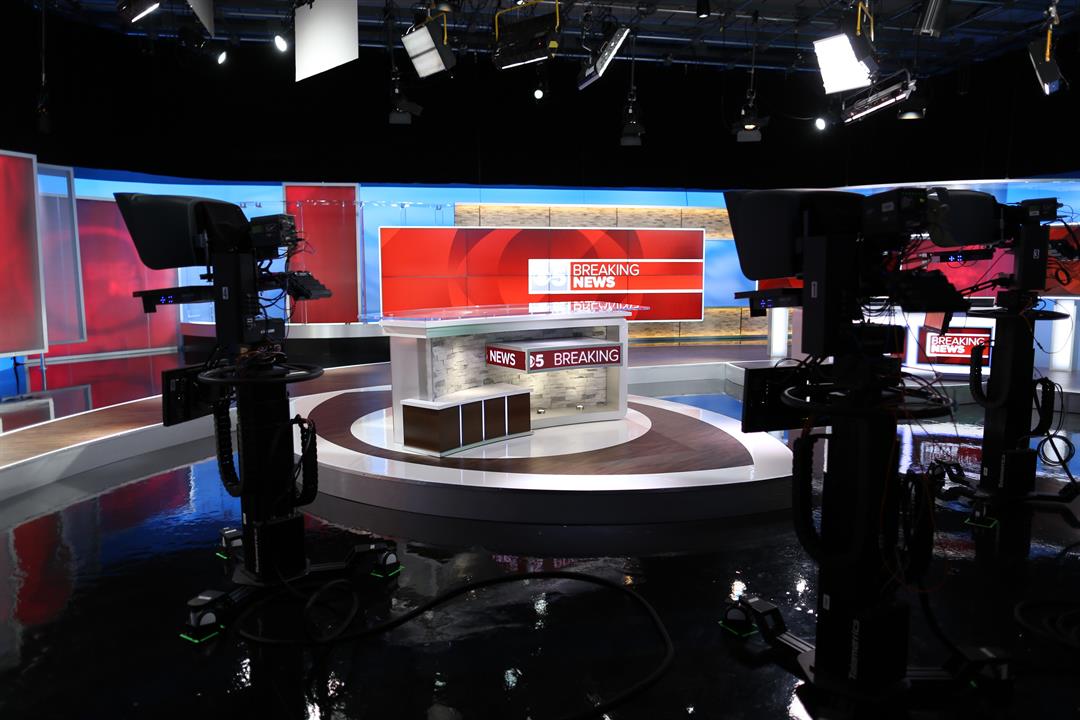
Meanwhile, the overwhelming popularity of using LED video walls on news sets has led to an interesting twist in producing breaking news reports.
Most commercial-grade LED panels used at local stations all the way up to the networks are engineered to remain powered on 24 hours a day, even if the array is just showing “nothing” — giving it the appearance of being black (technically LED can’t produce true black, though, since it’s created by simply extinguishing the red, green and blue nodes of the diode).
However, this does mean that whatever is feeding the video wall can almost instantly take over and start feeding an image, including a breaking news or special report background, often only requiring a few seconds to adjust to the correct intensity and color temperature needed for broadcasting.
The predecessor to the LED video wall, rear projection screens, often required some time for the bulbs to warm up, so it wasn’t uncommon for sets equipped with these types of screens to leave the RPs powered on all the time — which could ring up a hefty bulb bill.
During the height of the coronavirus pandemic, many networks had mini-studios set up in the homes of their primary anchors typically with a large LED panel behind the setup, often with the ability to control the camera, lighting, audio and video screen remotely and special reports were produced this way many times.
According to sources, ABC News had been toying with the idea of switching over to labeling unplanned special reports “breaking news,” and reserving the term “special report” for pre-planned major news events such as presidential addresses. That plan, however, apparently never came fully to fruition, although the network does often use the “breaking news” phrase in the lower left of the screen during special reports.

The famous (or infamous) ‘alert’ graphic from Fox, accompanied by a trademark ‘gong’ sound effect, used by the right leaning Fox cable channel.
Ultimately, the now common overuse of the “breaking news” and similar phrasing can be at least partially blamed on TV executives — some of whom may not even work in the news division. Some station owners, for example, have come under repeated criticism for weather “alert” days that are reportedly determined by corporate executives and not meteorologists or forecasters at the local station who are more likely to have hands-on knowledge of on-the-ground conditions.
Networks and stations are notorious for watching each other closely — so what one does with success, others are likely to follow suit.


tags
rear projection screen
categories
Branding, Cable News, Featured, Network Special Reports, Networks