

Broadcasters urge FCC to halt migration of sports behind streaming paywalls

Weekly insights on the technology, production and business decisions shaping media and broadcast. Free to access. Independent coverage. Unsubscribe anytime.
Filings submitted in the FCC’s sports broadcasting docket pressed the agency to use its regulatory authority to keep live sports on free over-the-air television, while one of the most prominent college athletic conferences argued the current system is working as intended.
The reply comments, filed in MB Docket No. 26-45, came from a number of broadcast and policy entities, including the National Association of Broadcasters, the E.W. Scripps Company, Cox Media Group, the Southeastern Conference and a joint filing from the affiliate associations representing more than 700 local stations affiliated with ABC, CBS, Fox and NBC.
The FCC’s Media Bureau opened the proceeding in February with a public notice seeking input on sports broadcasting practices and marketplace developments.

Broadcasters present a united front
The NAB set the tone for the reply round, arguing that the record in the proceeding left no room for debate about where live sports should be distributed.
“Taking the record as a whole, there isn’t any credible argument as to why broadcast television shouldn’t remain the lifeblood of the live sports ecosystem,” NAB wrote in its filing.
The trade association, which represents free local radio and television stations and broadcast networks, pointed to what it described as thousands of comments from viewers, local officials, labor organizations and nonprofit groups supporting the continued availability of live sports on broadcast television. More than 8,600 individual comments had been filed in the docket as of mid-April according to the FCC website.
NAB cited viewership data from Fox Corporation’s earlier comments showing that the World Baseball Classic matchup between the United States and Venezuela drew 10.78 million viewers and that Friday night college basketball games on broadcast attracted nearly 50 percent more viewers than NBA games on streaming platforms.
The association reserved its sharpest language for the Consumer Technology Association, which had argued in initial comments that streaming platforms give fans more access and choice. NAB called CTA’s position “totally unserious” and accused the trade group of caring more about selling devices than about consumer access to sports.

“While CTA professes to promote a ‘consumer-first’ mindset, in reality, it only cares about pushing more devices on consumers — even if consumers end up paying thousands of dollars for multiple paywalled pureplay streaming services that make their live sports content harder to find,” NAB wrote.
NAB also took aim at the International Center for Law and Economics, which had argued in initial comments that local news is not dependent on broadcasting. NAB called that assertion “downright foolish,” noting that blogs, newsletters and social media accounts do not employ professional reporters with connections to local communities.
Consumer costs and the digital divide
The cost of accessing live sports across multiple streaming platforms was a recurring theme across the filings.
NAB noted that, by some estimates, it can cost $1,500 annually to subscribe to every service that carries NFL games. The affiliate associations’ filing cited the same figure.
Cox Media Group included a chart listing major professional sports events and college conferences that have become streaming-exclusive or streaming-first, including NFL “Thursday Night Football” on Amazon Prime Video, NBA weekly national games split between Amazon and Peacock, MLS on Apple TV+ and Formula 1’s U.S. rights on Apple.
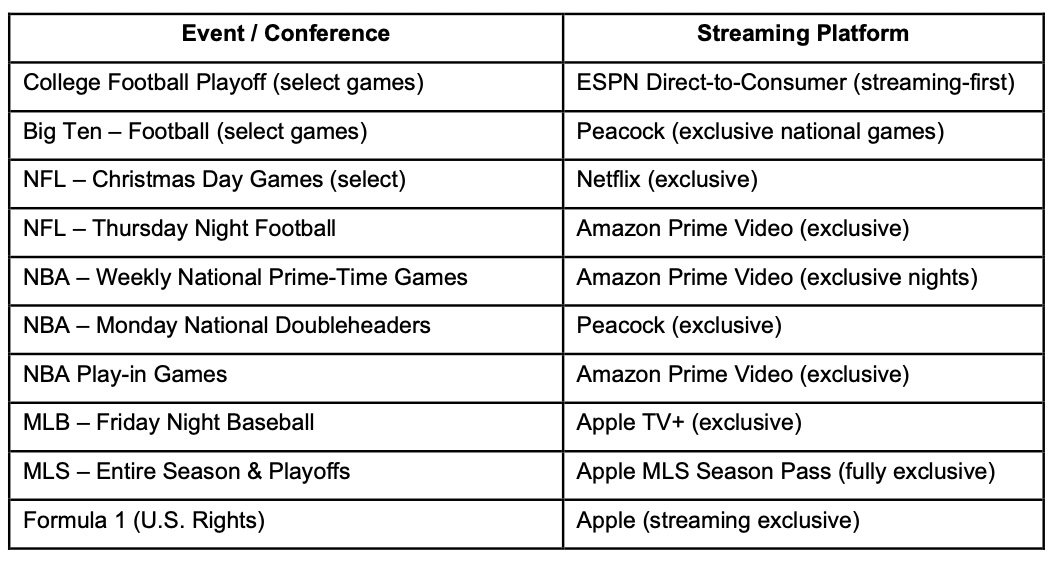
“The financial costs for fans to keep up are staggering,” Cox wrote.
Several filings raised the issue of unequal access. NAB cited U.S. Census Bureau data from the 2024 American Community Survey showing that 19.3 percent of Americans with incomes below $20,000 lack an internet subscription. Cox argued that lower-income, elderly and rural households are the most affected when sports move away from broadcast distribution.
“For these audiences, fragmentation is more than inconvenience. It is exclusion,” Cox wrote.
The local news connection
Each of the broadcast-aligned filings drew a direct line between sports programming revenue and local news operations. NAB cited data from Sinclair’s initial comments showing that advertisers spend approximately $17.7 billion on national linear television sports programming and that the NFL generates $6.7 billion in annual advertising across the major broadcast networks.

“If the NFL were to stop distributing games on local broadcast, the entire local broadcast industry in its current form likely would collapse, taking with it not only local news coverage but local amateur sports coverage, such as college and high sports reporting,” NAB wrote, quoting from the Sports Fan Coalition and Public Knowledge’s comments.
Scripps described its own experience as a case study. The company, which owns and operates more than 60 television stations in more than 40 markets, said the revenues from its sports programming are reinvested in local news and other public interest content.

“Scripps’ experience shows that sports programming is an essential component of local, community-focused programming — there are few things like sports that can bring communities together,” Scripps wrote.
Cox Media Group broadened the argument beyond economics. The company framed the fragmentation of sports distribution as a threat to shared civic life and democratic participation, noting that sports broadcasts serve as a venue for political advertising that reaches broad and diverse audiences.
“As sports become increasingly fragmented or paywalled, the most ubiquitously experienced channels for political persuasion are weakened as well,” Cox wrote.
The company argued that the shift is not driven by consumer demand but by market structures that steer content toward network-owned and technology company platforms.
Ted Leonsis, the majority owner of the Washington Capitals, Mystics and Wizards, was cited in the Cox filing as having stated that the success of sports must be “anchored in strong local foundations.”
Affiliates want preemption rights and SBA clarity
The joint filing from the four affiliate associations — representing ABC, CBS, Fox and NBC affiliates — focused on specific regulatory actions. The associations asked the FCC to confirm that local stations have the right to preempt network programming in favor of local and regional sports content without risking damage to their network relationships.
They also called on the commission to require virtual multichannel video programming distributors, commonly known as vMVPDs, to negotiate retransmission consent directly with local stations rather than through the networks. The associations argued that the current system, under which networks negotiate on behalf of affiliates, leaves multicast channels and independent stations — often the home of local sports — without vMVPD carriage.
On the Sports Broadcasting Act, the affiliates went further than other filers.
They urged the FCC to declare that the SBA’s antitrust exemption applies only to agreements that result in free over-the-air distribution, not to streaming deals. They also called on the commission to use Section 303(i) of the Communications Act to require networks to distribute all games obtained under the SBA exclusively through local affiliates.
“Networks should not be permitted to compete with their affiliates for distribution of marquee sporting events that affiliates help pay for,” the associations wrote.
SEC defends decentralized college sports rights model
The Southeastern Conference filed one of the more distinct replies in the proceeding, responding to proposals that would amend the Sports Broadcasting Act to create a centralized entity for pooling college sports media rights.
Greg Sankey, commissioner of the Southeastern Conference, signed the filing, which argued that the current conference-based model has produced revenue growth comparable to major professional leagues without federal intervention. The SEC reported distributing more than $1.03 billion to its member institutions in the 2024-25 fiscal year. The Big Ten’s seven-year agreement with Fox, CBS and NBC was cited as generating approximately $1.14 billion annually.
The SEC argued that centralized pooling would reduce output, particularly for women’s and Olympic sports, which have expanded under the current system. The filing cited Nielsen data showing that women’s sports accounted for 46 billion minutes of viewership in 2025.
“Every historical attempt to centralize college sports media rights — the pre-1984 NCAA model, the College Football Association — generated far less revenue than the conference-based model that replaced it,” the SEC wrote.
The conference’s position put it at odds with the broadcast industry’s general call for more content on free over-the-air platforms. While the SEC acknowledged the value of broadcast television for reach, it defended the hybrid distribution model that includes cable networks, conference-branded networks and streaming platforms as the means by which thousands of college sports events now reach audiences.
What comes next
The filings reflect a proceeding in which the broadcast industry is broadly aligned on diagnosis, that the migration of sports behind paywalls harms consumers, local news and the public interest, but where the specific regulatory remedies vary in scope and ambition.
NAB and several other filers called for modernizing broadcast ownership rules, accelerating the ATSC 3.0 transition and reexamining the Sports Broadcasting Act. The affiliate associations pressed for specific actions on network-affiliate relations. The SEC asked the commission and Congress to leave the college sports market alone.
The FCC has not indicated a timeline for further action on the docket.

tags
ABC Television Affiliations Association, CBS Television Network Affiliates Association, Consumer Technology Association, Cox Media Group, E.W. Scripps, E.W. Scripps Company, FCC, Fox Television Affiliations Association, Media Rights, NAB, NBC Television Affiliates, scripps, Scripps Broadcasting, Scripps Sports, sec, southeastern conference
categories
Broadcast Business News, Heroes, Policy, Sports Broadcasting & Production