

TVNZ’s chief digital officer on measurement, monetization and why the algorithm doesn’t optimize for truth

Weekly insights on the technology, production and business decisions shaping media and broadcast. Free to access. Independent coverage. Unsubscribe anytime.
For most of its history, Television New Zealand has not needed to think about subscribers.
As a government-owned broadcaster funded entirely by advertising revenue – one that pays the New Zealand government a dividend rather than receiving public funding – TVNZ’s digital business has been built around a simple metric: how much is a stream worth in ad revenue, measured in cents.
That model is running out of room.
“There is absolutely not enough advertising revenue left to fund a broadcaster properly in a small market like New Zealand,” said Rob Hutchinson, chief digital officer at TVNZ, speaking with NCS at the NAB Show. “Digital ad revenue is traveling towards global entities, US-based. They are hoovering up all the share, including from television.”
TVNZ’s response is a shift in how it thinks about its digital audience.
For the first time in its history, the broadcaster is launching paid products – beginning with pay-per-view passes for the FIFA World Cup and UFC events – and with them, an entirely different set of business questions. Not how many streams did we serve and what did each one earn, but how do we convert a viewer into a customer, retain them, and build a relationship worth more than a few cents per session.
“Suddenly we’re interested in customers, not audiences,” Hutchinson said. “And it’s a really radical change.”
The economics of the pivot
The logic is straightforward, even if the execution is not. TVNZ’s digital audience is growing while its linear broadcast audience declines.

Digital streams have historically generated lower revenue per user than linear television, where more ad inventory and co-viewing mean each impression reaches more people. Add a pay layer, and the calculation changes.
“You add pay, and suddenly the digital audience on average is actually more valuable than the linear audience,” Hutchinson said. “And our digital audience is growing and our broadcast linear audience is in decline. So we’re going to attach ourselves to the growth product and increase the value of every single one of those customers.”
The structural shift in how TVNZ thinks about its audience is already visible in how it segments users. The broadcaster tracks royals — its most engaged viewers — alongside dormant users and those who have churned after 12 months of inactivity. Previously that segmentation existed to bring people back to watch ads. Now it is the foundation of a funnel designed to convert the right viewers into paying customers at the right moment.
He used a specific example that illustrates how dramatically the thinking has changed. Young men who come to TVNZ’s platform once a week to watch UFC for free represent some of the lowest revenue-per-user figures in the business. Under a pay model, those same viewers become the highest-value customer segment — the ones most likely to buy a pay-per-view pass on fight night. The challenge is converting them consistently rather than occasionally.
Building the platform to support it
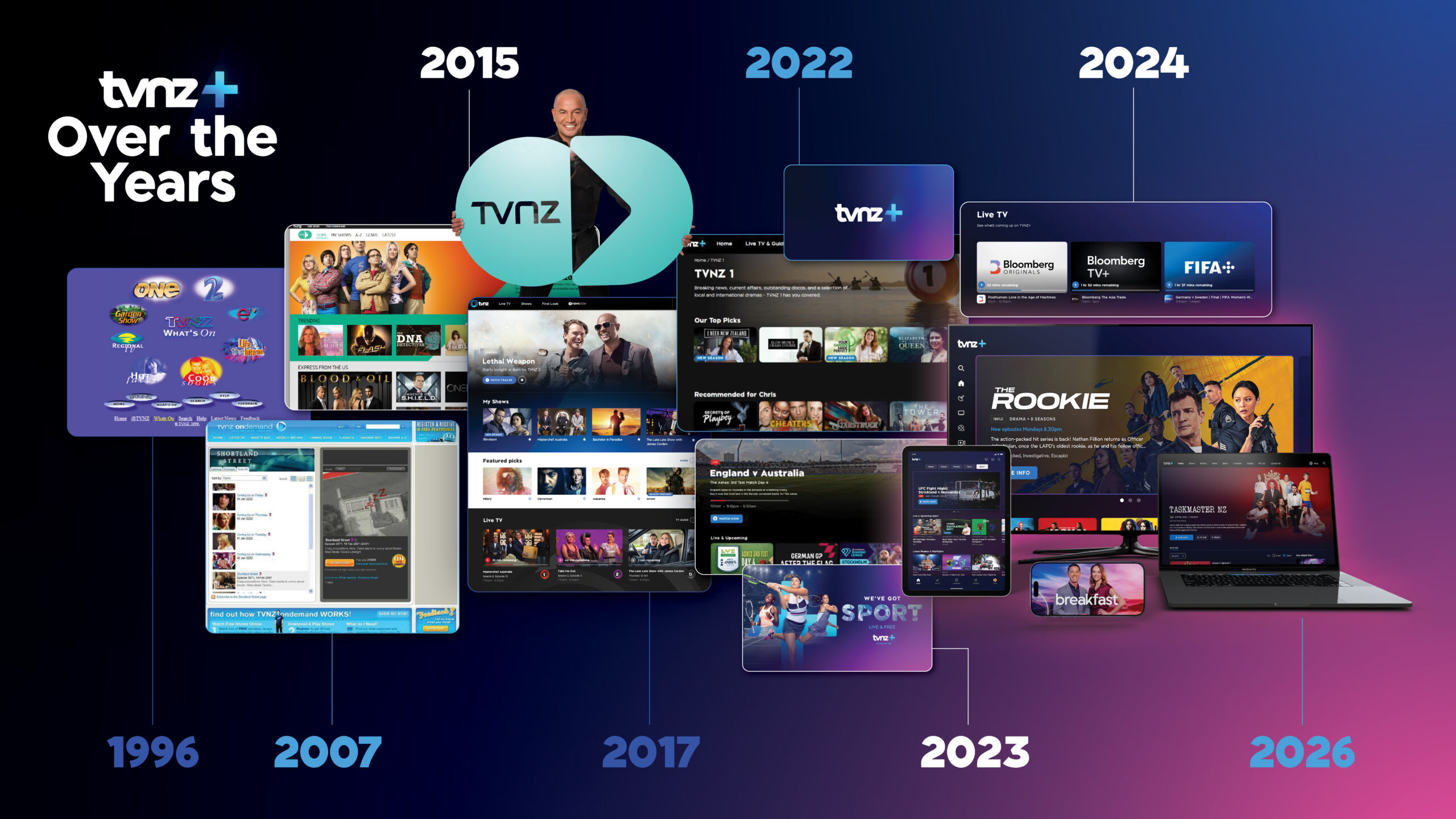
To support the transformation, TVNZ partnered with Quickplay to rebuild its streaming platform from the ground up.
The project, completed in 12 months, replaced a fragmented stack of six or more vendors across content management, video processing, advertising and analytics with a single unified platform built on AWS. The consolidation reduced complexity and cost while creating the technical foundation for capabilities TVNZ could not have built on its previous infrastructure.
Hutchinson described three areas where TVNZ plans to innovate on the new platform.
The first is personalization – not relying exclusively on Quickplay’s built-in tools, but leveraging the platform’s flexibility to test recommendation algorithms from multiple partners and measure which ones actually drive results. The second is a vertical video and short-form product for mobile, designed to give younger audiences a swipeable, algorithmically driven entry point into TVNZ’s content without requiring them to navigate a traditional streaming interface.
“In a dream environment we would roll a short product out, but we wouldn’t just have promos in there,” he said. “We would put our news in there, being processed through automated systems, our sports highlights, microdramas, everything we can that gives a younger audience a really rich impression of what we have to offer.”
The third area is operational automation, using AI tools embedded in the content supply chain to prepare and process content for digital delivery with less manual intervention.
Solving the co-viewing problem
But streaming revenue relies on proper measurement, which TVNZ is working to solve from a new direction.

More than 70% of TVNZ’s streaming viewing happens on connected televisions, where multiple people typically watch together. Digital advertising, however, is measured as a single impression to a single logged-in user. The result is that a household of three people watching a drama together generates the same ad revenue as one person watching alone – even though three people saw every ad.
TVNZ’s co-viewing model uses a probabilistic approach built on an active survey of users to predict who is watching the moment a stream starts, then passes those predictions into the ad stack in real time. Advertisers can target and report on co-viewers as distinct impressions, not just the logged-in account holder.
“Different ads will actually be targeted to each of us, but the value that all three of us saw that ad is measurable,” Hutchinson said. “Suddenly we’re not all the way, but we’re on the way to measuring streaming like television is measured.”
The practical results have been immediate.
Hard-to-reach audiences, such as younger males in particular, are surfacing in TVNZ’s data in ways they had not before. The broadcaster discovered significant male viewership of “Love Island,” a show whose logged-in profile audience is almost entirely female, once co-viewers were made visible in the data. Several advertisers have already increased their spend on the platform in response.
TVNZ has also launched segments built specifically around co-viewing patterns, including what Hutchinson described as a segment called “mums watching with sons,” combining female viewers aged 55 and over with male viewers aged 18 to 24.
“You can tell who would find that interesting,” he said.
Trust, authenticity and what the algorithm will never optimize for
Hutchinson closed the conversation in territory that goes beyond TVNZ’s specific business — the question of whether trusted journalism has a measurable commercial value in a media environment where the algorithm optimizes for engagement rather than accuracy.
TVNZ tracks trust in news through a regular survey, and Hutchinson said the score has been declining for years before recently beginning to reverse. He attributed the shift in part to a growing awareness among audiences that algorithm-driven feeds tell people what they want to hear rather than what is happening, a realization that becomes visible when real events, like a significant natural disaster, produce footage that looks less believable than AI-generated alternatives.
“The cynical me would say there’s a product manager with an OKR (Objectives and Key Results) around engagement, and truth is not engaging,” he said. “People are suddenly realizing — those newsrooms full of hardened, grizzled reporters who, when they hear someone talk, go, ‘How true is that?’ We need more of that.”

He described a recent landslip in New Zealand that buried a holiday park. TVNZ crews were on the ground and captured footage of an entire forest moving down a mountain. AI-generated versions of the event circulated online. The real footage was so extreme that audiences initially questioned whether it was authentic.
“To believe that the true event was not believable,” he said. “That’s where we are.”
For TVNZ, authenticating its own content, building systems that allow viewers to verify that footage was captured by a TVNZ camera crew, is both a journalism commitment and, increasingly, a competitive differentiator. In a market flooded with generated content, verified footage from a trusted local newsroom may be one of the few things a national broadcaster can offer that no algorithm can replicate.
“No one else has a video newsroom like us,” Hutchinson said. “Our ability to have throughput about New Zealand, with our accent – that can’t really be competed with.”

tags
Amazon Web Services, AWS, Quickplay, Television New Zealand, Vertical video
categories
Heroes, Streaming