

Why the spaces between systems are broadcasting’s hardest problem
Weekly insights on the technology, production and business decisions shaping media and broadcast. Free to access. Independent coverage. Unsubscribe anytime.
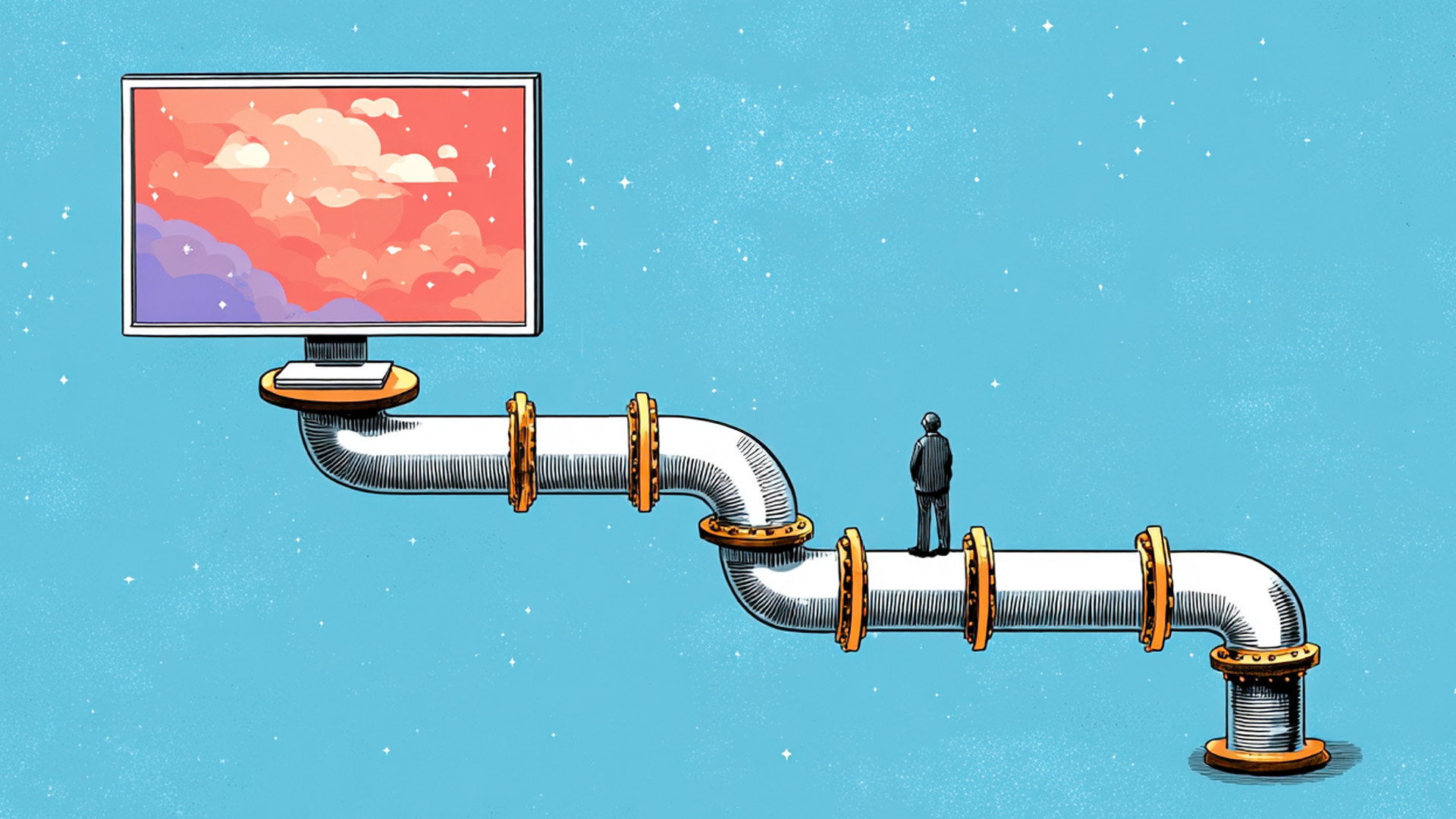
The bottlenecks most often described in broadcast operations are not located inside any single system. They sit between systems, at the points where content moves from one team’s responsibility to another’s.
Production into post-production. Post into distribution. Each transition introduces a moment when the people accountable for quality change, and the information that should travel with the content does not always make the trip.
“The bottlenecks we hear about most often sit at handoff points, where content moves from production into post, or from post into distribution, and where responsibility for quality shifts between teams. These gaps create blind spots: problems that originate upstream aren’t caught until they’re downstream and difficult and expensive to fix,” said Thomas Carlisle, senior solutions architect at TAG Video Systems.

The framing locates the operational risk not in any specific tool but in the seams between tools. The seam is where a producer signs off on a deliverable and an editor inherits it. It is where an editor signs off and a QC operator picks it up. It is where a QC pass clears a file and a distribution system ingests it.
At each of those points, something has to be trusted that was not done by the receiving team. When problems do surface downstream, the cost of resolving them is higher than it would have been at the source.
The most visible casualty of the handoff is metadata.
Language tags, audio descriptors, timecode references, rights information and editorial context all live in the data that travels alongside a file. When that data is generated in one system and read by another, the integrity of the transfer is rarely verified at the seam itself.
“Metadata integrity is a QC problem as much as a data management problem. Errors or gaps introduced early in a pipeline, like wrong language tags or missing audio descriptors, compound as content moves downstream. Automated QC at multiple pipeline stages is the most reliable way to catch metadata drift before it affects delivery,” said Carlisle.

The drift is rarely the result of a single failure. It is the cumulative effect of small inconsistencies that survive each handoff until they reach a point where they matter operationally.
Álvaro Montalbán, chief sales officer at Knox Media Hub, described the same pattern from the asset management side.
“The metadata journey is often quite erratic and many organizations struggle to have a proper organization, especially when automatic generated metadata comes into play. In order to make the most of the different metadata sources and maximize the quality of the metadata preserved and distributed, organizations need to have clear guidelines on metadata structure within their organization,” said Montalbán.
The argument is that metadata governance has to be defined at the workflow level, not at the level of individual systems. Otherwise, each system makes its own assumptions about what to preserve, and the handoff between them becomes the point where those assumptions diverge.
The cascade problem
The handoff was a manageable risk when each downstream stage involved human review. A producer or QC operator could catch upstream errors before they propagated.
Automated pipelines change the math.
When a file leaves an upstream stage and feeds an automated downstream system that distributes content across broadcast, streaming, social and syndication endpoints simultaneously, a single error at the seam stops being a contained problem.
“The margin for error has simultaneously shrunk — because when a single automated pipeline feeds broadcast, streaming, social, and syndication simultaneously, a bad file or a broken rule doesn’t create one problem, it creates a cascade across every delivery point at once,” said Rich Zabel, VP of media supply chain at Diversified.
The cascade is the operational consequence of automation without verification at the seams. A workflow that runs cleanly when each stage works correctly fails dramatically when a handoff introduces an error that no downstream system is configured to catch.
The standard response is to add automated checks at each transition. Those checks only work when the workflow has been designed with the handoff in mind.
Making workflows continuous
Several respondents described the same direction of travel: workflows are being designed to remove handoffs rather than to manage them.
“What’s changing is the expectation that workflows should be continuous, not segmented. Editorial, asset management, storage, and delivery should be aware of each other and operating in real time,” said Guillaume Aubuchon, VP of product management at Avid.

The word “continuous” is doing specific work in that framing. A continuous workflow does not eliminate the technical boundaries between systems. It changes the expectation that those boundaries are also organizational ones.
In a segmented workflow, each team owns its stage and the responsibility for what happens between stages is implicit. In a continuous workflow, the orchestration layer owns the transitions and the responsibility is explicit.
Bob Caniglia, director of sales operations, Americas at Blackmagic Design, described the same shift in terms of how teams are connected.
“The emphasis is no longer just on moving files, but on maintaining a continuous flow of information through teams that are often spread across multiple cities or even countries. Ultimately, the industry has been shifting toward a model where production, post and distribution are no longer viewed as separate stages, but part of a unified media ecosystem,” said Caniglia.
The unified ecosystem framing relocates the seam from a point of transition to a feature of design. The handoff still happens, but it is monitored, validated and recoverable rather than implicit and trusted.
A single source of truth
The mechanism most respondents pointed to for managing seams is a unified view across them.
Without one, governance becomes manual reconciliation. With one, the seam becomes observable.
“Consistency requires a single source of truth about what’s happening across your ecosystem. When organizations rely on siloed monitoring tools for each platform, governance becomes a manual reconciliation exercise. A unified monitoring fabric, one that ingests telemetry from every system and presents it coherently, is increasingly how teams maintain operational governance at scale,” said Carlisle.
The fragmentation argument is reinforced by data structure as much as monitoring.
“The challenge today isn’t a lack of data, it’s that the data is fragmented across too many systems to be easily actionable. Organizations are moving toward unified visibility models that consolidate operational signals into a ‘single pane of glass,'” said Brett Beers, chief architect and innovation at TMT Insights.
The third element, beyond monitoring and data structure, is shared vocabulary. Santiago Miralles, founder and CEO of Knox Media Hub, described it as one of the three operational requirements for workflows that span multiple vendors.
“We see that organizations are leveraging three primary levels of convenience. One: advanced API capabilities to interconnect systems. Two: partnership between vendors to provide advanced jointly built features. Three: a common ground for taxonomy of data,” said Miralles.
The taxonomy point is the one that bears most directly on handoffs. Two systems can be technically connected and still produce conflicting results if they do not agree on what the data they exchange actually means.

Design, not tooling
The shift that several respondents described is less about adopting new tools than about designing workflows differently.
“Consistency starts with strategy. Standardizing how data is defined, validated, and carried through the workflow, rather than relying on individual systems to enforce governance is the most effective way organizations can maintain control even as processes span multiple platforms and partners,” said Beers.
The framing shifts responsibility for the seam from the systems on either side of it to the strategy that defines what passes through it. A handoff governed by a defined data model and a verifiable contract behaves differently from one governed by the conventions of each adjacent system.
For broadcasters that have grown by stacking new capabilities on top of existing workflows, the design-first approach is the harder part of the transition.
The technology to bridge two systems is generally available. The discipline to define what the bridge has to carry, and how its delivery is verified, is less consistently in place.
The handoff is not going away.
Production will continue to feed post. Post will continue to feed distribution. The change underway is in how the seam between them is treated: not as the point where one team’s problem becomes another’s, but as the most consequential observation point in the workflow.
The bottleneck has not moved. It has become measurable.

tags
Álvaro Montalbán, Blackmagic Design, Bob Caniglia, Brett Beers, Knox Media Hub, Media Asset Management, Metadata, TAG Video Systems, Thomas Carlisle, TMT Insights
categories
Broadcast Automation, Broadcast Engineering, Broadcast Industry News, Featured, IP Based Production, Media Asset Management