

Inside the XR stage and design strategy anchoring Fox Sports’ World Cup coverage

Weekly insights on the technology, production and business decisions shaping media and broadcast. Free to access. Independent coverage. Unsubscribe anytime.
For past World Cups, Fox Sports built its studio and broadcast operations in or near a host city, whether that meant a set overlooking Red Square in Moscow or one with a view of the Eiffel Tower in Paris.
The 2026 tournament gave the network no such option.
At 48 teams, 104 matches and 16 host cities spread across the United States, Mexico and Canada, it is the largest World Cup ever played, and no single city or country could serve as its center.
“Where is home base in three countries? Is it Kansas City? Is it New York? Is it LA? They’re playing everywhere,” said Gary Hartley, executive vice president and creative director at Fox Sports.
So Fox built one anyway, just not in any of the host countries.
Camera feeds and graphics from matches played thousands of miles apart funnel into Stage B, the network’s LED volume on the Fox lot in Los Angeles, while a fleet of mobile sets follows the matches around the continent.

Fox describes the space as the largest live multi-camera LED volume used for television production, built from more than 54 million individual LEDs.
“The big difference maker with this World Cup is there’s not a real centralized location for us to anchor and create a set like we have in the past,” said Zac Fields, senior vice president of graphic technology and innovation at Fox Sports.

That flexibility comes with its own demands. Because the set itself doubles as a graphic, it keeps changing as the tournament moves forward, with producers revising it from show to show rather than locking it in before the first match.
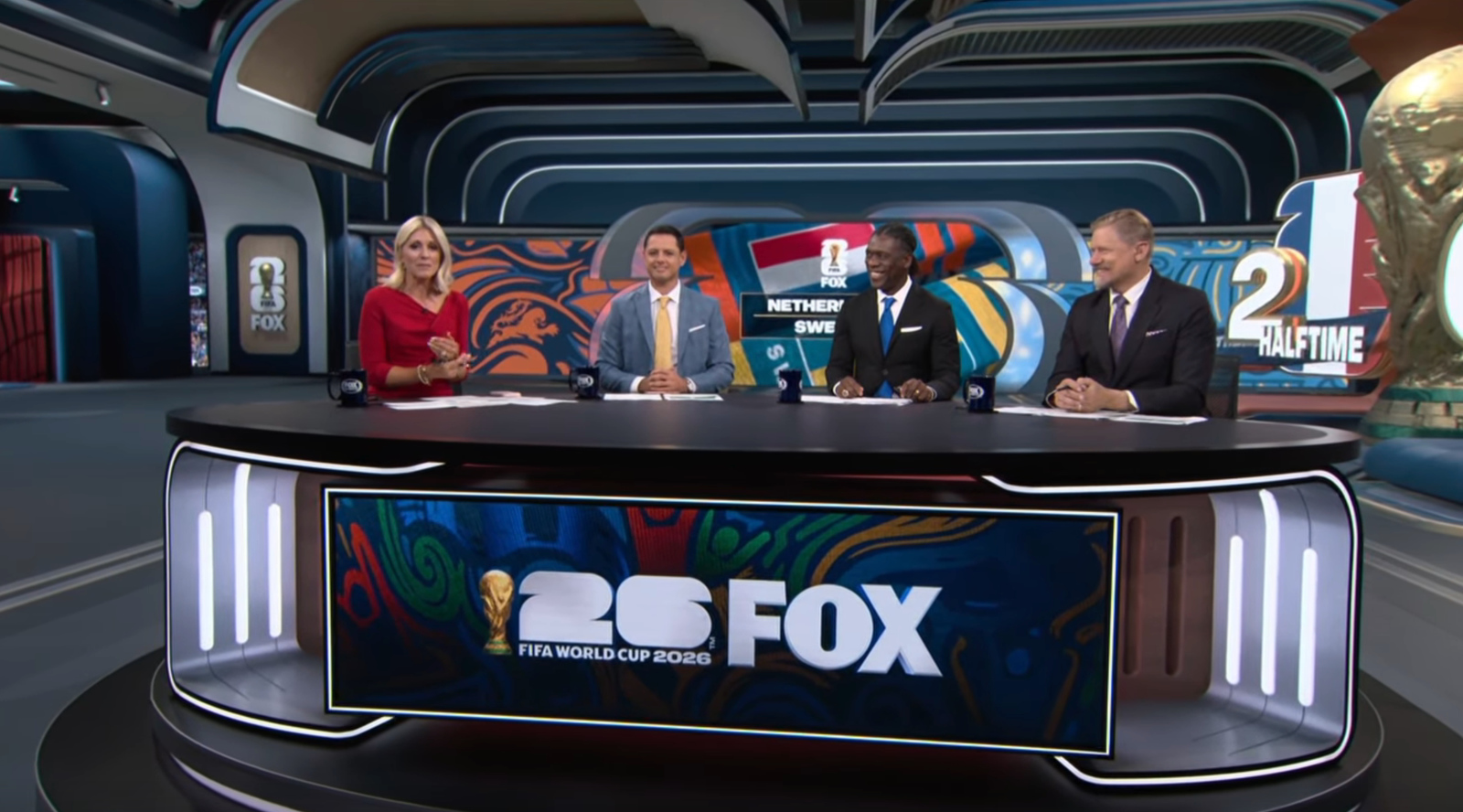
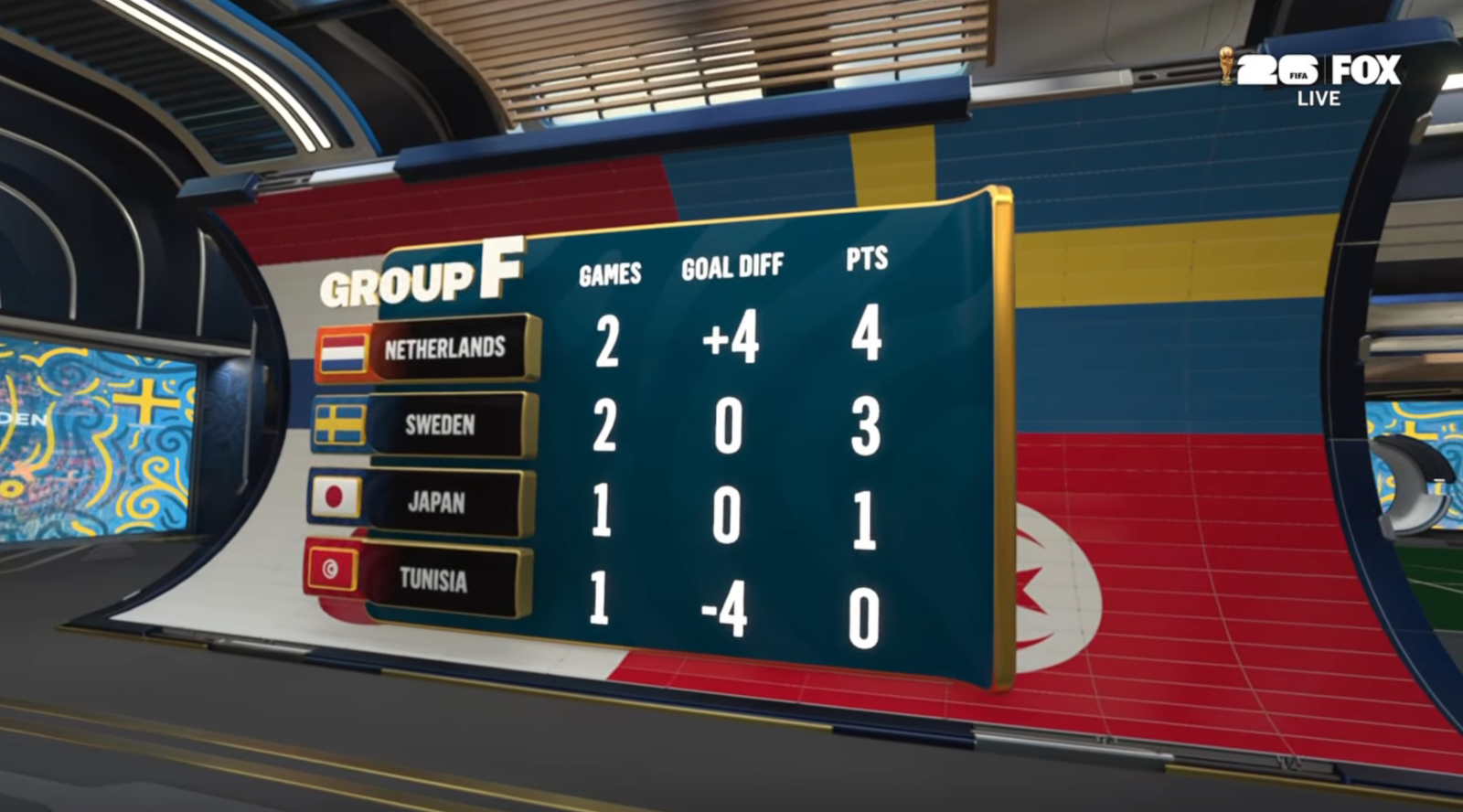
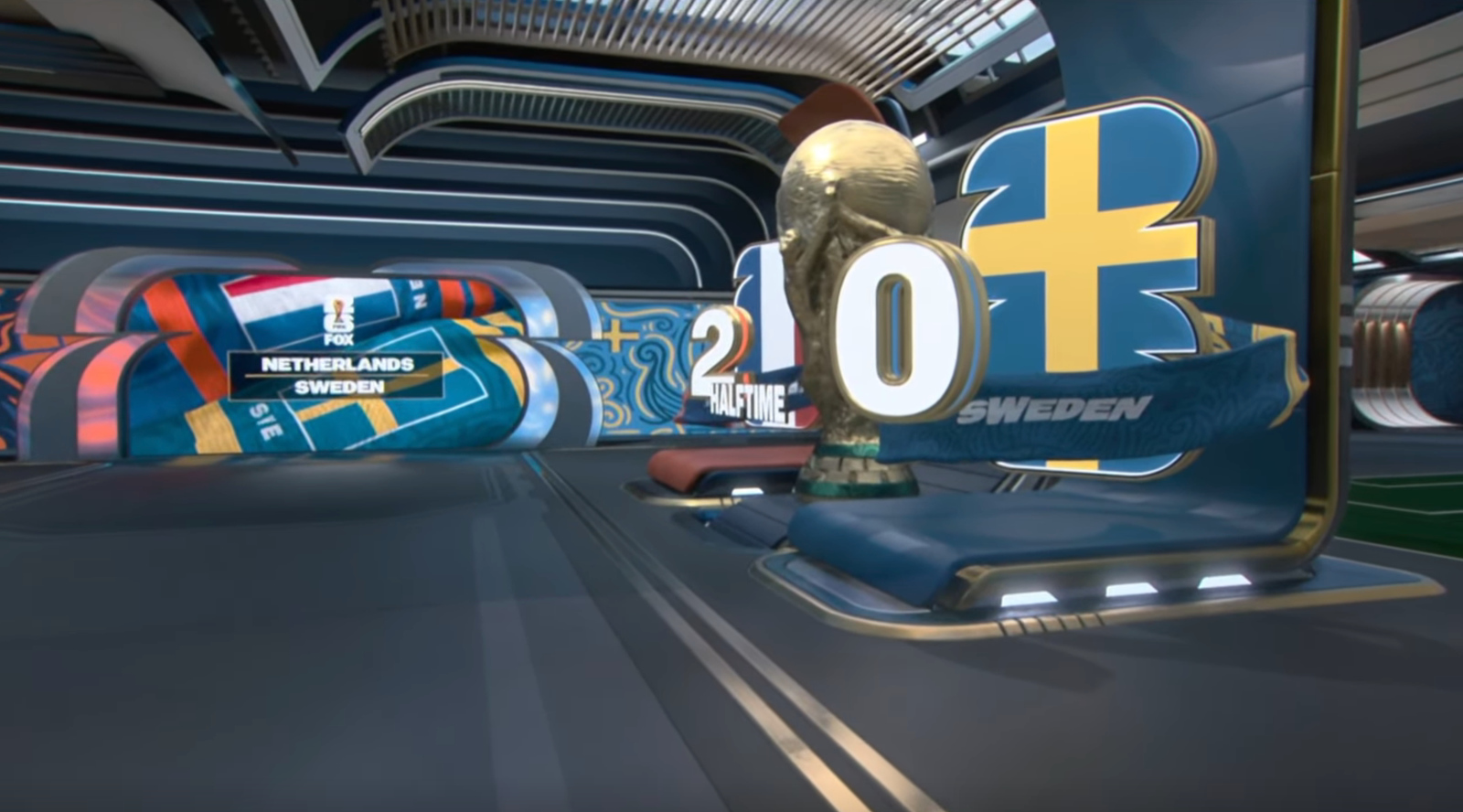
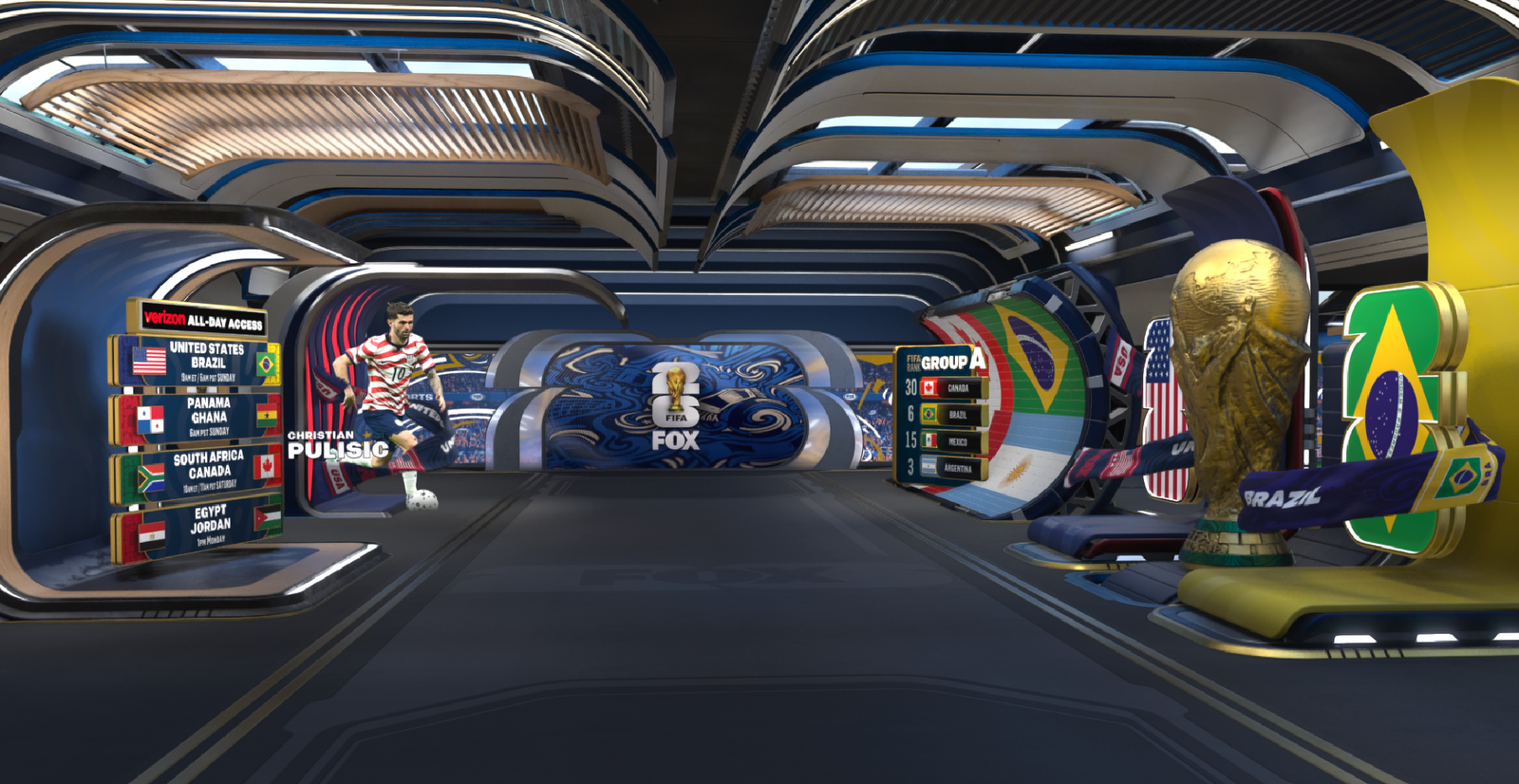
All 104 tournament matches air live, split between Fox (70) and FS1 (34), and every match also streams live and on demand through the Fox One and Fox Sports apps. Forty matches, more than a third of the tournament, fall in prime time, with 21 on Fox and 19 on FS1, which Fox says is a record for the event.
Six sets on the road, one studio at the center
Stage B is only part of the operation.
Six additional sets move to a different city each day, and Fox’s field operations team works with engineering and graphics staff to bring each one online and augment it with AR.
“We’re using a combination of optical tracking to be able to implement graphics on a drone, on a pitch-side cam,” Fields said.
At SoFi Stadium, the team ran four AR cameras with rendering and calibration handled remotely rather than on site; meanwhile, the next day’s set was already being prepared elsewhere.
Camera signals from those remote sets travel back to Los Angeles, where graphics are inserted before air, a workflow that draws on remote production infrastructure Fox has built out over the last five-plus years.
“All the cameras are coming back to us, and all the graphics are being inserted from LA. The entire building is just this huge remote compound right now,” Hartley said.

Fields said the setup does not necessarily make the work easier, but it lets the team do more with the same resources, since most of them now sit at home base instead of a temporary compound overseas.
A portable kit for the remote feeds
Connecting six traveling sets to one Los Angeles facility required a custom system built just for the job: the Broadcast Remote Studio IP Kit, or BRISK, a portable flypack built on SMPTE ST-2110, a standard that carries video, audio and data as separate streams over standard computer networks instead of dedicated broadcast cabling.
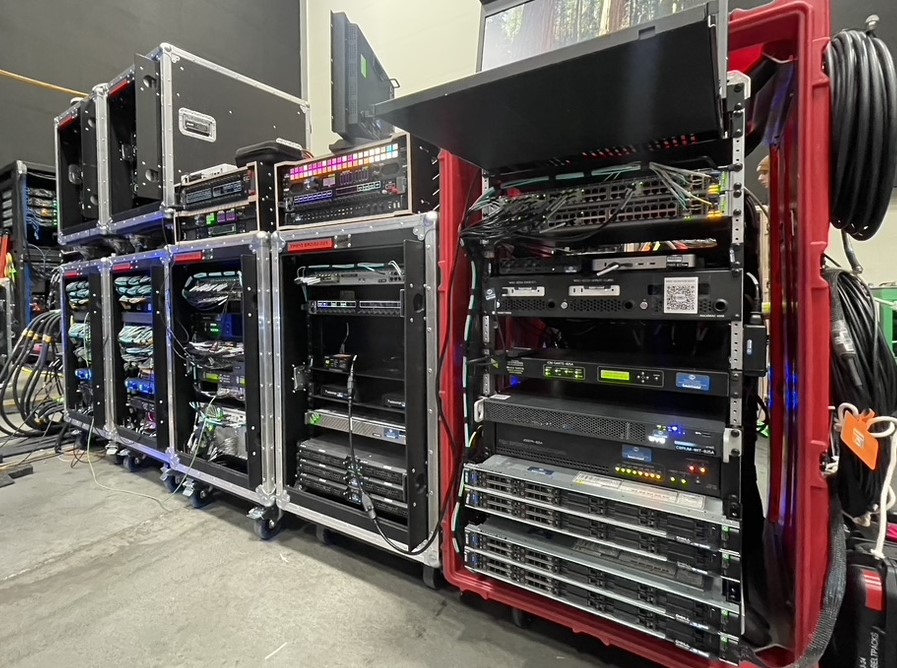
Fox says a BRISK unit can be set up at a venue in about two hours.
The kit relies on JPEG XS, a compression format that maintains high video quality while adding very little delay, to send feeds from a match site back to Los Angeles. Fox notes that the resulting picture is visually lossless, and because latency remains low, directors and producers can run the broadcast from the home studio rather than traveling to the venue itself.
Running entirely over internet protocol also means Fox can route and monitor each kit remotely, which the company says cuts down on the number of field engineers and the amount of equipment it has to ship to each site, lowering travel and logistics costs compared with sending out a full mobile production unit.
Bringing the outside in
The look of the broadcast started with a single line in the creative brief.
“The first sentence in the creative brief was, ‘we want to bring the outside in,'” Hartley said.
That instruction was a reaction to earlier tournaments. Hartley said the studio designs for the European Championship and Copa América could feel subdued whenever coverage cut from a stadium back to the studio.
“When they came from a remote setting into the studio, it felt almost like a mausoleum, because it was so quiet,” Hartley said.
For this year’s World Cup, the team moved away from what Hartley called an Olympic-style, world-coming-together perspective and toward the viewpoint of a fan in the stands.

The resulting package, which the team named “fanthom,” runs on a wall of typography, scarves and crowd chants drawn from fan culture rather than tournament pageantry. To get the chants right, the team researched the primary chant associated with each participating country and rendered them as both AR elements on the set and animated graphics.

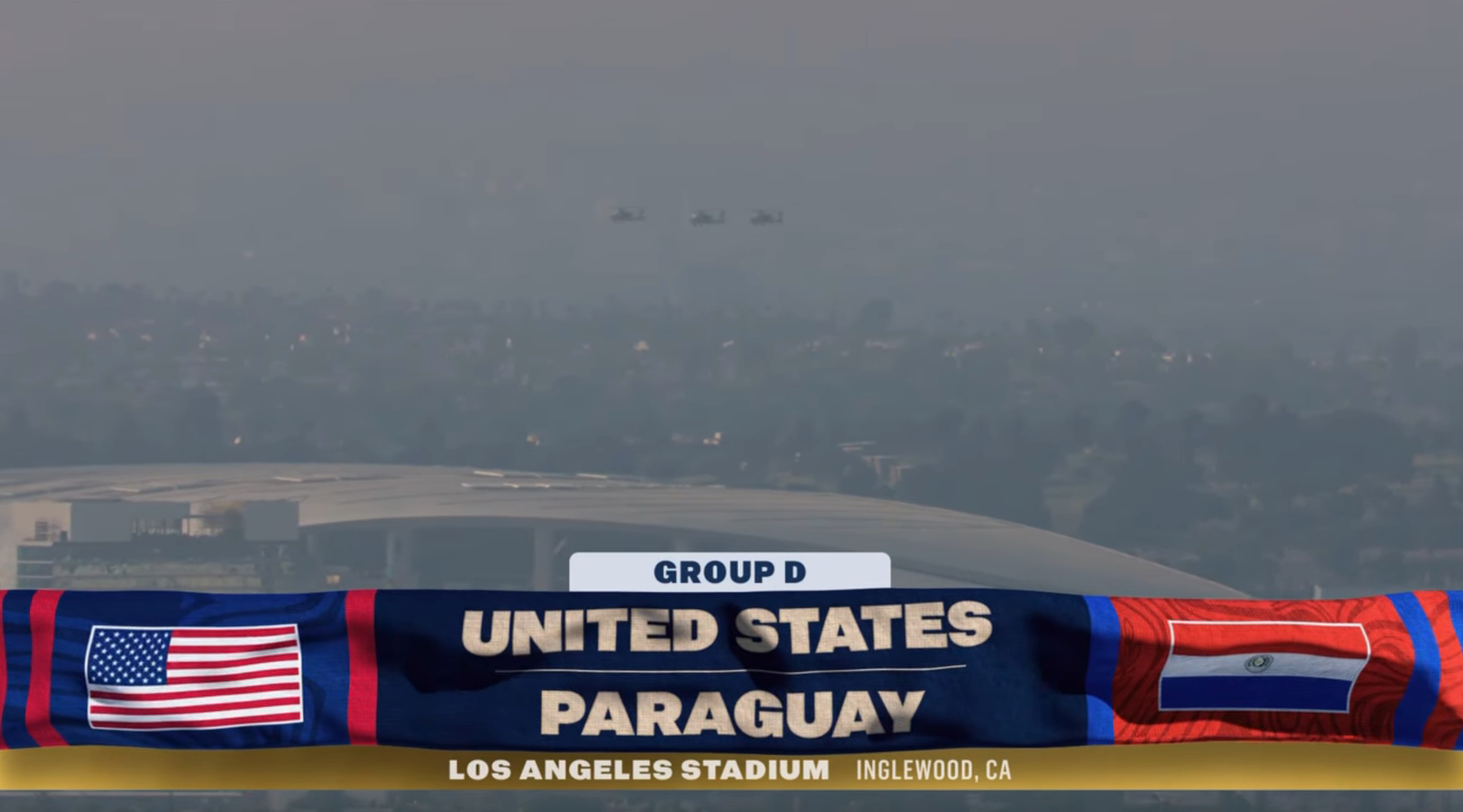
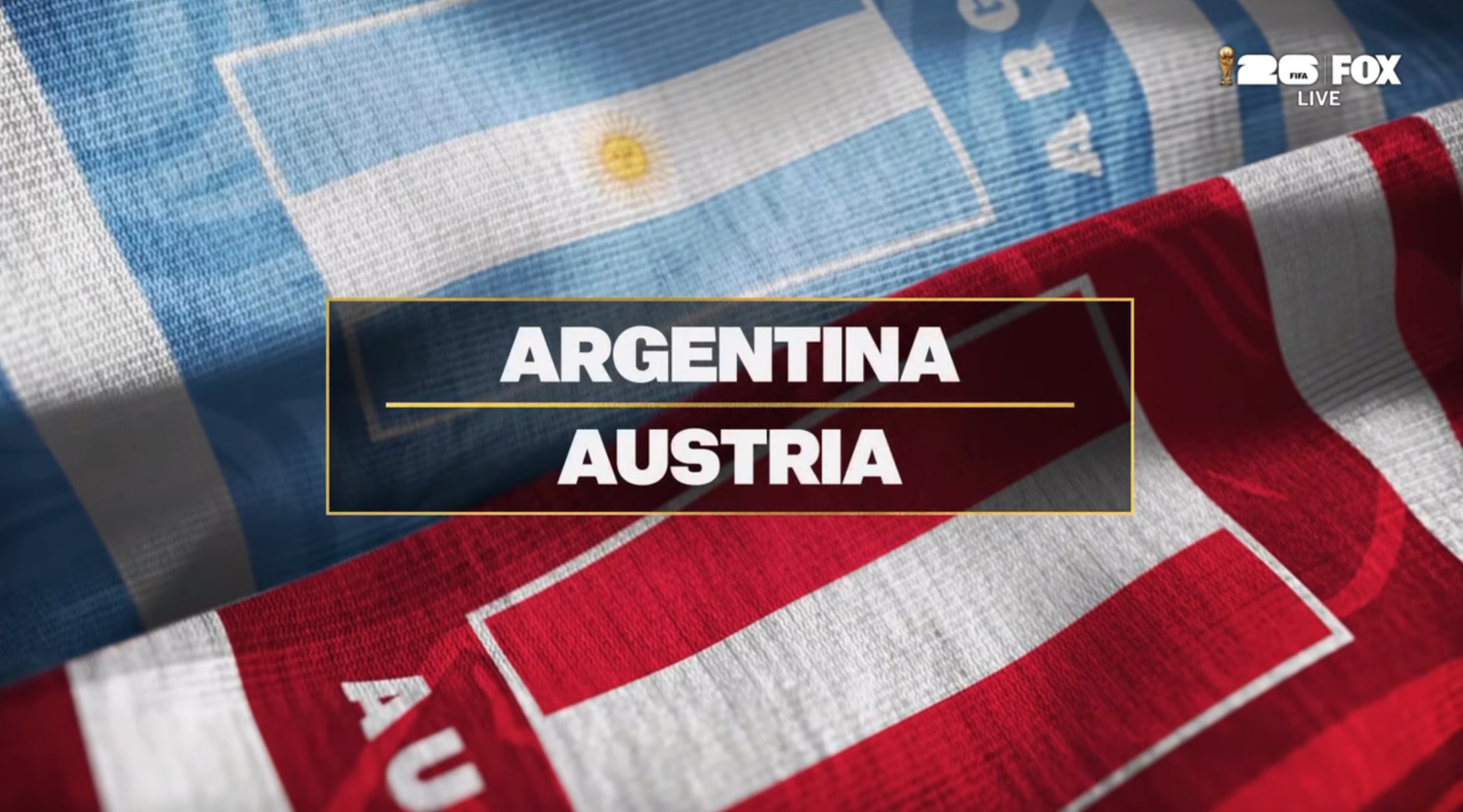
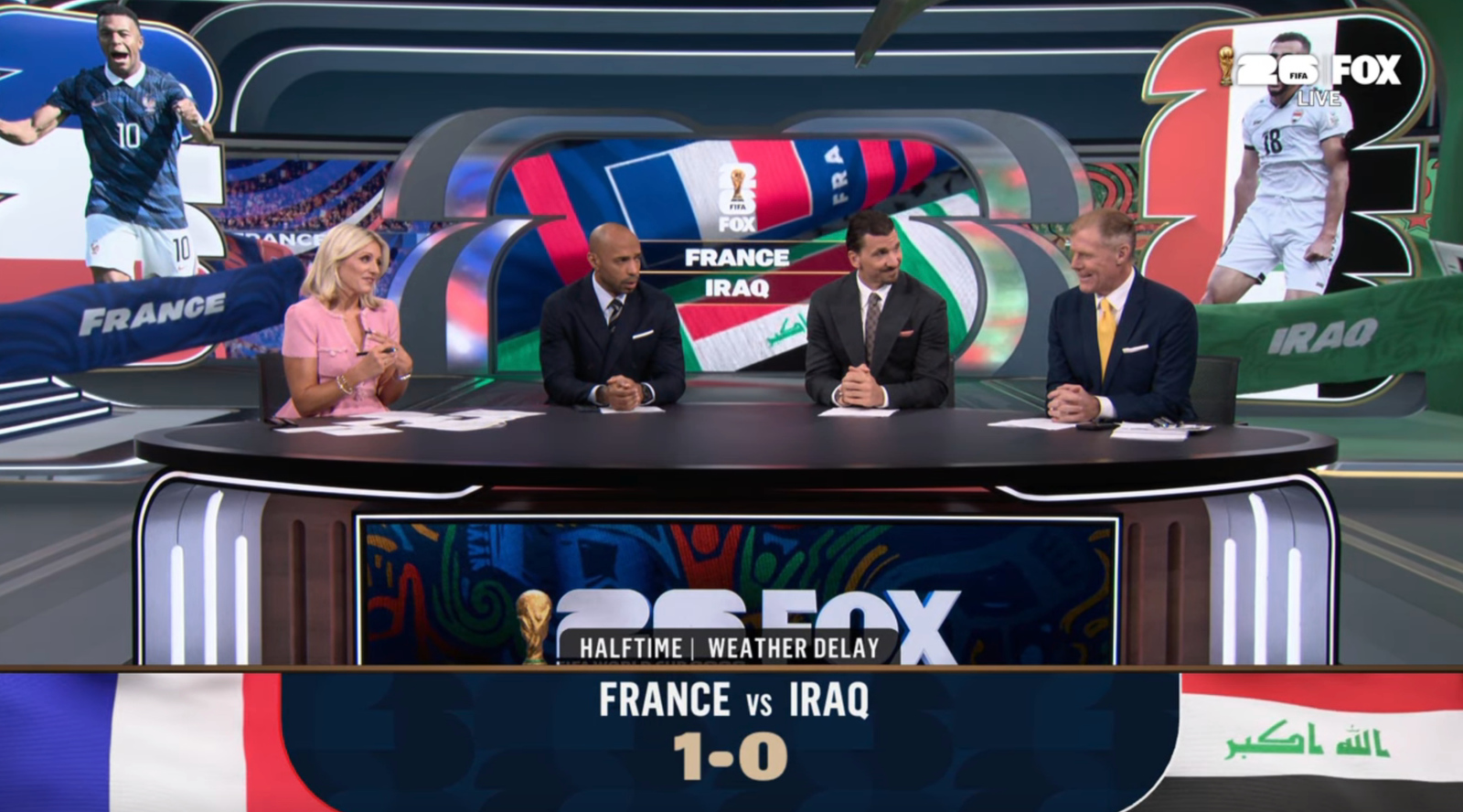
“We did a ton of research on what each individual country’s primary chant was,” Hartley said.
The scarves do double duty in the design, working as both a recurring visual motif and a way to title segments on screen. Fox also recomposed its broadcast theme with a more anthemic arrangement and layered in crowd noise, changes Hartley said gave the package more energy than the network’s previous World Cup looks.

Fox built much of its design around FIFA’s own “26” tournament branding, which Hartley said departed from the approach the governing body has taken in the past. Earlier World Cup packages, including those for Qatar and Russia, leaned on the host country’s culture and architecture; this one reads as more contemporary and design-driven, with fewer references to any single place.
“Their approach was much more contemporary and much more design-based, not so much environmental,” Hartley said.
Fox had already spent roughly a year developing its fan-focused concept before FIFA revealed that branding, but Hartley said the “26” icon proved a useful building block once the team saw it, and it became a recurring element on set.
Recreating plays and overlaying data
On the technology side, Fields said Fox built tools around FIFA’s player-tracking data, including limb-level tracking, that let talent step into a recreated play on the XR set or call up a composite of a single player’s actions across a match.
“Show every single shot that Lionel Messi took tonight and overlay them over the top of each other and display that over the pitch,” Fields said, describing one use of the system.
Making that data usable in the middle of a live broadcast required a tool built for the job, so Fox developed one with an outside partner.
“We built an application with a vendor partner named Skyhook, and built out a web-based platform that allows a producer to essentially select any sort of play or combination of plays to really utilize that tracking data further,” Fields said.
Fox has worked with player-tracking data on past events, but Fields described this version as the most complete the network has built, calling it essentially productized at this point.
Pulling the stadium into the studio
The team is also preparing to add immersive feeds from unique cameras at venues around the tournament, brining 8K, 180-degree visuals into Stage B’s volume.
“That feed gets streamed back here on site and then we decode it and can pump it into the volume,” Fields said.
Developed by Cosm, an immersive media company known for its 180-degree, 8K camera systems and LED-dome venues, the goal is to bring more of the fan perspective and energy to the studio.
Hartley said the cameras are the same units Cosm uses in its own venues, which explains the resolution, and described the goal less as transporting talent to a stadium and more as folding the live atmosphere of the venue into the studio itself.
“It’s pulling the live experience into the studio,” Hartley said.
Fields said Fox planned to expand its use of the Cosm feeds over the following week and a half. Both he and Hartley described the production as one that keeps evolving while it is on the air, with producers adjusting the set and graphics match by match rather than locking in a fixed plan before the tournament began.
Hartley said the scale of the design work for this tournament outpaced what Fox built for past World Cups, stretching the network’s in-house staff to keep up.
“The scale of what we’re trying to achieve really stretched our in-house capabilities. We have people who have been working crazy hours leading up to it, and in the midst of doing other sports,” Hartley said.
He credited that effort across the industry broadly, while pointing to his own team in particular.
“All networks kind of do an amazing job on this thing. The amount of talent and creativity that they bring into the overall branding is really remarkable,” Hartley said. “But our guys really worked hard.”

tags
2026 FIFA World Cup, 2110, Cosm, fifa world cup, Fox Sports, fox sports studio b, Gary Hartley, JPEG XS, LED Volumes, SMPTE ST 2110, Zac Fields
categories
Augmented Reality, Virtual Production and Virtual Sets, Graphics, Heroes, Set Design, Sports Broadcasting & Production, Sports Set Design