

Broadcast sector faces renewed scrutiny on political airtime, foreign investment
Weekly insights on the technology, production and business decisions shaping media and broadcast. Free to access. Independent coverage. Unsubscribe anytime.
The Federal Communications Commission adopted new transparency requirements for foreign ownership and issued guidance on equal time obligations for broadcasters at its January 2026 open meeting, marking the agency’s first actions of the year on broadcast regulation.
The most contentious item centered on clarification of the equal opportunity rule, which requires broadcast stations to provide equal airtime to qualified political candidates.
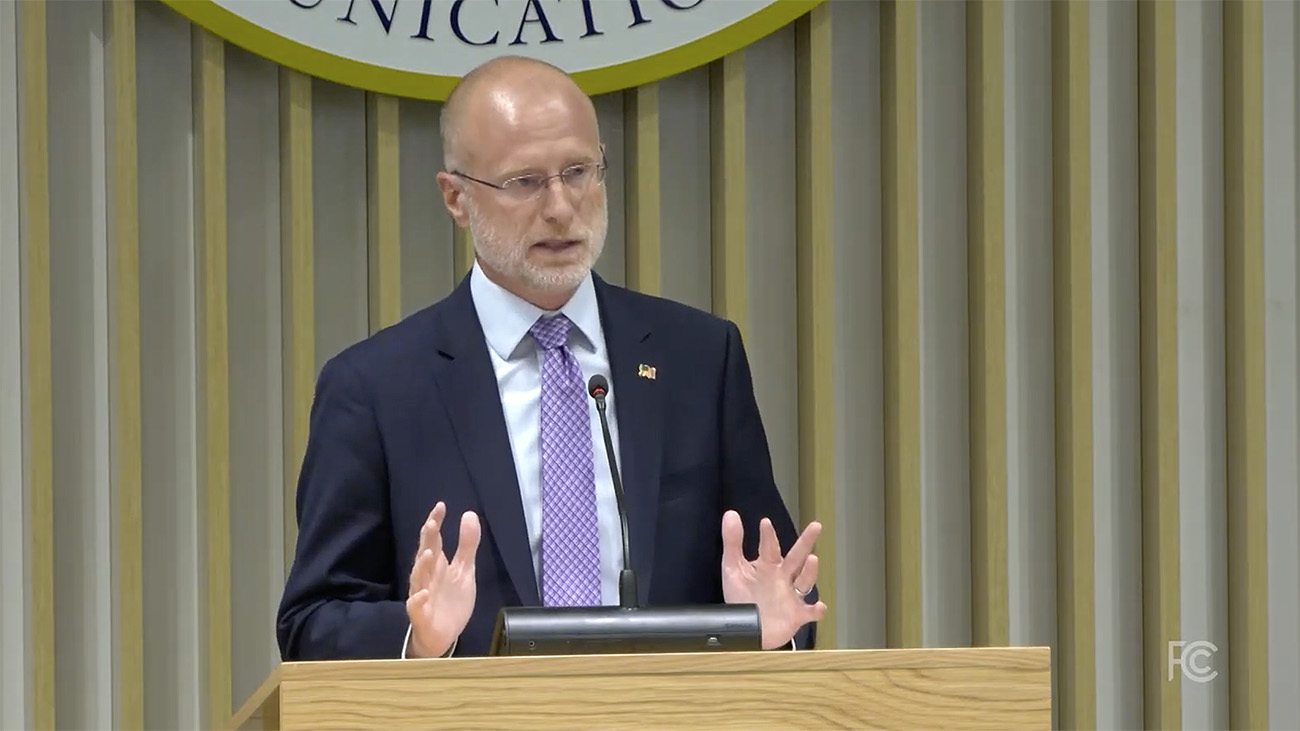
Chairman Brendan Carr said the guidance addressed what he described as industry misinterpretation of prior FCC decisions.
“The cases that were decided in the past were really limited to the four corners of those decisions,” Carr said. “The extent that people were taking one adjudication from the way a particular show operated in 2006 and extrapolated from that that every single late night, every single daytime show must be bona fide news, that’s not right.”
The guidance applies to both television and radio broadcasters. Carr said the FCC has not been presented with evidence that existing late-night or daytime interview programs qualify for the bona fide news exemption from equal time requirements.
Commissioner Anna Gomez disputed the need for the guidance and said it represented an attempt to influence broadcast content.
“The equal time rule covers all broadcasters, whether it’s television or radio, whether they’re friends or foe of this administration,” Gomez said. “The threat is the point.”
She added that the longstanding practice has been for broadcasters to work directly with FCC staff on a case-by-case basis to resolve equal time questions quickly during election periods.

“Congress was clear that the FCC has a role with respect to bonafide news because otherwise, I think the statutory history is clear, they were worried that TV programmers would broadly take advantage of trying to claim they were bonafide news when they weren’t. But if you’re fake news, you’re not going to qualify as the bonafide news exception,” said Carr.
Foreign ownership rules codified after decade of practice
The commission also adopted a report and order codifying foreign ownership review practices that have developed over the past decade. The item, presented jointly by the Media Bureau and Office of International Affairs, formalized procedures under Section 310(b) of the Communications Act.
“Over the past decade, we have been asked to approve increasingly complex foreign ownership structures,” said Emily Harrison, attorney advisor in the Media Bureau’s Video Division. “This report and order facilitates the commission’s public interest analysis and codifies current practices to make it easier for entities to understand and navigate our foreign ownership rules.”
The order clarifies definitions, including controlling U.S. parent, disclosure requirements for trusts and trustees, and requirements for entities seeking to correct inadvertent compliance violations. It also establishes procedures for processing broadcast applications during pendency of remedial petitions.
Carr framed the action as part of the agency’s broader regulatory streamlining effort.
“Having those uncodified and unclear rules adds needless costs, makes it harder for entities to understand and navigate our requirements and risks inconsistent outcomes,” Carr said.
Both Gomez and Commissioner Geoffrey Starks, who was not present at the meeting but whose position was represented by Commissioner Nathan Simington as “Commissioner Trustee” in the transcript, supported the foreign ownership item.
Separate national security measure adopted
The commission also adopted reporting requirements for all license holders regarding foreign adversary control, which applies to broadcast licensees among other services. The measure requires entities to attest whether they are subject to foreign adversary control and to disclose ownership interests of 5 percent or greater.
Mason Sheffa, attorney advisor in the Wireline Competition Bureau, said the requirements place licenses into three schedules based on national security risk factors. Schedule A holders must attest to foreign adversary control status, Schedule B holders subject to such control must provide additional disclosures, and Schedule C holders are exempt from filing requirements.
The commission set a 60-day filing deadline for most entities after launch of the consolidated reporting system, with a 120-day period for small entities.
Political tensions surface over broadcast regulation
The meeting highlighted ongoing tensions over the FCC’s approach to broadcast regulation under the current administration. Gomez used her closing statement to criticize what she characterized as politically motivated actions targeting broadcasters.
“The last few weeks have shown that this FCC is no longer independent and it is no longer primarily interested in acting in the interest of consumers,” Gomez said. “The FCC is now a political arm of this administration.”

She said the equal time guidance was intended to pressure broadcasters regarding editorial decisions rather than address legitimate compliance questions.
Carr defended the agency’s actions as applying existing law in an evenhanded manner. He noted that the equal opportunity statute was passed by Congress and remains in effect.
“Our approach here is to apply the law in a fair and even-handed manner,” Carr said. “Everyone’s going to get fair and even-handed treatment.”
The chairman also addressed competition from streaming platforms, noting that services like YouTube TV face fewer regulatory requirements than traditional multichannel video programming distributors while capturing increasing market share.
On broadcast ownership caps, Carr said the proceeding remains under review with no final decision reached. He noted that questions about competitive impacts from streaming platforms would primarily fall to the Federal Trade Commission or Department of Justice rather than the FCC.
The commission did not address the multilingual emergency alert templates that Gomez said had been published in the Federal Register but remain delayed in implementation.

tags
Anna Gomez, Brendan Carr, Deregulation, FCC
categories
Broadcast Business News, Featured, Policy