

FPV drones deliver athlete perspective, unique angles with Winter Olympics debut
Weekly insights on the technology, production and business decisions shaping media and broadcast. Free to access. Independent coverage. Unsubscribe anytime.
Olympic Broadcasting Services is using up to 15 first-person-view drones across venues at the 2026 Winter Olympics, marking the first deployment of the technology at a Winter Games. The organization introduced FPV drones to Olympic coverage at Paris 2024 for mountain bike events.
The drones are operating in both outdoor and indoor venues across multiple winter sports disciplines.
OBS is using the technology in Alpine skiing, freestyle skiing, snowboarding, ski jumping, speed skating, biathlon and sliding sports.
Mark Wallace, OBS chief content officer, said the visual strategy for Milano Cortina 2026 centers on what the organization calls “movement in sport,” which the drones help present to viewers.
“It’s about capturing the motion of the athlete – not just the result, but the sensation of speed, the tactics, the technique, and the environment in which they compete,” Wallace said.
FPV drones are tracking athletes at speeds approaching competitive pace without cable or ground-based constraints.
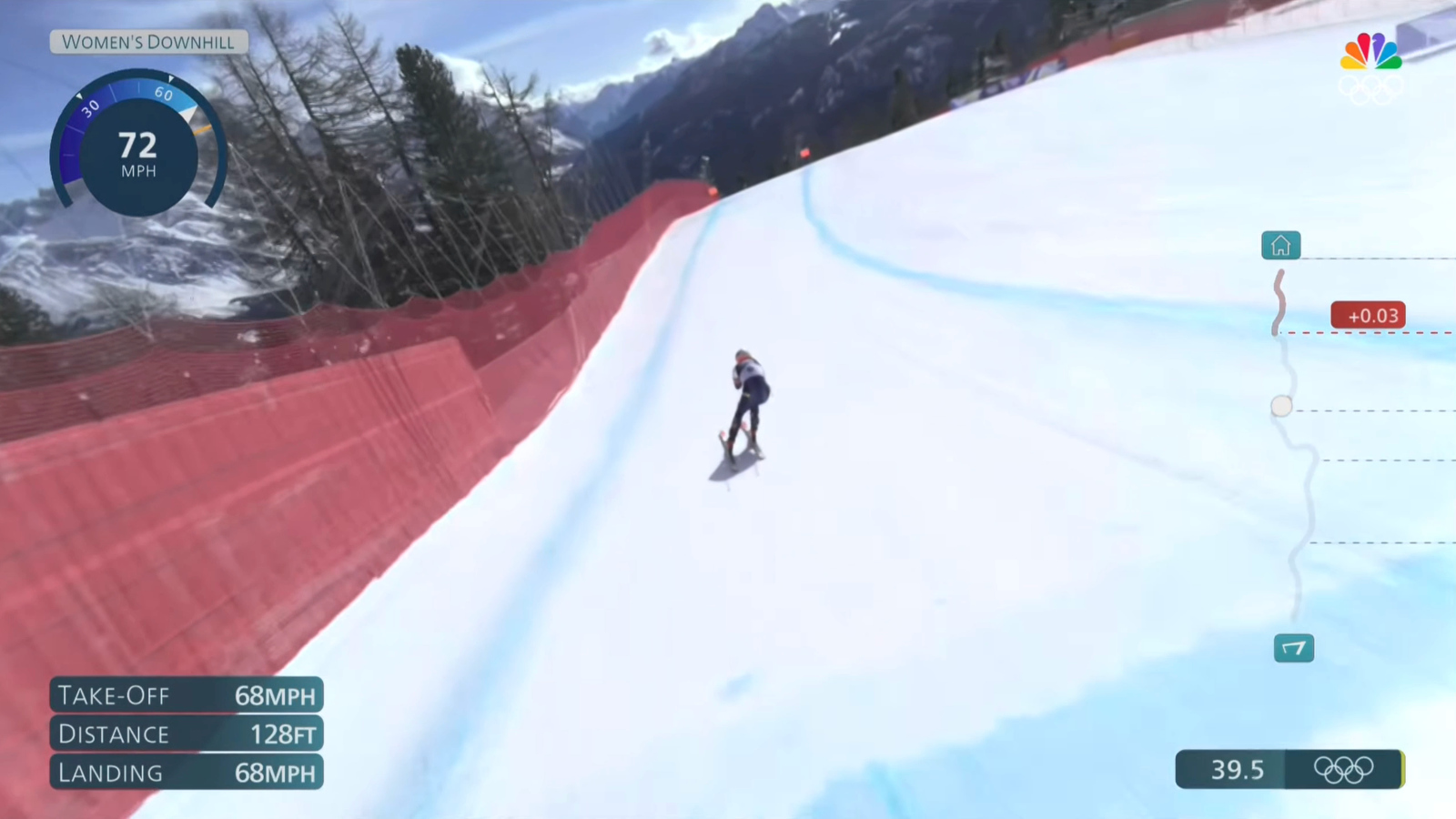
In Alpine skiing, the drones follow athletes down courses to capture line choice, compression absorption and technique through turns. For freestyle skiing and snowboarding, the drones track athletes over jumps to show height, rotation and amplitude.
“FPV drones, small, agile drones that can follow athletes down the field of play, will be used extensively in Alpine skiing, snowboarding, and freestyle skiing,” Wallace said. “We’re even testing them for sliding sports such as bobsleigh and luge, and remarkably, for speed skating indoors.”

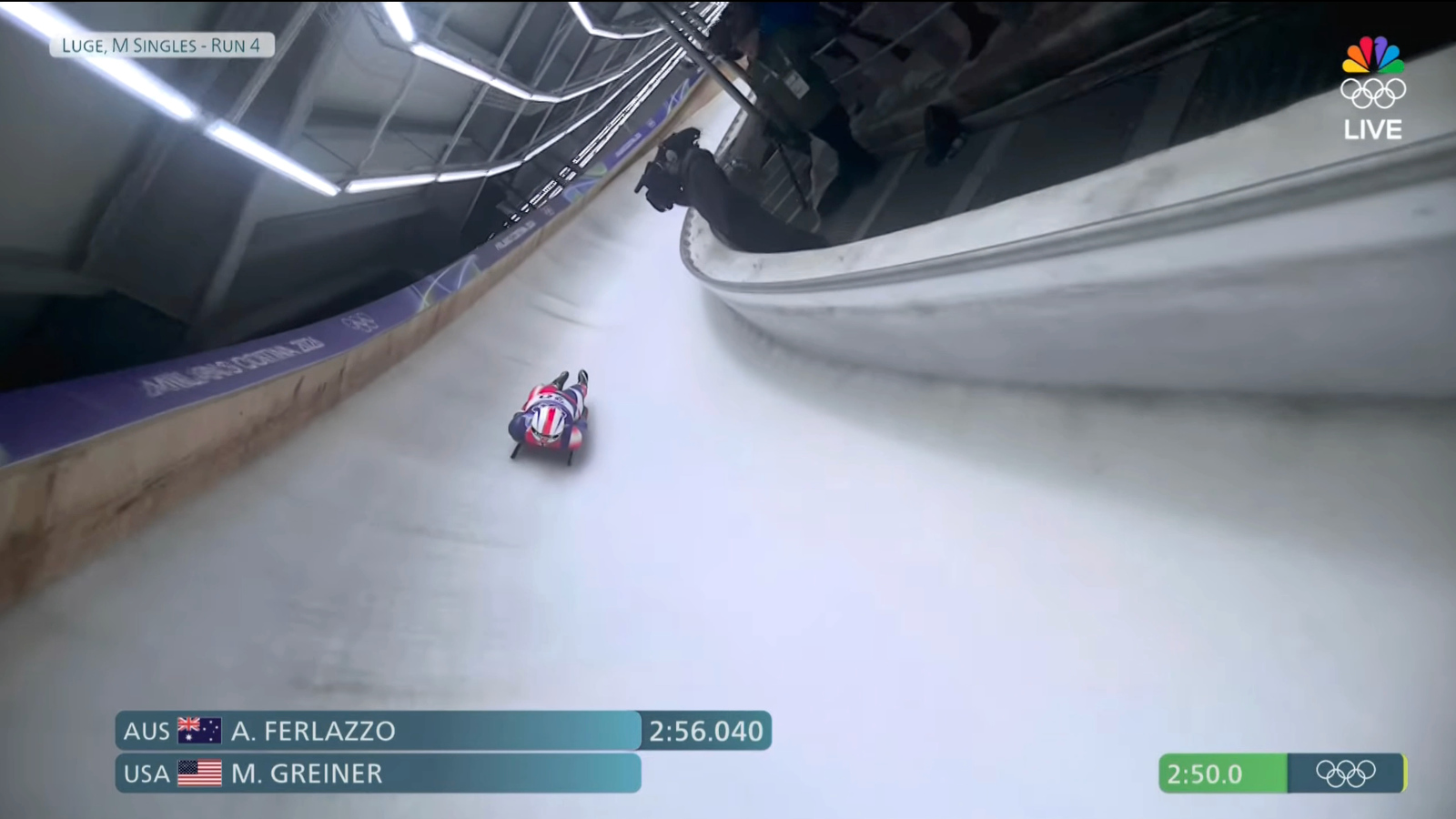
In ski jumping, drones follow athletes down the in-run and through take-off before separating mid-flight to show body position and distance. In sliding sports, the drones follow athletes racing at speeds up to 90 MPH through ice tracks, moving in and out of curves to convey speed and the precision required to maintain racing lines.
“The drones are a game changer because it gives you a different perspective,” said Molly Solomon, executive producer and president, NBC Olympics. “You are sitting on the back of a skier… I think most of all, it’s the speed and the drop. It’s funny, we showed some footage to some of the U.S. alpine skiers this fall, and they said that’s the closest that we’ve ever seen to allowing the viewer to understand what we’re doing.”
Drone specifications and broadcast systems
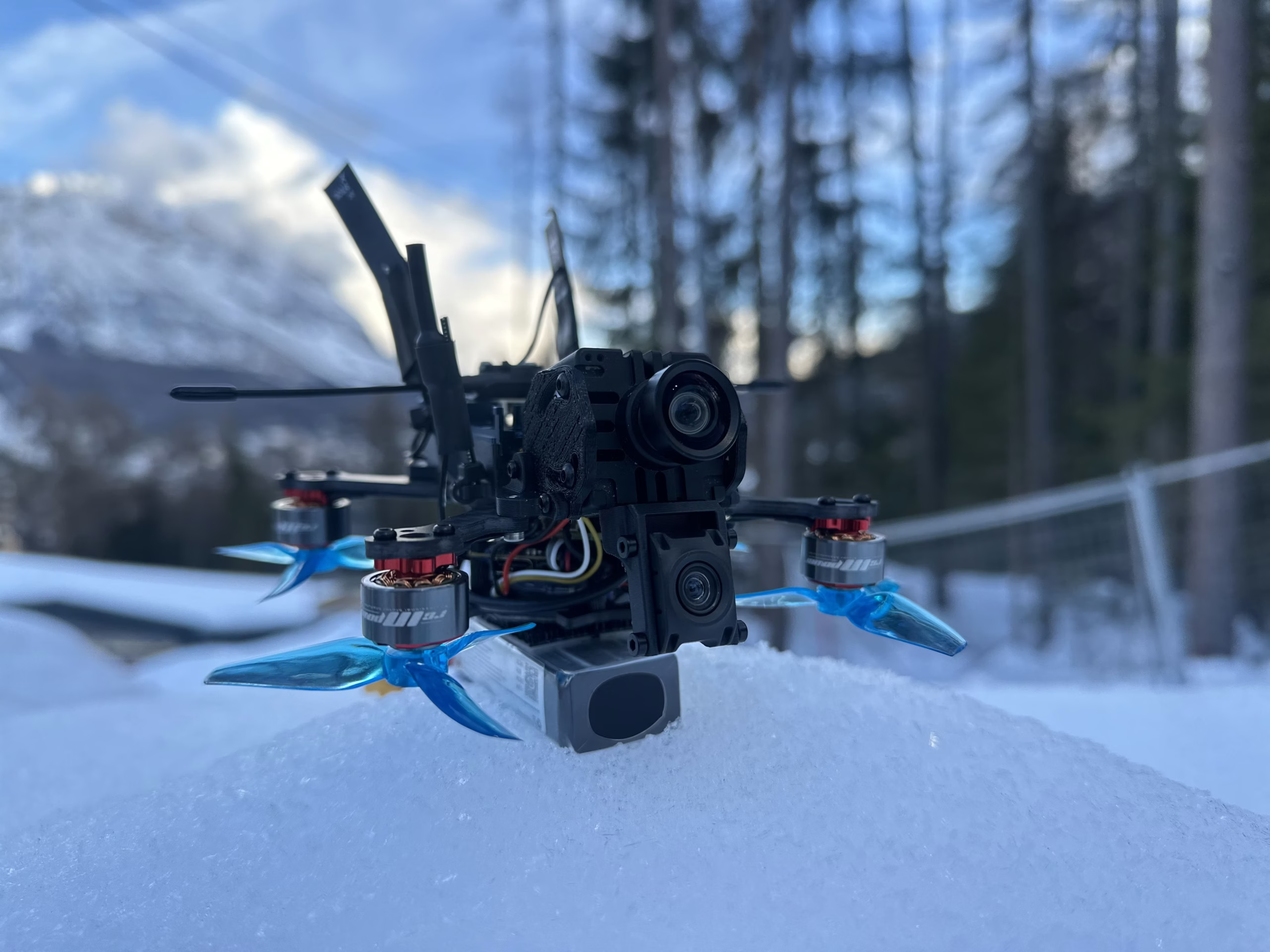
Dutch Drone Gods developed a custom FPV broadcast drone for sliding sports, which uses similar rig as those deployed across the other sports.
Courtesy of Dutch Drone Gods
The 2.5-inch configuration weighs 243 grams and reaches speeds up to 60 MPH with a flight time of up to five minutes.
The drone uses a dual-camera system to separate pilot control from broadcast output. The broadcast feed runs through a Proton CAM Full HD Mini camera and Domo Pico Tx transmitter, which delivers footage to production teams with 300 to 400 milliseconds of latency. The pilot operates using a separate DJI O4 Air unit that provides a feed at 15 to 40 milliseconds of latency.
Different teams operate drones ranging from 2.5-inch to 7-inch configurations for other sports, with most using similar transmitter and camera systems. The drones use an inverted blade design with propellers mounted beneath the frame rather than above, a configuration that enhances aerodynamic efficiency during flight curves.
Operations and team structure
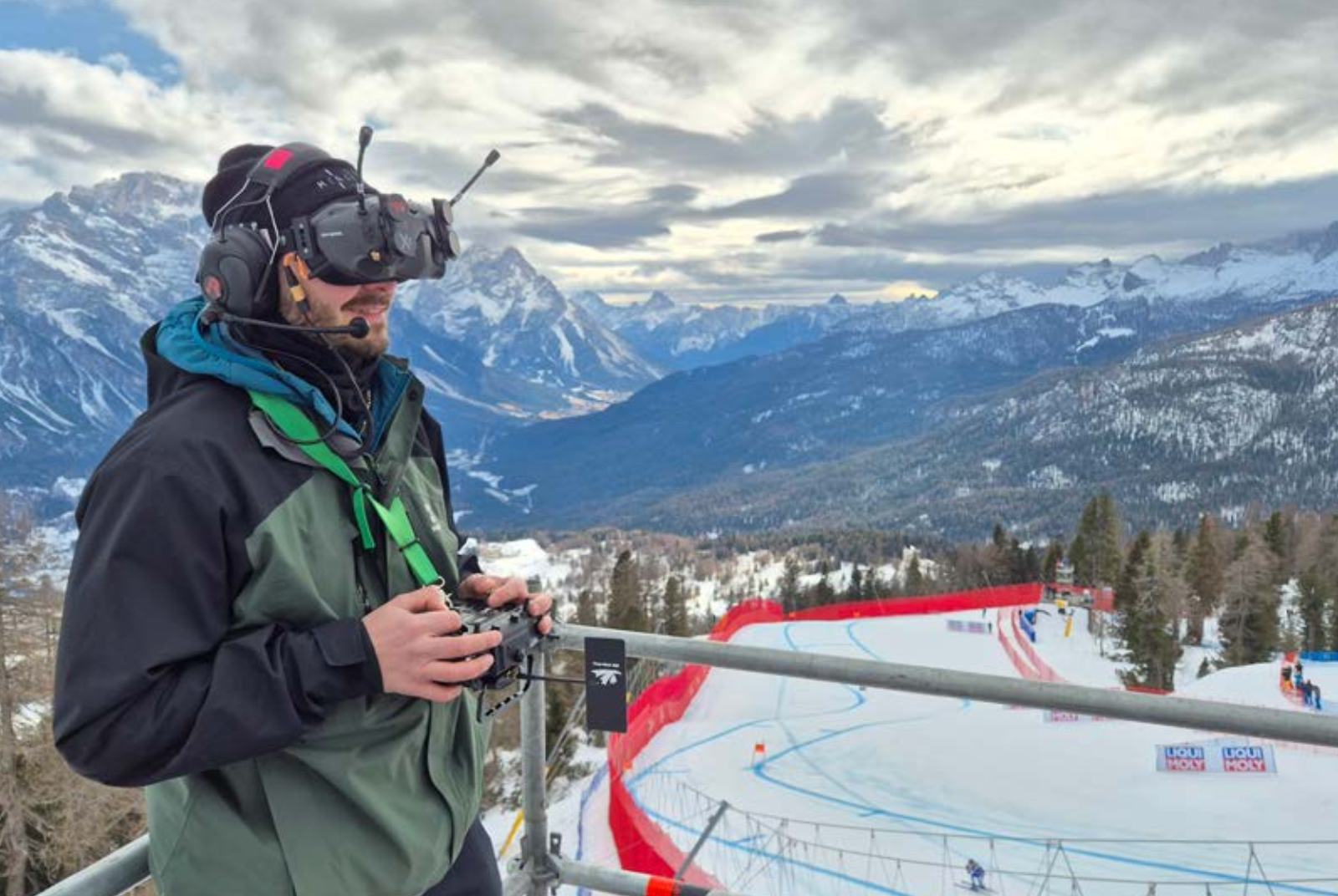
Each FPV drone team consists of three specialists: a pilot, a director and a technician. The teams communicate via a dedicated channel and maintain contact with the director in the outside broadcast van and technical crew.
For outdoor operations, pilots work from elevated positions to maintain line of sight with athletes. A heated support cabin serves as the operational base, containing a battery charging station, spare drone, receiver and dual monitors for tracking drone signal integrity and race developments.
The batteries used in the drones require replacement after approximately two athlete runs. Teams can adjust video filters in real time to adapt to weather and light conditions.
Jonas Sandell, an FPV drone operator who competed on the Norwegian Ski Association’s B national team in ski jumping, founded a production company that developed methods for capturing ski jumping through FPV drones.
“Watching teammates in training, I realised the athlete’s view of the flight was the most thrilling angle,” Sandell said, noting his athletic background informs operational decisions during broadcasts.
“Every athlete accelerates and flies differently,” Sandell said. “If you don’t understand those subtleties, you miss the moment or outrun them.”
For Milano Cortina 2026, Sandell said the goal is to convey the experience of ski jumping.
“How fast, intense, and extreme, ski jumping really is,” Sandell said. “Seeing an athlete soar 140 metres through the air on two skis is incredible. I want audiences to experience that sensation as if they were in the air too.”
Context and venue integration
Drones have been part of Olympic broadcasting since the Sochi 2014 Olympic Winter Games. For these Games, OBS has deployed traditional hovering drones alongside the FPV units for scenic and transitional coverage.
“Many of the venues — Stelvio, Tofane, Anterselva — are iconic, almost sacred within their disciplines, having hosted generations of champions,” Wallace said.
The organization’s visual strategy also includes what Wallace described as Real-Time 360-degree and stroboscopic replays, cinematic cameras and behind-the-scenes access. OBS introduced an AI-driven stone tracker for curling that displays trajectory, speed, rotation and timing. Alpine skiing coverage includes team radio communications between coaches and athletes with translations.
Safety protocols
All drone flights operate under coordination with Italian Civil Aviation Authorities, Prefectures and Police. OBS also coordinates with international sports federations, venue management and production teams.
Flights take place in controlled areas with drones maintaining distance from athletes, spectators and restricted zones. All operations received pre-approval from relevant authorities. Certified professionals pilot the drones following aviation regulations at venues.
Wallace said OBS draws on lessons from previous Games while developing approaches specific to each host location.

“When we start planning the production of an Olympic Games, the first step for our team is to immerse ourselves in the host country — its culture, landscapes, venues, and the Organising Committee’s vision,” Wallace said. “Milano Cortina 2026 has a unique story to tell, and for us, that story begins with understanding how to showcase it in the most dynamic and engaging way possible.”
Photos courtesy of OBS / Dutch Drone Gods

tags
2026 Winter Olympics, Broadcast Drones, drone, Drone Broadcasting, Dutch Drone Gods, Olympic Broadcasting Services
categories
Cameras, Featured, Olympics, Sports Broadcasting & Production