
Definitions of ‘TV’ diverge across generations, CivicScience data shows
Weekly insights on the technology, production and business decisions shaping media and broadcast. Free to access. Independent coverage. Unsubscribe anytime.
A new CivicScience report found that U.S. television audiences are becoming increasingly fragmented, with growth at both extremes of viewing behavior and shifting definitions of what constitutes “TV.”
The report, published April 3, analyzed real-time consumer survey data and showed that so-called “power viewers,” those watching more than four hours per day, have grown by 35% since 2023 and now account for more than one-quarter of U.S. adults. At the same time, the share of Americans who say they never watch TV has risen to 11%, up from 3% in 2012.
The findings indicate a decline in moderate viewing, with audiences splitting between heavy consumption and alternative forms of media engagement. The company said this shift reflects a broader redefinition of television consumption rather than a simple decline in viewership.
The report also found that definitions of “watching TV” vary widely across generations.
Fewer than half of U.S. adults identify the television screen as the primary factor, while 21% define TV by the service used, 20% by content type and 16% consider any video content to fall under the category.
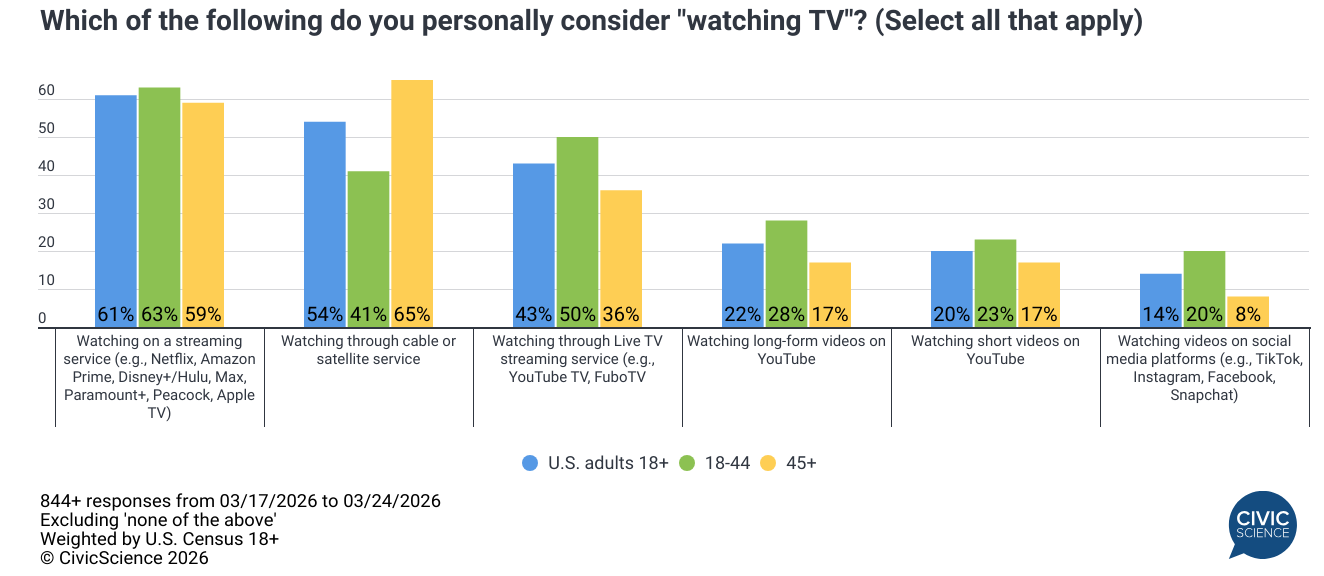
Generational differences were pronounced.
Among adults ages 18 to 44, 63% consider on-demand streaming services to be TV, compared with 41% for cable. Among those 45 and older, 65% associate TV with cable or satellite, while 59% include streaming.

The report also found that 43% of U.S. adults classify virtual multichannel video programming distributors (vMVPDs), such as YouTube TV or FuboTV, as TV, with that figure rising to 50% among younger viewers. Social video platforms showed the widest generational gap, with 20% of adults ages 18 to 44 considering them TV, compared with 8% of those 45 and older.
Platform preferences varied by age group. Streaming services led across all demographics under 55 and were most prominent among viewers ages 35 to 54, at 45%. Among viewers 55 and older, traditional media accounted for 41% of viewing, while streaming fell to 28%.
The report concluded that audience fragmentation presents an opportunity for content creators and distributors. Strategies that account for generational differences and platform diversity are more likely to effectively reach viewers across the evolving television landscape.

tags
CivicScience
categories
Heroes, Market Research Reports & Industry Analysis, Streaming