

Blackmagic Design goes all in on 100G with launch of complete IP broadcast stack
Weekly insights on the technology, production and business decisions shaping media and broadcast. Free to access. Independent coverage. Unsubscribe anytime.
Blackmagic Design did not arrive at 100G Ethernet by accident. The company’s announcement at the 2026 NAB Show of a complete SMPTE 2110 production infrastructure – switchers, recorders, storage, converters and an Ethernet switch – reflects a deliberate decision to build a full broadcast facility stack with a keen focus on live production.
The suite of products is built around 100G Ethernet and the SMPTE 2110 IP video standard, alongside two new URSA Cine camera models with native 100G connectivity for live production.

The throughline across all of it is a single argument: that the broadcast industry’s move toward IP infrastructure has reached the point where a complete, integrated 100G workflow is now both necessary and viable.
“We started to do some IP-centric products, we realized that we were doing 10 gig originally, but over time we thought, well, we need to go up to a higher resolution to do more streams per connection,” said Bob Caniglia, director of sales operations for North America at Blackmagic Design. “So we skipped over 25 and 40 and went up to 100.”
The decision to go directly to 100G rather than incrementally expand was deliberate, he said.
Once the company committed to that architecture, the product logic followed: a switcher requires a recorder, a recorder requires storage, storage requires a conversion path from SDI environments, and all of it requires a switch capable of handling the traffic. Rather than announce pieces over time, Blackmagic laid out the full footprint at once.
“Our idea was if we lay out the full footprint for what you can do and not a piece at a time, then it’ll be better for everyone to wrap their heads around,” Caniglia said, “because these have become larger projects.”
Tier ones are in the room
The market Blackmagic is targeting with this infrastructure push is different from the one that made the company’s name. The ATEM 4 M/E Constellation IP — a 32-input native SMPTE 2110 switcher starting at $7,995, with a 64-input model at $14,295 — is priced and specified for broadcast facilities and mobile production units, not the corporate or independent market.
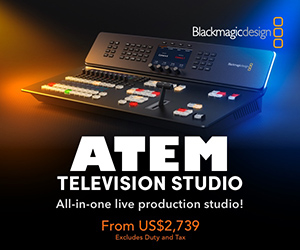
The HyperDeck ISO Recorder 100G, the Cloud Store Ultra flash storage and the Ethernet Switch 820 complete a production chain that can support a 24/7 broadcast facility with the redundancy requirements that entails. Every product in the lineup includes dual redundant power supplies, front-to-back cooling and SMPTE-2022-7 seamless protection switching.
Caniglia said the response from major broadcasters has been better than the company anticipated, in part because those customers already know the software. Many tier one facilities have used Blackmagic’s ATEM switchers or DaVinci Resolve in some capacity, which reduces the friction of adopting a new infrastructure platform.
“A lot of them have used our other ATEMs. They know what the software is, they know how that all works,” he said. “And we’ve literally had — all right, now we are, you know.”
He also pointed to the front-to-back cooling design on the new switchers as a specific response to feedback from facilities operators who had been interested in earlier Blackmagic infrastructure products but needed the thermal and redundancy specifications to match broadcast facility standards.
“Some of the things that they may not have thought were built the way they would use them, we’ve solved that with this new iteration,” he said.
Spatial and live as a growth driver
Two of the more unique announcements at the show — the URSA Cine 12K LF 100G and the URSA Cine Immersive 100G — extend Blackmagic’s cinema camera line into live broadcast production. Both cameras output SMPTE 2110 over 100G Ethernet, bringing the image quality of the URSA Cine platform into OB van and studio environments.
The Immersive model, positioned as the first immersive cinema camera designed for live production with Apple Immersive Video, was already used during the 2025-2026 NBA season for live Lakers games captured for Apple Vision Pro. Caniglia said the spatial and immersive category is evolving faster than the company expected, with live production emerging as the most compelling use case.
“Live is sort of the best way for certain product to be presented — sports, obviously, but then you get into concerts and all these things,” he said. “When you do it, you want to do it on a grand scale so people feel like when they spend all that money, they’re getting something.”
Audio enters the live stack
A less expected announcement was Fairlight Live, a software-based live audio mixer that entered public beta at the show.
The application handles SMPTE 2110 audio workflows and connects to ATEM switchers via USB-C, with audio-follows-video camera selection for up to 100 cameras and support for spatial audio formats.
Caniglia described it as a deliberate extension of the company’s live production ecosystem rather than a standalone product. A university studio or corporate broadcast facility running an ATEM switcher now has a native audio mixing option in the same software family without requiring a separate hardware console.
“We wanted to build a live-only product,” he said. “We thought if we had it as a separate application, it would show that it’s intended to work with our ATEM switcher — or any switcher for that matter.”

DaVinci Resolve 21, also released in public beta at the show, added a Photo page for still image grading using the same node-based color tools the application uses for video, along with several AI-assisted tools for metadata, face manipulation and audio generation.
A different kind of customer
What ran through the conversation with Caniglia was a picture of a company whose customer base now spans a wider range than its product positioning has historically suggested, and which is increasingly finding that the entry points at the bottom of the market create pathways to the top.
Users who learned Blackmagic tools on a camera phone app, a pocket cinema camera or a URSA Mini at a university eventually move into facilities that are evaluating infrastructure decisions. The familiarity with the software and workflow carries with them.
For Blackmagic, the 100G infrastructure push is an attempt to ensure that when those users arrive in roles where they are making facility-level decisions, the company has a product that can follow them there.

tags
Blackmagic Design, Bob Caniglia, NAB Show 2026, NAB Show News, SMPTE ST 2110
categories
Audio Mixing & Audio Consoles, Broadcast Equipment, Cameras, Encoders, Featured, IP Based Production, NAB Show