

FCC chairman signals broadcast spectrum flexibility as Disney dispute deepens at May meeting
Weekly insights on the technology, production and business decisions shaping media and broadcast. Free to access. Independent coverage. Unsubscribe anytime.
The Federal Communications Commission completed its May open meeting Wednesday with a four-item agenda focused on robocall mitigation, broadband mapping, disaster reporting and universal service funding.
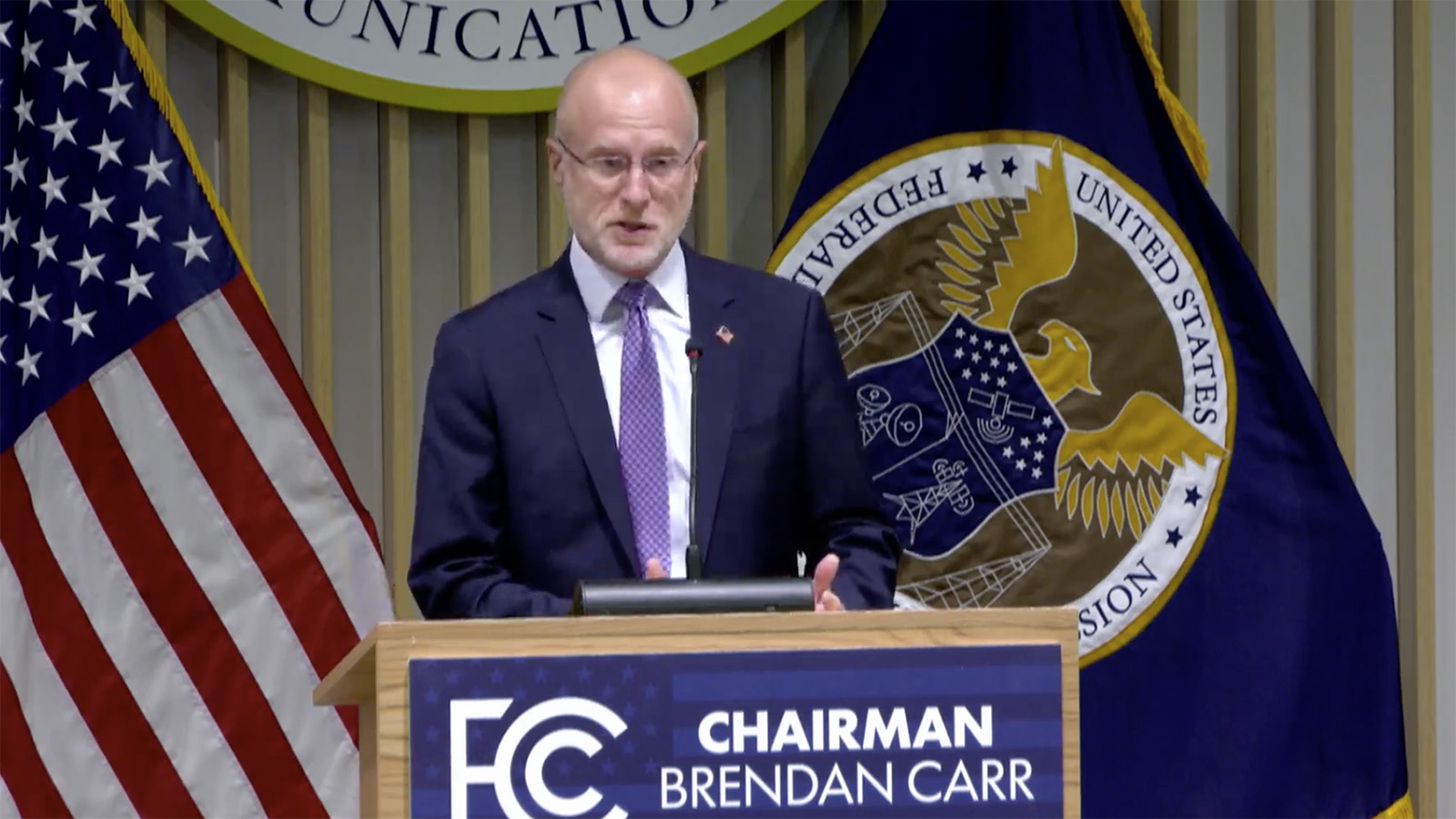
The most substantive discussion of broadcasting came during the chairman’s press conference that followed, where regulatory action against The Walt Disney Co., the future of broadcast spectrum and a pending media consolidation drew most of the questions.
Chairman Brendan Carr said the commission was “pretty far down the path” of evaluating greater flexibility for broadcasters to use their existing six-megahertz channels through the ATSC 3.0 transition. He cited datacasting applications, including over-the-air software updates for connected vehicle fleets, as one potential use case.

“Originally, they got that spectrum for free, and that ultimately ties back into a broader discussion of the public interest standard and some of the obligations there,” Carr said.
Carr said the commission was reviewing multiple petitions related to broadcast spectrum, including a recent filing requesting consideration of 5G and 6G uses, along with the possibility of another broadcast incentive auction. He said the commission had not selected a specific approach.
Disney filing on ‘The View’ under review
A significant portion of the press conference focused on Disney’s recent filing regarding its daytime program “The View.”
Disney has asked the FCC to recognize the program as a bona fide news interview program, an exemption under the agency’s equal time rules for political candidates.
Carr said the commission would process the petition through normal channels. He acknowledged a prior FCC document addressing the program’s status but said it was based on the record at that time.

“A letter based on the contours of a program that existed many, many years ago isn’t necessarily binding precedent for a show that exists today,” Carr said.
The chairman said the equal time provision in federal law, which requires broadcasters that air a legally qualified candidate to provide comparable time to opponents, “promotes more speech, not less.” He said the regulatory framework applies uniquely to broadcasters because of their use of federally licensed spectrum.
Commissioner Anna Gomez, speaking at a separate press conference, said the underlying agency action had been a recognized declaratory ruling for 24 years.
“The commission can’t just wave a wand and make a prior declaratory ruling disappear,” Gomez said. “If the commission wants to do that, then it needs to go through the proper regulatory channels.”
Gomez said Disney’s filing indicated the company had invited conservative voices and administration officials onto the program and that those invitations had been declined.
Early license renewals and DEI investigations
Carr was asked whether the FCC’s open investigation into Comcast Corp.’s diversity, equity and inclusion practices would lead to early license renewal proceedings for NBC-owned stations, similar to action taken against Disney’s eight ABC-owned stations.
“No news to break on the Comcast front,” Carr said. He said the Disney matter had progressed further through discovery and document production, and that the commission allocates investigatory resources based on case status.
Gomez characterized the DEI investigations differently.
“What the investigation into Disney’s diversity, equity and inclusion practices is, is a pretext,” Gomez said. “It’s a way to go after them for the content that this administration doesn’t like.”
Gomez said she sent a letter last week to Disney’s chief executive documenting the agency’s actions involving the company and ABC. She said she had not received a response and had not requested one.
TV ratings comment period closing
Carr said the comment period for a Media Bureau proceeding on potential updates to the television ratings system was scheduled to close later this week. The proceeding seeks input on whether ratings should include additional descriptors for content related to gender identity in children’s programming.
“Congress passed a law because they wanted parents to be informed about the types of TV programming that their children get,” Carr said. He said the rating system was designed to address a range of parental concerns beyond violent content.

Carr said feedback had been “pretty robust” but declined to characterize specific positions before the comment period closed.
Paramount-Skydance foreign ownership review
The chairman addressed the FCC’s role in the proposed combination involving Paramount and Warner Bros. Discovery, noting that the transaction itself would not require commission approval because it involves cable properties, not broadcast licenses. The agency is reviewing foreign investment associated with the deal.
“We are running regular course process on that,” Carr said. He said the Committee on Foreign Investment in the United States, known as CFIUS, would handle national security review.
Gomez raised concerns about the scope of the foreign ownership petition, which she said requests authorization for up to 100 percent foreign ownership and involves sovereign wealth funds.
“These are not just some foreign companies. These are sovereign wealth funds controlled by countries that are not friendly to the press,” Gomez said. She called for a public proceeding and a full commission vote on the foreign ownership question.
Public interest standard
Gomez said the commission appeared prepared to issue a public notice rather than initiate a formal rulemaking on the public interest standard applied to broadcasters. She said a rulemaking would allow for public participation and judicial review.
“When the government claims the authority to police whether broadcasters are serving the public interest, the American people deserve clear rules developed transparently and applied consistently,” Gomez said.
Meeting items
The four items adopted at the open meeting passed with unanimous votes from Carr, Gomez and Commissioner Olivia Trusty.
The commission adopted a further notice of proposed rulemaking on Know Your Upstream Provider requirements and the STIR/SHAKEN caller ID authentication framework. A report and order modified the broadband data collection process and challenge procedures. A third report and order modernized the Disaster Information Reporting System, or DIRS, including a single dynamic reporting form, a one-click option for unchanged status and new reporting requirements for public safety broadband networks such as FirstNet.
A notice of proposed rulemaking on the High Cost program sought comment on the future of legacy universal service support mechanisms, the role of low-earth orbit satellite service in high-cost areas and deployment obligations for current support recipients.
The next FCC open meeting is scheduled for June 25.

tags
Brendan Carr, Disney, FCC, Paramount, Paramount Skydance, Warner Bros. Discovery, WBD-Paramount Merger
categories
Broadcast Business News, Heroes, Policy