
Disney fight dominates FCC’s June meeting as emergency alert overhaul passes quietly
Weekly insights on the technology, production and business decisions shaping media and broadcast. Free to access. Independent coverage. Unsubscribe anytime.
The Federal Communications Commission adopted five items at its June 25 open meeting, covering broadband permitting, the E-Rate school-and-library program, Next Generation 911, emergency alerting and undersea cables. None of those produced the headlines.
The session, and the dueling press conferences that followed, returned again and again to a single subject: the agency’s expanding set of disputes with Walt Disney Co. and its ABC stations.
For broadcasters, the meeting offered two threads worth watching at once.
One is technical and largely bipartisan, including a rewrite of the rules governing the Emergency Alert System that broadcasters operate.
The other is a series of proceedings that the agency’s only Democratic commissioner described as coordinated pressure on a single company, and that Disney has begun fighting in public.

Three Disney proceedings, one contested premise
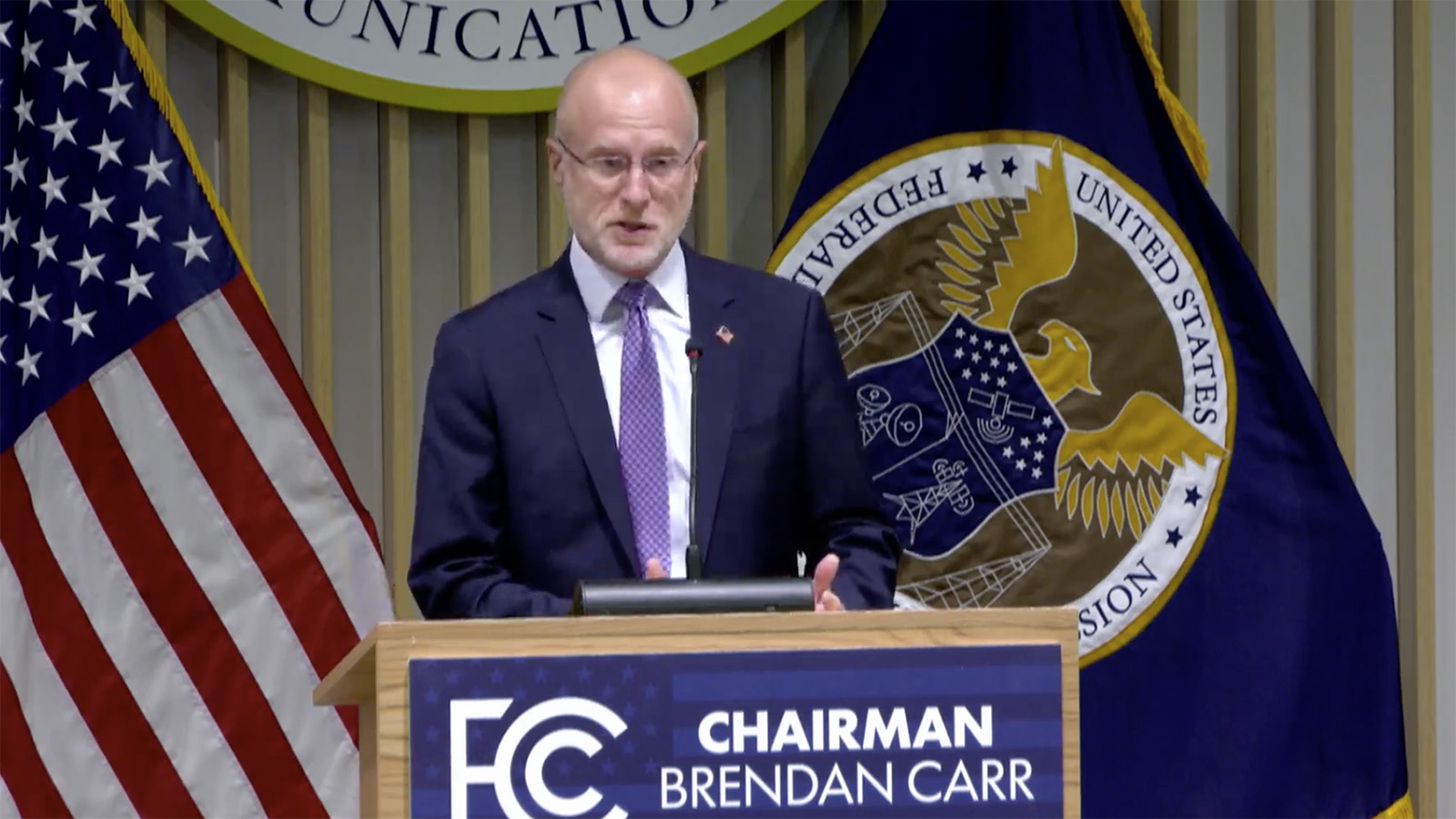
Chairman Brendan Carr laid out the state of play himself. The agency, he said, has three active matters involving Disney: a diversity, equity and inclusion investigation opened in March 2025; an early license-renewal proceeding for ABC’s stations; and an equal-time proceeding tied to the daytime program “The View.”
“We’re full steam ahead. We’re going to follow the facts and the law wherever they take us,” Carr said. He repeated the phrase, or a version of it, in answer to nearly every Disney question.
The sequence behind those proceedings is documented in the public record and is harder to square with Carr’s “standard process” framing.

“The View” received an exemption from the equal-time rule in 2002, a ruling ABC says was never modified. After Texas Senate candidate James Talarico, a Democrat, appeared on the program in February, the FCC’s Media Bureau sent ABC’s Houston station, KTRK, a letter of inquiry, then a supplemental letter directing the station to file a petition for declaratory ruling asking the agency to confirm the exemption it already held. The early license-renewal order followed in April, the day after President Donald Trump publicly called on Disney to fire comedian Jimmy Kimmel.
Carr has tied the renewal review to the DEI investigation.
Asked whether he regretted opening the “View” petition for public comment, Carr deflected with a joke about a “no regrets” tattoo, then described the comment period as routine.
“It’s standard practice when someone files a petition like that to put it out for comment,” he said. He did not address the fact that the FCC had ordered Disney to file the petition in the first place.
Carr also drew a distinction between his words and his position when a reporter quoted a Washington Post account attributing a “campaign of misinformation” line to him.
“I didn’t say that,” Carr said, before adding, “I do think that Disney is running a campaign of misinformation here.”
“Disney has a lot of high-priced lawyers, so I would assume that they understand the law. And the law is actually very clear. Even if you’re not, bonafide news, the law simply requires the offering of comparable time in placement. It doesn’t dictate that you have to be on any particular show. So to the extent that was a statement of law, that’s not consistent with what the law provides,” added Carr.
The misinformation characterization has appeared in statements from an FCC spokesperson responding to an ABC advertising campaign that urges viewers to file comments with the agency.
Gomez: “This is a pretext”
Commissioner Anna Gomez used her own press conference to reject the agency’s framing point by point. She described the DEI investigation underpinning the license review as a pretext and questioned whether the FCC has authority over the matter at all.
“This whole diversity, equity, inclusion investigation is a pretext,” Gomez said, title of commissioner at the FCC. “The FCC is not the EEOC. We are bound by the Communications Act.”
That is a substantive legal claim, not only a rhetorical one.
Gomez said courts have previously told the agency it lacks jurisdiction over the hiring practices of the companies it regulates, and she recalled being “slapped back” as an FCC staffer during an earlier administration’s attempt to police employment practices. Carr, for his part, told reporters the agency’s media actions are “consistent with past cases upholding the FCC’s authority in this area,” without identifying the cases.
On the volume of public comment, both commissioners agreed the raw count does not control the outcome, though they framed the agency’s obligation differently.
Carr cited the Administrative Procedure Act standard requiring the FCC to address significant arguments in the record, and said the decision turns on “the merits of what people are saying,” not a tally. Gomez, who said the docket had passed 44,000 comments, said she expected the agency to “cherry-pick the submissions of partisan organizations,” pointing to filings from two Republican congressional campaign committees in a proceeding about a daytime talk show.
“I’ve talked about enforcement by mob when the FCC tries to gin up opposition,” Gomez said.
Disney’s own filing, referenced by reporters at both press conferences, argues the agency has not articulated a clear equal-opportunity standard and that denying license renewals would be disproportionate to any alleged violation.
Carr said the agency’s January public notice “didn’t break new ground” and merely collected existing precedent. He returned repeatedly to a framing of broadcasters as license-holders rather than owners.
“Broadcast licenses are not property rights,” Carr said. “If there’s nothing you can ever do to lose a broadcast license, it’s not a license, it’s a property right.”
The Paramount-Warner Bros. Discovery question
The second broadcast-ownership matter is the proposed Paramount Skydance acquisition of Warner Bros. Discovery, a roughly $111 billion deal that would place CNN, HBO Max and the Warner Bros. studios under common ownership.
Paramount has disclosed in FCC filings that foreign investors would hold about 49.5% of the combined company, including roughly 38.5% from the sovereign wealth funds of Saudi Arabia, the United Arab Emirates and Qatar. Paramount has asked the agency to approve foreign ownership, and has petitioned for advance approval that could allow those stakes to rise. The company says the Ellison family and RedBird Capital Partners will retain 100% of the voting control.
Carr again described the agency’s posture as routine, contrasting it with a Biden-era radio transaction he said was approved without a full national-security review. “We’re running the standard Team Telecom process first,” he said, declining to commit to a timeline.
Gomez argued the foreign-investment question is serious enough to halt the deal’s closing.

“All signs point to another billionaire buddy bypass without a full commission vote and without proper vetting of these national security concerns,” she said.
She noted that even indirect, non-voting ownership at this scale could shape decisions about what content the combined company carries, and tied the Saudi Public Investment Fund to the killing of a Washington Post journalist. Three Senate Democrats have asked the agency to formally notify Paramount that the transaction may not close while the foreign-investment review proceeds. Paramount faces a September 30 deadline to close.
Emergency alerting: the meeting’s substantive broadcast item
For broadcast engineers, the most consequential adopted item was the report and order modernizing the Emergency Alert System and Wireless Emergency Alerts.
The order requires EAS participants, including broadcasters, to take specified cybersecurity steps: changing default passwords, using strong passwords, promptly installing security patches and using a firewall or comparable network segmentation to limit remote access. The agency framed the requirements as a response to documented hijackings of broadcast EAS equipment, including a 2023 incident in which attackers triggered a false alert about a zombie attack.
Gomez, who supported the item, noted the agency had warned about these vulnerabilities since 2020 and said the order moves from voluntary commitments to mandatory practices.
An accompanying further notice seeks comment on requiring authentication of all alerts before transmission, using universal identification numbers to block duplicate alerts, and expanding geotargeting to allow polygon-based delivery similar to wireless alerts. It also proposes retiring the 90-character cap on wireless alert messages and, notably for station budgets, allowing EAS participants to deploy software-based solutions rather than dedicated hardware.
At his press conference, Carr connected that proposal to broadcaster costs.
“Historically, EAS was governed by expensive, bespoke pieces of equipment, and it was therefore costly,” he said. He said the agency is open to “a more software-based environment, which could potentially drive down costs for broadcasters,” but indicated no new requirements beyond the proposals already on the table.
The commission also adopted, without dissent, an order bringing operators of Next Generation 911 network components under its reliability framework for the first time and ending the annual reliability-certification filing in favor of a one-time certification updated only on material change.
A pattern, depending on who is describing it
Carr told reporters the agency’s media work extends beyond Disney, citing early-renewal action against a broadcast group he identified as Bridge News and a short-term renewal for a Mississippi radio station.
He framed the approach as uniform: “We’re just holding all broadcasters accountable to their public interest obligations.”
Gomez described the same record as selective.
She argued the agency is loosening rules for large incumbents while tightening eligibility for consumer programs such as Lifeline and E-Rate, and using its broadcast authority against companies whose content the administration dislikes. She pointed to the September 2025 episode involving Kimmel as the first time the dynamic “broke through” to the public, and said the “View” comments represent a second.
The agency’s next open meeting is scheduled for July 22.
Several of the Disney proceedings remain in their pleading cycles, and the Paramount foreign-ownership review and the “View” comment period are both expected to resolve before then. How those proceedings are decided, and on what stated grounds, will determine whether the June meeting reads as routine oversight or as something broadcasters have reason to study closely.

tags
ABC, Anna Gomez, Brendan Carr, Disney, Emergency Alert System, FCC, Paramount Skydance, Warner Bros. Discovery
categories
Broadcast Business News, Broadcast Engineering, Heroes, Policy