

FCC to vote on eliminating national broadcast ownership cap
Weekly insights on the technology, production and business decisions shaping media and broadcast. Free to access. Independent coverage. Unsubscribe anytime.
The Federal Communications Commission will vote Aug. 6, 2026, on replacing its national television ownership cap with a case-by-case review process, Chairman Brendan Carr announced Tuesday.
The current rule generally prohibits any single entity from owning stations that reach more than 39% of U.S. television households. Under the proposed change, the FCC would evaluate transactions individually against its public interest standard rather than applying the blanket cap.

“It should not be controversial to suggest that changed facts should lead to changed rules,” Chris Ripley, president and CEO of Sinclair, Inc., said in a statement.
Ripley called the move “common sense” and said Sinclair commends Carr “for his continued leadership in looking at ways to preserve local news by taking proactive steps to empower local broadcasters.”
The ownership cap has been in place for more than two decades without modification, according to the FCC. As currently applied, the rule operates as a blanket prohibition on mergers or acquisitions that would result in a combined entity reaching more than 39% of television households nationally.
The proposed replacement would subject any transaction exceeding that threshold to the commission’s standard public interest review. Deals that meet the standard could be approved; those that do not would be denied.
“There may be transactions that would have exceeded the limits of the 39% national cap that do not promote the public interest and those will be denied,” the FCC said in a statement. “On the other hand, there may be transactions that would have exceeded the cap that do promote the public interest and could gain Commission approval.”
Carr frames cap as outdated
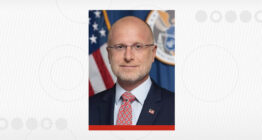
Carr published an op-ed in Breitbart on Tuesday morning laying out his rationale. He argued that the cap no longer serves its original purpose because national programmers and other media companies now distribute content without the same constraint.

“National programmers can distribute their programming to 100 percent of the country — either through their own streaming services or through deals they cut with nationwide ‘virtual cable companies,’ like YouTubeTV,” Carr wrote. “The cap no longer constrains their control over distribution in this respect.”
He pointed to cable channels, social media platforms, streaming services and podcasts as examples of competitors that face no equivalent ownership limit.
“But the 39 percent cap continues to apply uniquely to the owners of local broadcast TV stations — forcing the market out of balance,” Carr wrote.
Carr also drew a comparison to local newspapers, arguing that the FCC maintained a similar investment restriction on newspapers for more than 40 years before eliminating it in 2017.
“Meanwhile, local newspapers shut down by the dozen, and many Americans are now left to choose from a small number of national papers,” Carr wrote. “We can’t let local broadcast TV follow the same path.”
Sinclair among those positioned to benefit
Sinclair, one of the largest broadcast television companies in the U.S., was among the first to respond publicly to the announcement.
The company has long advocated for relaxing ownership limits, and a removal of the 39% cap could open the door for station group operators like Sinclair to pursue acquisitions that are currently prohibited.
Ripley characterized the current rules as failing to reflect “the undeniable change and disruption to the media ecosystem.”
The FCC said the action falls within its statutory authority under the Communications Act and noted that multiple past chairs from both parties have affirmed the commission’s ability to modify ownership limits. Congress, the agency said, “has never withdrawn our authority under the Communications Act to regulate or change ownership limits.”
The vote is scheduled for the commission’s August open meeting.


tags
Brendan Carr, Deregulation, FCC, sinclair broadcast group, sinclair broadcasting
categories
Broadcast Business News, Heroes, Policy