

FCC repeals 39% national ownership cap, opens door to case-by-case review

Weekly insights on the technology, production and business decisions shaping media and broadcast. Free to access. Independent coverage. Unsubscribe anytime.
The Federal Communications Commission voted 2-1 on Thursday to eliminate the rule capping the percentage of U.S. television households a single company’s stations can reach, ending a limit that had stood in some form since 1985.
The agency will now evaluate ownership transactions individually rather than applying a fixed ceiling. Under the previous rule, no company could own local stations reaching more than 39% of U.S. television households.
Chairman Brendan Carr, Commissioner Olivia Trusty voted to approve the Report and Order. Commissioner Anna Gomez dissented.
Adopted under Section 73.3555(e) of the commission’s rules, the national cap generally barred station group owners from exceeding the 39% threshold, regardless of the specifics of a given transaction. The FCC’s Media Bureau, which presented the item, said the rule no longer served its original purpose given changes in how networks distribute programming.
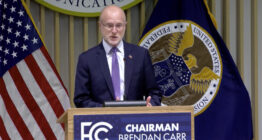
The chairman’s case
Carr framed the vote as a matter of survival for local broadcasting, drawing a direct comparison to the decline of local newspapers following decades of FCC inaction on cross-ownership rules.
“I don’t want local broadcast TV to go the way of local newspapers,” Carr said. “And yet the risk is real.”
“The future of local broadcast TV has to be localism. If they’re just a pass-through, a mouthpiece for the national feed, people can get that through YouTube TV or other channels,” Carr said.
Carr cited a recent op-ed by New York Times editor A.G. Sulzberger stating that more than 80% of local journalism jobs have vanished over the past two decades. He argued that broadcasters, unlike streaming platforms, cable channels or newspapers, face a hard ceiling on national reach even though competitors face none.

“Maybe a deal that exceeds a 39% cap is a good one. Maybe it’s a bad one,” Carr said. “Today’s decision lets the parties make their case.”
On the question of legal authority, Carr pointed to a 2002 D.C. Circuit decision and noted that FCC chairs under the Obama, Biden and first Trump administrations had all previously concluded the commission retains authority to modify the cap.
“I agree with President Biden’s FCC chair. I agree with President Trump’s first FCC chair. And I agree with President Obama’s FCC chair,” Carr said. “At least on this one.”
Trusty said the rule predated the rise of major streaming platforms and had not kept pace with how audiences now consume video.
“When the national broadcast television ownership rule was last meaningfully updated, Netflix had not yet begun its streaming service, YouTube did not exist,” Trusty said, adding that streaming viewership now surpasses the combined share of broadcast and cable.
She said the change would let broadcasters achieve scale that could fund local journalism and improve their negotiating position with national networks, including for sports programming rights. Trusty also noted the item includes initial guidance on how the commission will evaluate individual transactions going forward.
Gomez says cap removal ‘does nothing to protect communities’
Gomez dissented, arguing Congress fixed the cap in law in 2004 and stripped the FCC of authority to change it administratively.
“Today’s decision to eliminate the 39% national audience reach cap is unlawful on its face and a profound departure from both statutory boundaries and long-standing broadcasting policy,” Gomez said. “Congress set this cap in federal law and only Congress can change it.”
She said the 2004 statute removed the cap from the commission’s periodic ownership reviews, barred the FCC from declining to enforce it and required companies exceeding the cap to divest within two years, provisions she said are inconsistent with a discretionary rule the agency can waive at will.
Gomez also raised the prospect that eliminating the cap could shift leverage from national networks to a small number of large station-group owners, without addressing what she described as the underlying causes of newsroom closures.
“A handful of station group giants does not represent the wishes of local broadcasters,” Gomez said. “Trading a squeeze from big tech for a squeeze from big media does nothing to protect the communities this cap was designed to serve.”
She cited a pending legal challenge to the proposed Nexstar-Tegna merger, in which a federal judge found that states and DirecTV were likely to succeed in showing the deal would violate antitrust law, as a warning sign for further consolidation absent the cap.

Industry reaction
The National Association of Broadcasters, which had lobbied for elimination of the cap, praised the vote.
NAB President and CEO Curtis LeGeyt called it “a generational step toward strengthening local stations and ensuring they can compete in today’s media marketplace” and said the change would help broadcasters “invest in journalism, innovation and service to their communities.”
Carr said at a press conference following the meeting that he expects the order to be challenged in court, noting that FCC media ownership decisions have historically drawn litigation.
Gomez said she anticipates the change will lead to a wave of new merger filings that will test how the commission applies its public-interest standard on a case-by-case basis.
“It’s going to be an invitation to bring in a lot of transactions,” Gomez said. “I’m very curious to see what exactly the test is going to be for serving the public interest of a particular merger.”
The order takes effect following publication in the Federal Register.

tags
Anna Gomez, Brendan Carr, Curtis LeGeyt, Deregulation, FCC, NAB, Olivia Trusty
categories
Broadcast Business News, Heroes, Policy