

As FCC reviews sports broadcasting, NFL says current model works for fans and local stations

Weekly insights on the technology, production and business decisions shaping media and broadcast. Free to access. Independent coverage. Unsubscribe anytime.
The National Football League met with senior Federal Communications Commission staff on April 17 and filed a formal notice of that meeting four days later, entering the agency’s open proceeding on sports broadcasting with a detailed defense of its current distribution model.
The filing, submitted by Brendon Plack, senior vice president of public policy and government affairs at the NFL, was addressed to FCC Secretary Marlene H. Dortch and entered into MB Docket No. 26-45, the commission’s proceeding on sports broadcasting practices and marketplace developments, which has seen over 8,600 entries, including some from other major sports entities like the SEC.
The filing included an attached presentation titled “NFL Media Overview” that outlined the league’s media distribution structure and viewership figures.
Broadcast still primary, league says
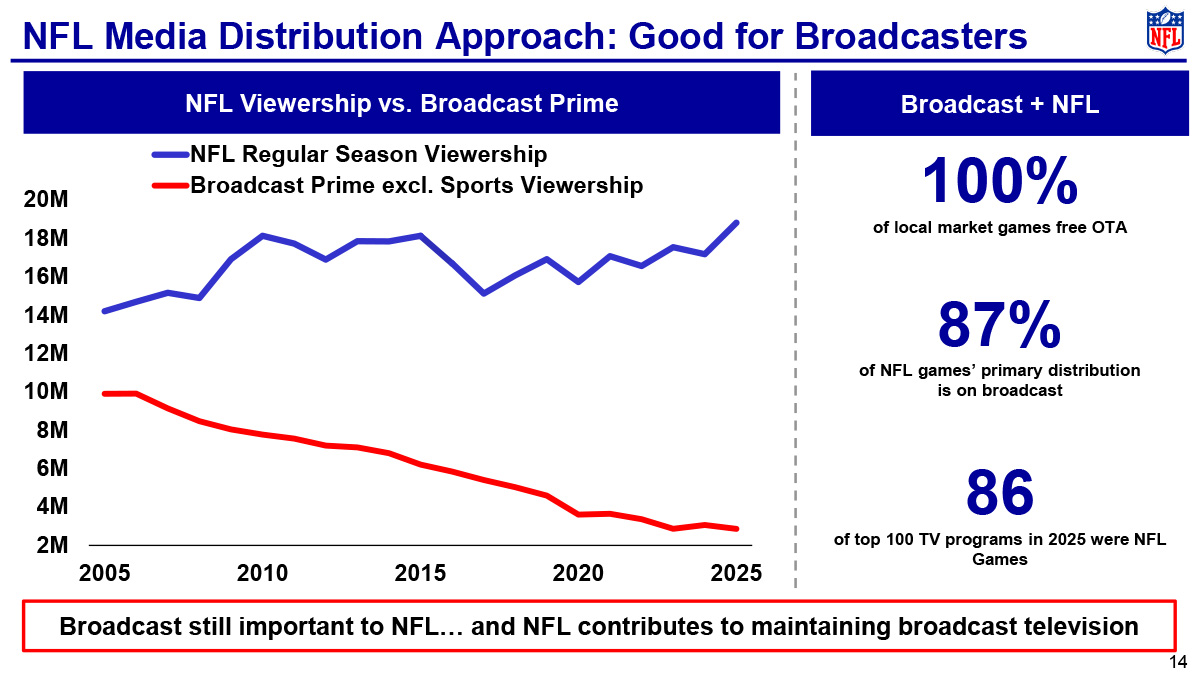
The NFL told FCC staff that contracts with ABC, CBS, Fox and NBC account for the distribution of more than 87% of all NFL games, a share that the league said has varied little over the past two decades. All games are available free over-the-air in the home markets of the competing teams.
“Since its founding, the NFL has strived to put its fans at the center of everything we do,” the filing stated.
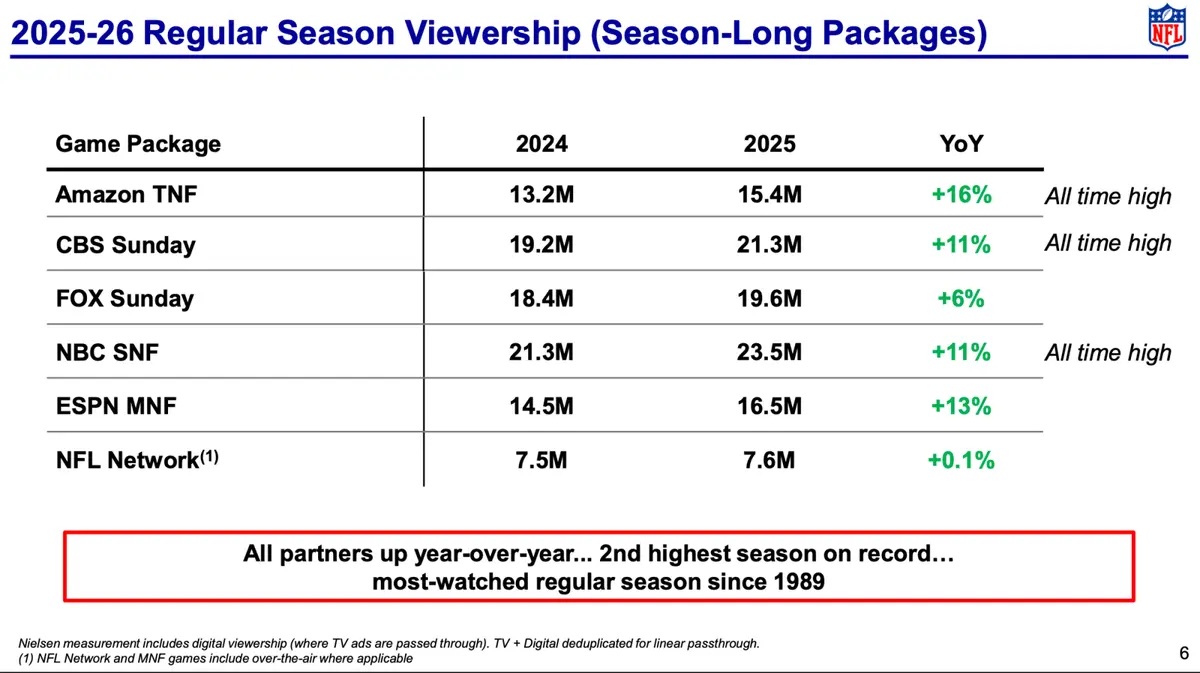
The league’s presentation cited data showing that the 2025 regular season was the most watched since 1989, with viewership up year-over-year across all distribution partners. NBC’s “Sunday Night Football” averaged 23.5 million viewers in 2025, up 11% from the prior year and an all-time high for the package. CBS Sunday games averaged 21.3 million viewers, also an all-time high, up 11%. Amazon’s “Thursday Night Football” on Prime Video averaged 15.4 million viewers, a 16% increase and another all-time high for that package.
Eighty-six of the top 100 television programs in 2025 were NFL games, according to data included in the presentation. “Sunday Night Football” on NBC has ranked as the top primetime show for 15 consecutive years, the league said.

A shifting media landscape
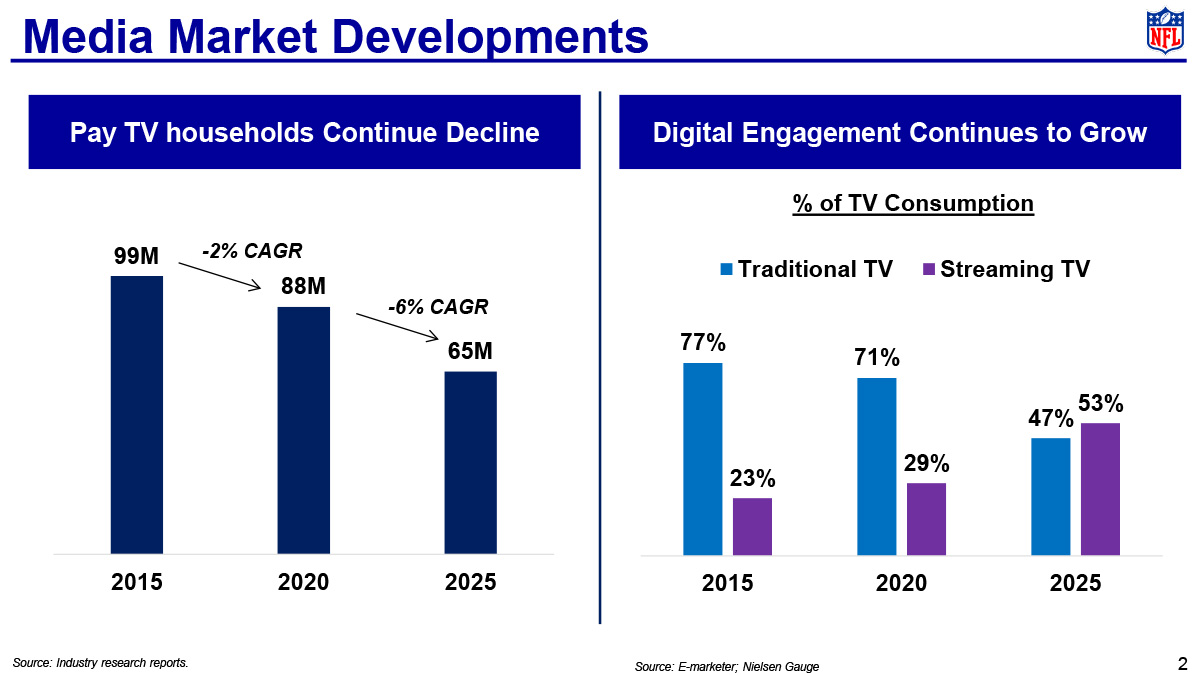
The presentation acknowledged broader changes in how Americans consume television. Data attributed to eMarketer and Nielsen Gauge showed pay TV households fell from 99 million in 2015 to 65 million in 2025. Over the same period, streaming’s share of total TV consumption grew from 23% to 53%, while traditional TV’s share dropped from 77% to 47%.
Against that backdrop, the NFL argued that its league-wide approach to media rights insulates fans from the kind of fragmentation affecting other sports. The presentation noted that if each of the league’s 32 teams negotiated its own media deals, fans would face a more fragmented and expensive landscape to follow the sport.
The filing also argued that the league’s distribution approach supports local broadcasters by generating viewership and advertising revenue that sustains network operations beyond sports programming.
A crowded docket
The NFL’s filing landed in a proceeding that has drawn responses from across the broadcast and policy landscape. The FCC’s Media Bureau opened the docket in February with a public notice seeking input on sports broadcasting practices and marketplace developments.
The National Association of Broadcasters, in its own reply comments, framed the issue in sharper terms, arguing that the migration of sports rights to streaming platforms threatens local stations and the news operations they fund.

“Taking the record as a whole, there isn’t any credible argument as to why broadcast television shouldn’t remain the lifeblood of the live sports ecosystem,” the NAB wrote.
Cox Media Group and the E.W. Scripps Company filed separately, each linking sports programming revenue to the financial health of local news. Cox cited data from Sinclair’s comments showing the NFL generates $6.7 billion in annual advertising across the major broadcast networks. NAB noted that, by some estimates, subscribing to every service that carries NFL games can cost approximately $1,500 per year.
Cox also raised the issue of access, noting that lower-income, elderly and rural households are the most affected when sports content moves away from free broadcast distribution.
“For these audiences, fragmentation is more than inconvenience. It is exclusion,” Cox wrote.

The joint filing from affiliate associations representing more than 700 local stations affiliated with ABC, CBS, Fox and NBC asked the FCC to clarify that local stations have the right to preempt network programming in favor of local and regional sports content without risking damage to their network agreements. The affiliates also pressed the commission to require virtual pay-TV providers to negotiate retransmission consent directly with local stations rather than through the networks.

The Southeastern Conference offered a different perspective, defending the current conference-based model for college sports media rights. Commissioner Greg Sankey signed the filing, which noted the SEC distributed more than $1.03 billion to member institutions in the 2024-25 fiscal year. The conference argued that centralized pooling of college sports rights would reduce output, particularly for women’s and Olympic sports.
“Every historical attempt to centralize college sports media rights — the pre-1984 NCAA model, the College Football Association — generated far less revenue than the conference-based model that replaced it,” the SEC wrote.
What the NFL is asking for
Unlike the NAB and affiliate associations, the NFL’s filing did not call for specific regulatory changes.
The league’s presentation positioned its current model as one that already achieves the access and affordability goals that other filers said require FCC intervention.
The FCC has not indicated a timeline for further action in the docket.

tags
FCC, football, Media Rights, NFL
categories
Broadcast Business News, Featured, Policy, Sports Broadcasting & Production