
Newsreel bets Gen Z will trade TikTok’s algorithm for curated news with quizzes and streaks
Weekly insights on the technology, production and business decisions shaping media and broadcast. Free to access. Independent coverage. Unsubscribe anytime.
Jack Brewster spent years writing Forbes articles he knew would be read primarily by algorithms. The headlines were optimized for Google. The structure catered to Facebook’s ever-shifting feed preferences. The actual readers felt like an afterthought.
His parents had met at Life magazine, back when journalism meant producing a physical object that landed on coffee tables across America. Brewster’s version of journalism meant feeding content into platforms controlled by companies that viewed news as just another category of engagement data. After a stint at NewsGuard rating the credibility of news websites and a Fulbright research project studying how the internet reshapes thinking patterns, he decided the distribution model for news was fundamentally broken.
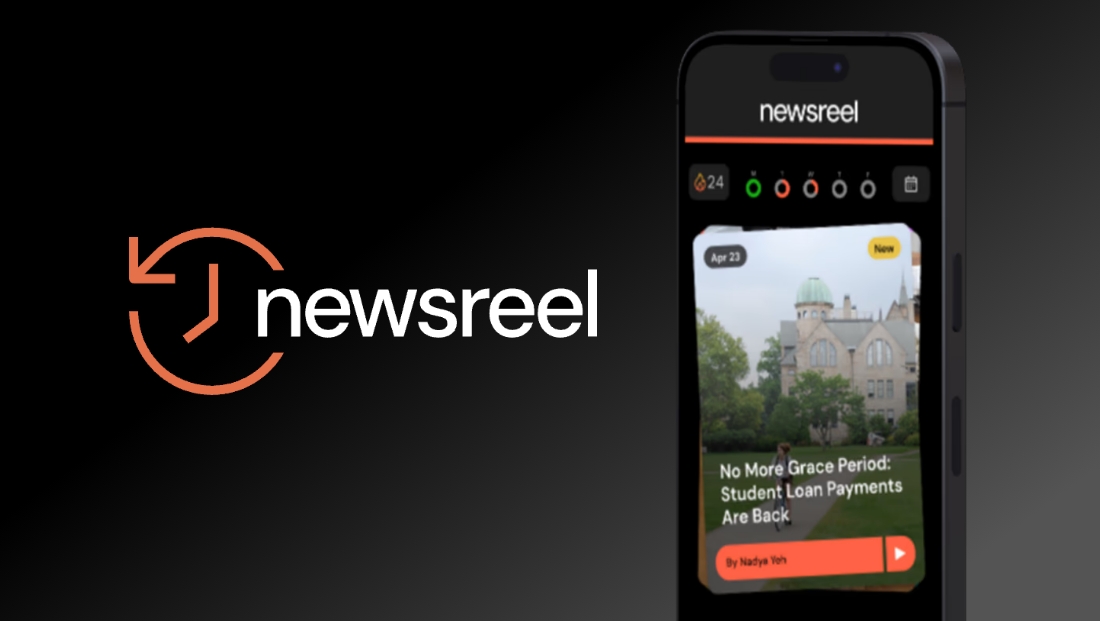
So in 2024, he built Newsreel, a mobile app that combines the swipeable interface of TikTok with the streak mechanics of Duolingo to deliver curated news stories to younger readers.
“I wanted to create a separate pipeline, a separate way of getting news that wasn’t your parents’ news app, but also wasn’t a social media app either,” said Brewster in an interview with NCS. “I have poured all of my heart… my effort into building this app that I hope will be a better distribution method for higher quality journalism.”
“I think of TikTok and Instagram as online casinos,” Brewster said. “We do use some of those same features and I’m not shy about it. I think that in order to play this game, news is going to have to if it’s going to survive.”
The statement captures both the ambition and the uncomfortable compromise at the heart of Newsreel’s approach.
Brewster is trying to compete with platforms that have fundamentally altered how a generation consumes information.
Research from Pew Research Center shows that 43% of adults under 30 now get news from TikTok. Twenty percent of all adults regularly get news from influencers they encounter algorithmically on social media. A September 2025 survey commissioned by Media.net found that 73% of respondents watch short-form video multiple times per day.

The question Newsreel is trying to answer is whether you can use the mechanics of addictive platforms to deliver something closer to actual journalism.
The app recently received investment from the Glen Nelson Center at American Public Media Group, marking what Brewster hopes will be a turning point in Newsreel’s reach. The company plans to open a pre-seed funding round in early 2026 as it expands from its initial launch in schools and libraries to a broader audience in the U.S. and Europe.
Why news needs a new distribution model
Brewster’s diagnosis of the problem is straightforward: traditional news outlets spent the past decade chasing algorithmic incentives and lost an entire generation in the process.
“If I’m writing for Google, I’m going to fashion my stories in a certain way. Same thing goes if you’re an influencer,” he said. “On Newsreel, the incentive is different. We’re trying to help give you higher-quality information and build a habit around that.”
He described the current internet as a “post-literate society” where success depends on communicating through short-form video. But he predicted a correction is coming.
“I think people are nostalgic for a reason right now. They do miss, at least in some parts of the internet, the intimacy that they used to have,” he said. “There was some gatekeeping that happened. There was tiers of information, and we’ve completely gotten away from that.”
When Instagram has Reels, X has its own TikTok clone and Facebook has pivoted to video, the competition for attention becomes unsustainable.
“Everything is video now and when everything is video and you’re competing with AI slop… There is a storm coming,” he said. “I think the future of the internet is more niche communities, based around things other than just short-form algorithmic video.”
The shift has been rapid.
In 2020, just 3% of U.S. adults got news on TikTok. That figure jumped to 20% by 2025. The speed of that change should worry traditional broadcasters, Brewster said, because it suggests viewing habits can collapse faster than stations expect.
For example, most of Brewster’s peers did not engage with local news while growing up.
“They didn’t grow up with a local news site. They get what they call news from the local Reddit thread,” he said, noting these communities are opportunities for news organizations.

How the app works
Newsreel launched with a deliberately narrow focus. Rather than competing directly with TikTok for attention, Brewster partnered with schools and libraries to introduce the app through those channels.
“We’ve been partnering with teachers to push this onto their students and using student ambassadors,” he said.
The strategy appears to have gained traction. The National Association for Media Literacy Education named Newsreel a 2025 Resource of the Year. User retention has been strong, according to Brewster, though he did not provide specific metrics.
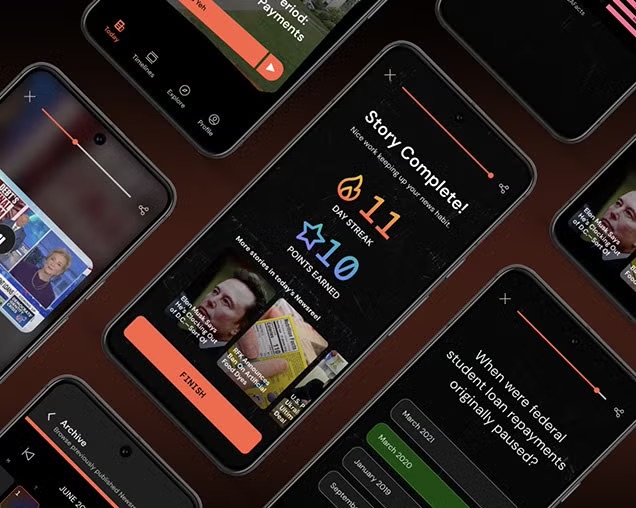
The app’s core mechanic is simple: users receive a curated set of stories each day and must complete them to maintain their streak. After each story, they answer a quiz question for points and respond to a poll question on the topic. The app tracks how their positions change over time and shows them how their views compare to other users.
“I think a lot of young people particularly feel like they’re just bombarded with opinions all day and they don’t really know where they stand,” Brewster said. The company plans to expand these polling features in the coming months to show users stories that present views different from their own. The app added social features in early November, allowing users to add friends and see each other’s polling responses.
But the addition of social features raises questions for a founder who previously covered online misinformation.
“People keep asking for more and more social features. They want to see more what their friends believe. They want communities online, like groups,” he said. “As soon as you say that, the journalist who’s covered radicalized groups online starts to think, oh God, am I becoming part of the problem? So I want to make sure we do that right.”
The company is also wrestling with how much choice to give users in selecting stories.
Some users have asked to focus only on sports and entertainment while avoiding politics. Brewster said this creates tension with the app’s stated mission of providing a balanced news diet.

“That’s an open question that I have: what do users want and how do we give that without straying too far away from our mission,” he said.
The path forward
Newsreel has run pilot programs with national news outlets and college newspapers but has not made these partnerships public. Brewster compared the potential model to Apple News or Yahoo News but said those services have not successfully adapted to current user expectations.
The company is also evaluating partnerships with individual journalists.
Brewster said he sees an opportunity to create a model that offers better revenue sharing than Substack while avoiding what he called “newsletter fatigue.”
“I can’t tell you how many people just said that they’ve subscribed to too many emails now,” he said. “Inboxes are flooded and people need a completely new way of creating a direct relationship between a journalist and a reader.”
The most significant challenge ahead will be local news.

Brewster acknowledged that while his app focuses on national stories, the collapse of local journalism creates a gap the app does not currently address. Some college newspapers now produce the only substantive local coverage in their areas, he said, and the company has begun partnering with student outlets to offer their content through Newsreel’s format.
“Is there enough out there to sort of satisfy the needs in terms of local news on the platform?” he said. “Can we get that kind of content at that scale? That’s another question.”
The supply problem is real. Broadcasters are consolidating local stations under the assumption that the market will eventually leave just a couple of players. If those stations continue to prioritize repackaged national stories over local coverage, the gap will only widen.
But Brewster sees an opportunity in the collapse.
As AI-generated content floods inboxes and algorithmic feeds become indistinguishable, he believes users will seek alternatives.
“There’s going to be a premium on authenticity, human-created curation in a way that there really hasn’t been in the last 25 years,” he said.
The company will use the Glen Nelson Center investment to test whether that theory holds beyond schools and libraries. For now, Newsreel is betting that at least some portion of Gen Z wants to escape the algorithm, even if it means trading one set of dopamine hits for another.

tags
American Public Media Group, Jack Brewster, Newsreel, Vertical video
categories
Heroes, Journalism, Online and Digital Production, Social Media