

What does it mean if the FCC isn’t independent?

Weekly insights on the technology, production and business decisions shaping media and broadcast. Free to access. Independent coverage. Unsubscribe anytime.
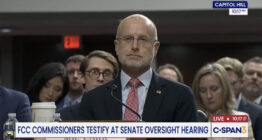
When Sen. Ben Ray Luján asked Federal Communications Commission Chair Brendan Carr whether the agency is independent during a Dec. 17 oversight hearing, the answer did not match what appears on the FCC’s website (at least at the time).
“The FCC is not formally an independent agency,” Carr said, pointing to the lack of “for cause” removal protections for commissioners. “The president is the chief executive vested with all executive power in our government, and FCC commissioners do not have for cause removal protections, which means that we aren’t independent.”
The statement represents a departure from how the commission has historically characterized itself. The FCC website had described the agency as “an independent U.S. government agency overseen by Congress.”
Luján pressed Carr on the discrepancy.
“Is this factual or is this a lie?” Luján asked, holding up a printout of the FCC homepage.
“Possibly,” Carr responded, adding that the key legal test of independence is whether officials can be removed by the president without cause. “The sine qua non of independence is being removable by the president.”
Of course, as soon as this “discrepancy” was pointed out, the website was modified to remove the term “independent.”
Commissioner Olivia Trusty agreed with Carr’s interpretation.

“The president is the chief executive vested with all executive power in our government and FCC commissioners are not, we do not have for cause removal protections, which means that we aren’t independent,” Trusty said.
Commissioner Anna Gomez disagreed. When asked the same question, she said simply, “Yes, and we should be.”
The legal framework
The question of FCC independence turns on statutory language and Supreme Court precedent. The Communications Act of 1934, which created the commission, does not explicitly provide “for cause” removal protection for commissioners. Such language typically requires that an official can only be removed for specific reasons such as neglect of duty or malfeasance, rather than at the president’s discretion.
Carr referenced the 1935 Supreme Court case Humphrey’s Executor v. United States, which established that Congress can limit presidential removal power for certain independent agencies. However, Carr argued that because the Communications Act was passed in 1934, one year before that decision, and contains no explicit removal protections, commissioners serve at the president’s pleasure.
“The theory had been that courts would read for cause removal into the statute and that was the basis for that viewpoint,” Carr said. “I think now it’s clear that that’s not the case.”
The interpretation marks a shift from Carr’s own previous statements.
In prior testimony before Congress, Carr stated that “Congress long ago determined that the FCC is an independent expert agency” and that Congress “placed the authority outside of the executive branch for a reason.”
When asked about the apparent contradiction, Carr said there has been “a sea change in sort of the law in the approach” since he wrote that statement.
Practical implications for the broadcast industry
If the FCC operates as an arm of the executive branch rather than an independent regulator, the shift affects how the commission approaches decisions on mergers, licensing and enforcement.
Independent agencies are designed to insulate technical and quasi-judicial decisions from short-term political considerations. The model assumes that commissioners will apply expertise and statutory mandates rather than align decisions with White House priorities.
Carr made clear he views his role differently.
When asked if President Trump is Carr’s boss, Carr said Trump designated him as chairman and can remove him from the commission entirely.
“I think it comes as no surprise that I’m aligned with President Trump on policy,” Carr said. “I think that’s why he designated me as chairman.”
Smith pressed further: “Do you consider him your boss?”
“The president designated me as chairman,” Carr replied. “I can be fired by the president. The president is the head of the executive branch.”
For broadcasters, this framing suggests that FCC decisions on ownership limits, retransmission consent rules and license renewals may track more closely with administration policy goals. Companies whose business strategies align with White House priorities could see favorable treatment, while those whose interests diverge may face greater scrutiny.
The approach also raises questions about how the commission evaluates public interest obligations. If commissioners view themselves as implementing executive policy rather than exercising independent judgment, the standard for what serves the public interest becomes more fluid and potentially more politicized.
Historical context and norms
The FCC has traditionally operated under a bipartisan structure intended to prevent any single party from dominating decisions. The commission consists of five members, with no more than three from the same political party. Commissioners serve five-year terms that are staggered to avoid complete turnover with each presidential administration.
This structure was designed to promote stability and consistency in telecommunications policy. The assumption was that commissioners, once appointed, would exercise independent judgment based on technical expertise and statutory mandates rather than political loyalty.
Carr’s characterization upends that model.
If commissioners can be removed at will and view their role as implementing presidential priorities, the bipartisan structure becomes less meaningful. A president could, in theory, remove commissioners who vote against administration preferences and replace them with more compliant officials.
Sen. Tina Smith asked Carr directly whether it would be appropriate for the president to remove a commissioner solely because he disagrees with their votes.
“The president can remove any member of the commission for any reason or no reason at all,” Carr said.
“I know that, but do you think that’s appropriate?” Smith asked.
“It’s up to the president to decide,” Carr replied.
Divergent views among commissioners
The hearing exposed a clear split among commissioners on the question of independence. Gomez repeatedly emphasized that the FCC should function as an independent regulator constrained by the First Amendment and statutory limits on its authority.
“This administration has been on a campaign to censor content and to control the media and others, any critics of this administration,” Gomez said in response to questions about broadcaster investigations. “And it is weaponizing whatever levers it has in order to control that media. That includes using the FCC to threaten licensees.”
Gomez said the commission’s role is to apply consistent legal standards, not to advance political objectives. “The First Amendment governs what we do, as does the Communications Act prohibition on censorship, and this commission is abusing that,” she said.
Trusty took a different view, emphasizing that commissioners have statutory obligations to enforce public interest standards for broadcast licensees. “My job is to enforce the law as it relates to broadcasters,” Trusty said. “Broadcasters have public interest obligations, and it relies on a case-by-case basis.”
The disagreement suggests that the question of FCC independence is not merely academic. It reflects fundamentally different views about the commission’s role and the constraints on its authority.
The FCC’s stance on independence has direct consequences for how the broadcast and media industries plan long-term investments and navigate regulatory risk. If commissioners view themselves as implementing executive policy, companies must factor White House priorities into merger timelines, programming decisions and capital allocation.
This creates winners and losers based on political alignment rather than market fundamentals. Broadcasters whose content or business models align with administration preferences may find smoother paths through license renewals and transaction approvals. Those whose operations conflict with White House priorities face heightened regulatory scrutiny regardless of whether their conduct violates specific statutory requirements.
The shift also erodes predictability. Independent agencies provide stability across administrations because decisions are based on technical expertise and statutory mandates that change slowly, if at all. An FCC that views itself as part of the executive branch introduces volatility, as policies can shift dramatically with each election.
Carr’s assertion that he can be fired for any reason or no reason at all makes the point explicit. If commissioners operate under that constraint, the commission’s claim to technical expertise and impartial judgment becomes difficult to sustain. What remains is an agency that regulates based on the policy preferences of whoever occupies the White House, with all the uncertainty and risk that entails.

tags
Anna Gomez, Brendan Carr, Deregulation, FCC, Olivia Trusty
categories
Broadcast Business News, Featured, Policy