

WBD’s Olympic production starts on the slopes of Cortina and Livigno
Weekly insights on the technology, production and business decisions shaping media and broadcast. Free to access. Independent coverage. Unsubscribe anytime.
For the 2026 Winter Olympics, Warner Bros. Discovery opted to place its main broadcast studios closer to the competition, nestled in the mountains, outside the confines of the International Broadcast Centre.
The result is a pair of purpose-built structures, one in Cortina d’Ampezzo and another in Livigno, that serve as the on-air home for coverage across 47 markets and 21 languages on WBD Sports. The Games are carried on Eurosport, TNT Sports, HBO Max, Discovery+ and Player.pl.
“When the audience turns on our coverage every day, we want them to see the mountains, the snow,” said Scott Young, executive vice president at WBD Sports Europe, in an interview with NCS. “We don’t want to be inside an IBC studio.”
“We are in this region. These are our games. They’re in our time zone. They’re in our backyard,” said Young. “We want to be where the action is.”
The approach is part of a long-term rethink of the IBC’s role in covering major sporting events, with the space requirements shrinking each Olympic Games. The IBC now functions primarily as a relay point for WBD, a place to receive signals from Olympic Broadcasting Services and route them to facilities in London and Paris, and from there to local markets across Europe.
“Every Games that goes past, we have a smaller requirement on ground at the IBC,” Young said. “For us, a footprint in the IBC is a relay station to take the signals from OBS.”
The WDB House and the Snow Dome
WBD’s primary studio, called WBD House, sits in the Nations Village in Cortina d’Ampezzo, in an area with multiple temporary structures for rights-holding broadcasters.
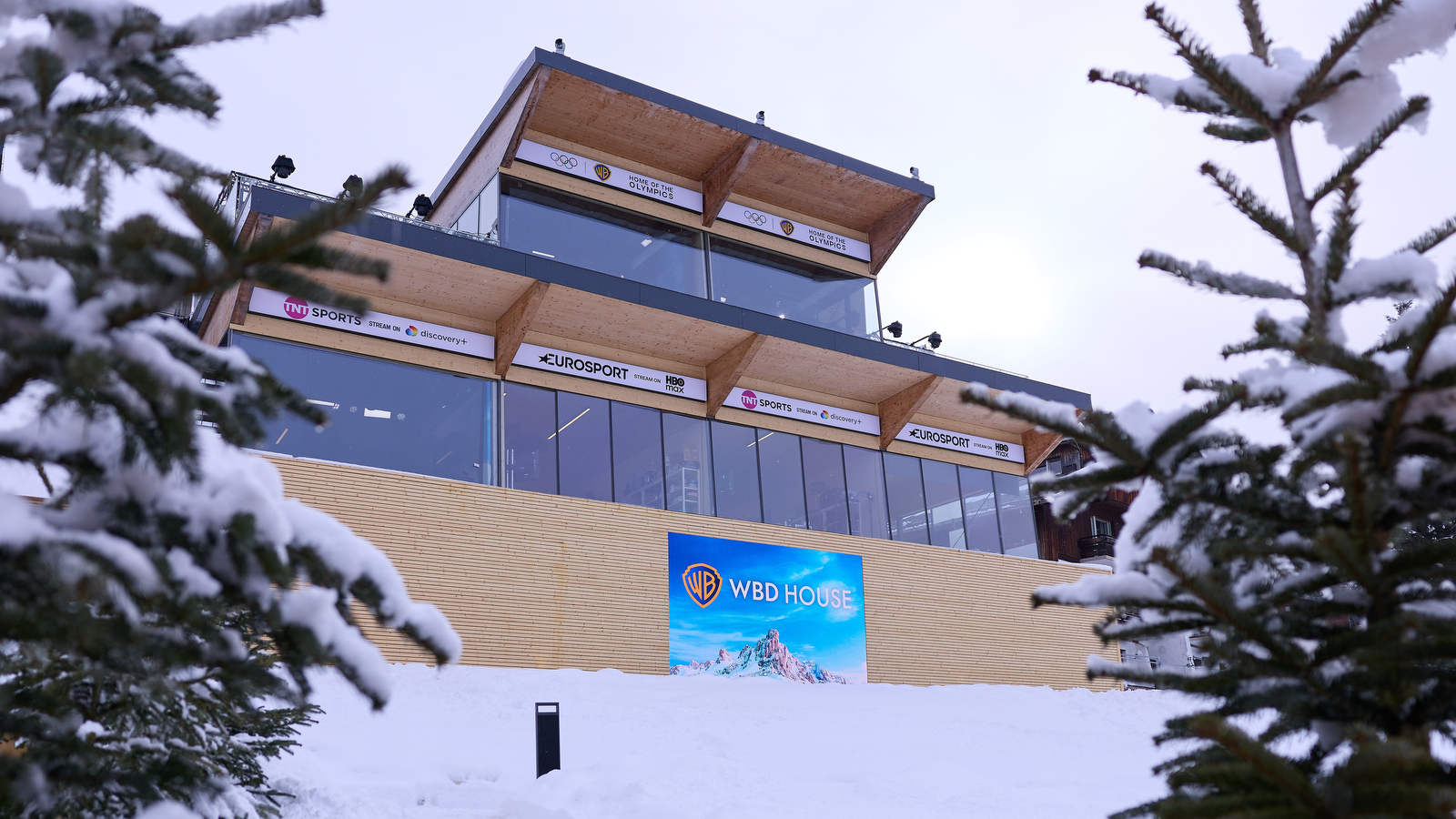

The two-story, nearly 6,500-square-foot structure was assembled over three weeks using 217 pieces of steel and glass, some recycled from previous Games. Its exterior-mounted cameras capture views of the Dolomites and nearby Olympic venues, including the Tofane Alpine Skiing Centre and the Cortina Sliding Centre.
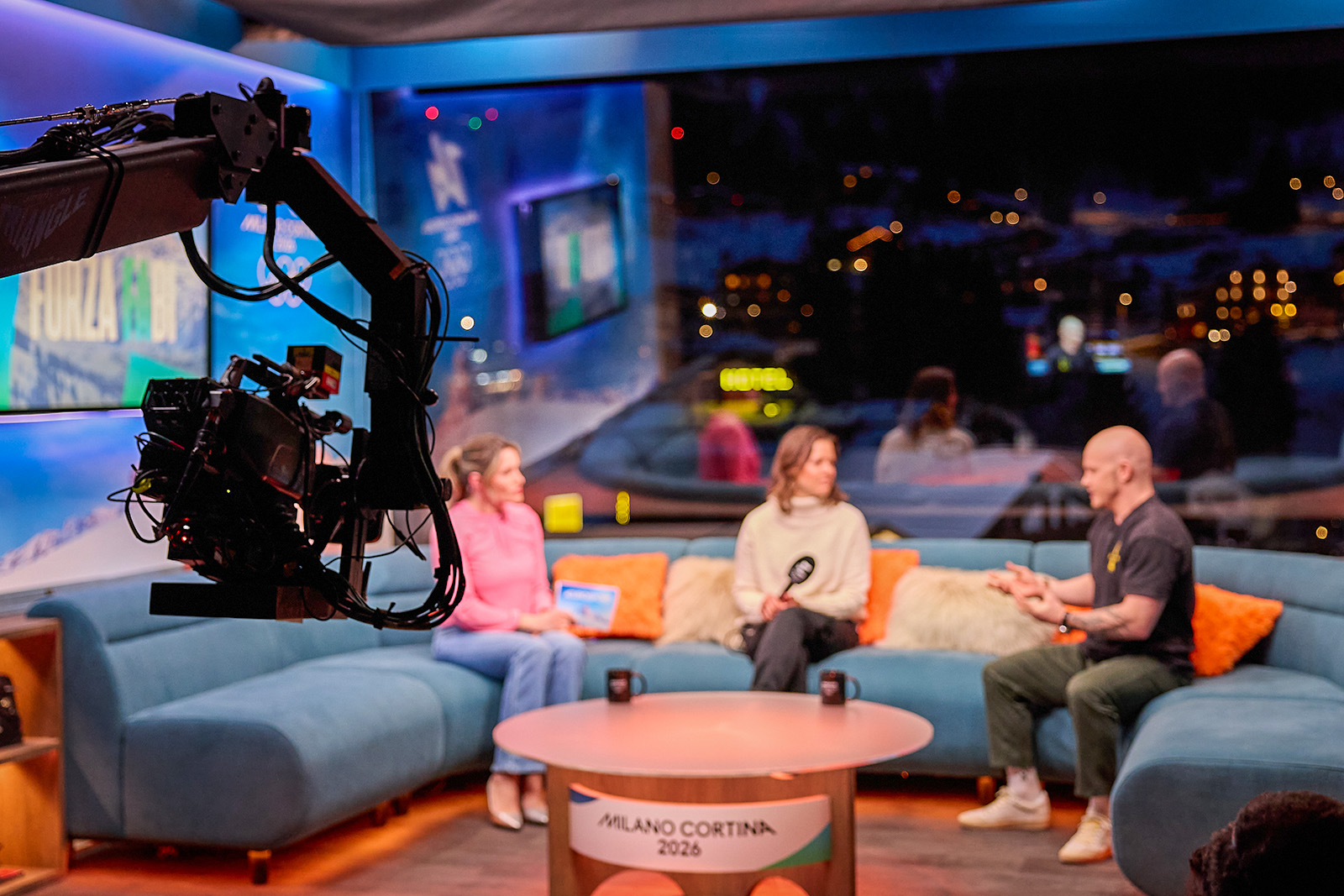
Inside, the building houses three studios, including two with anchor desks and one with a large semi-circular couch. Scenic design for the spaces was handled by Toby Kalitowski of BK Design Projects, who kept the focus on the view with minimal elements framing it.
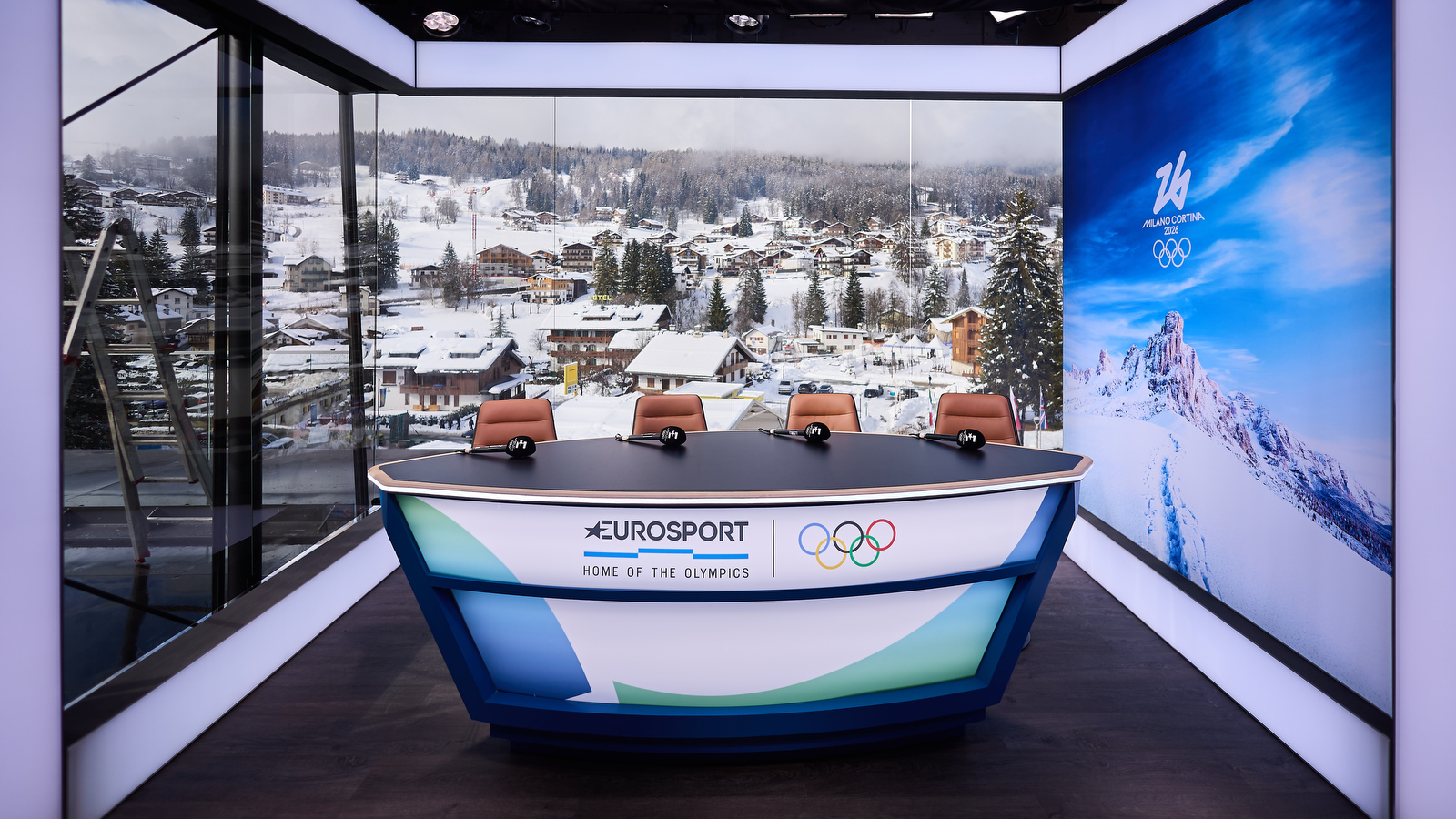
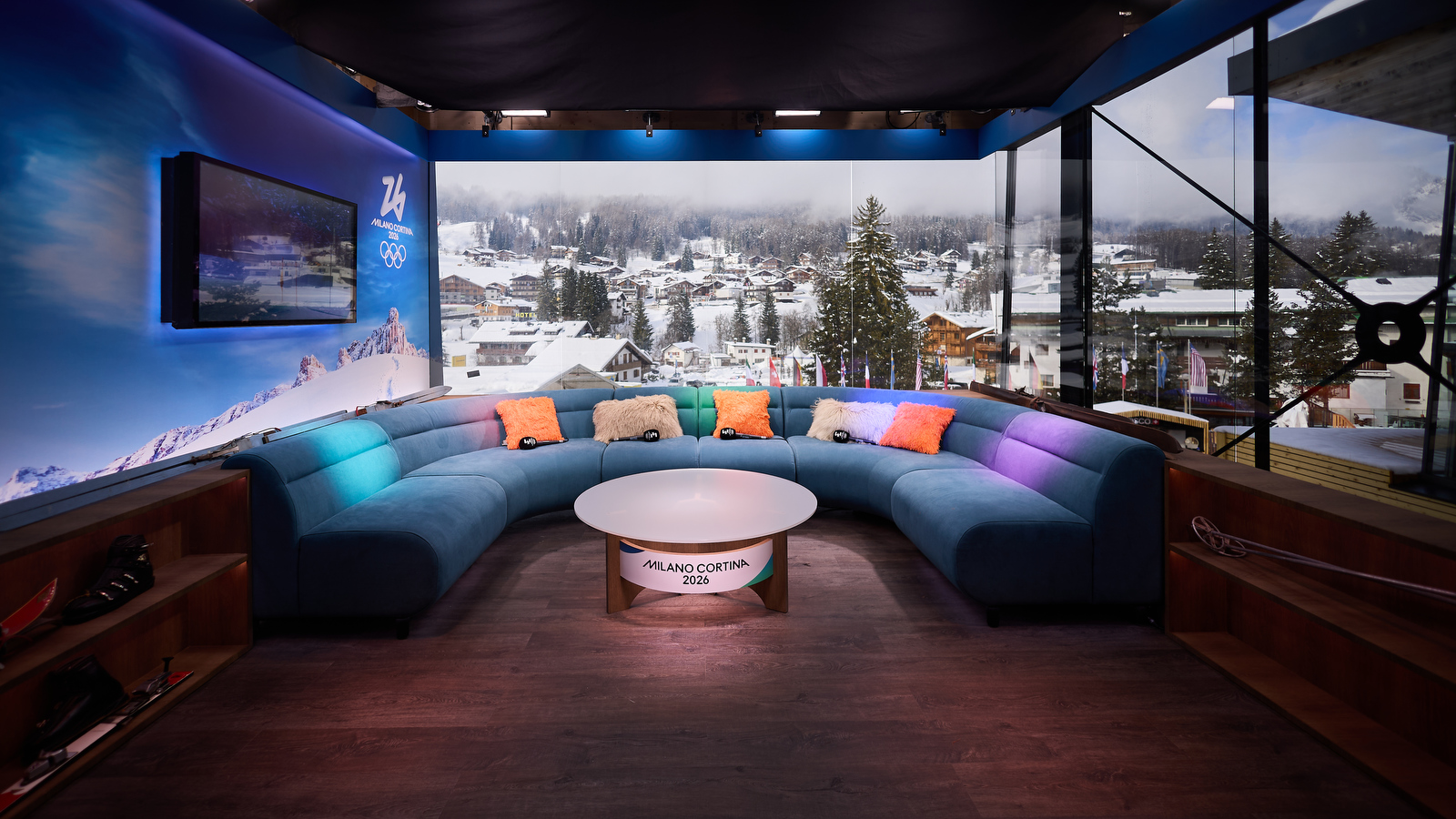
A total of 12 cameras serve the facility, with each studio outfitted with three fixed cameras and a jib. The WBD House also has a drone that captures footage of the surrounding village, two RF cameras, a Steadicam and three exterior extended reality cameras used to layer on augmented reality graphics across broadcasts.
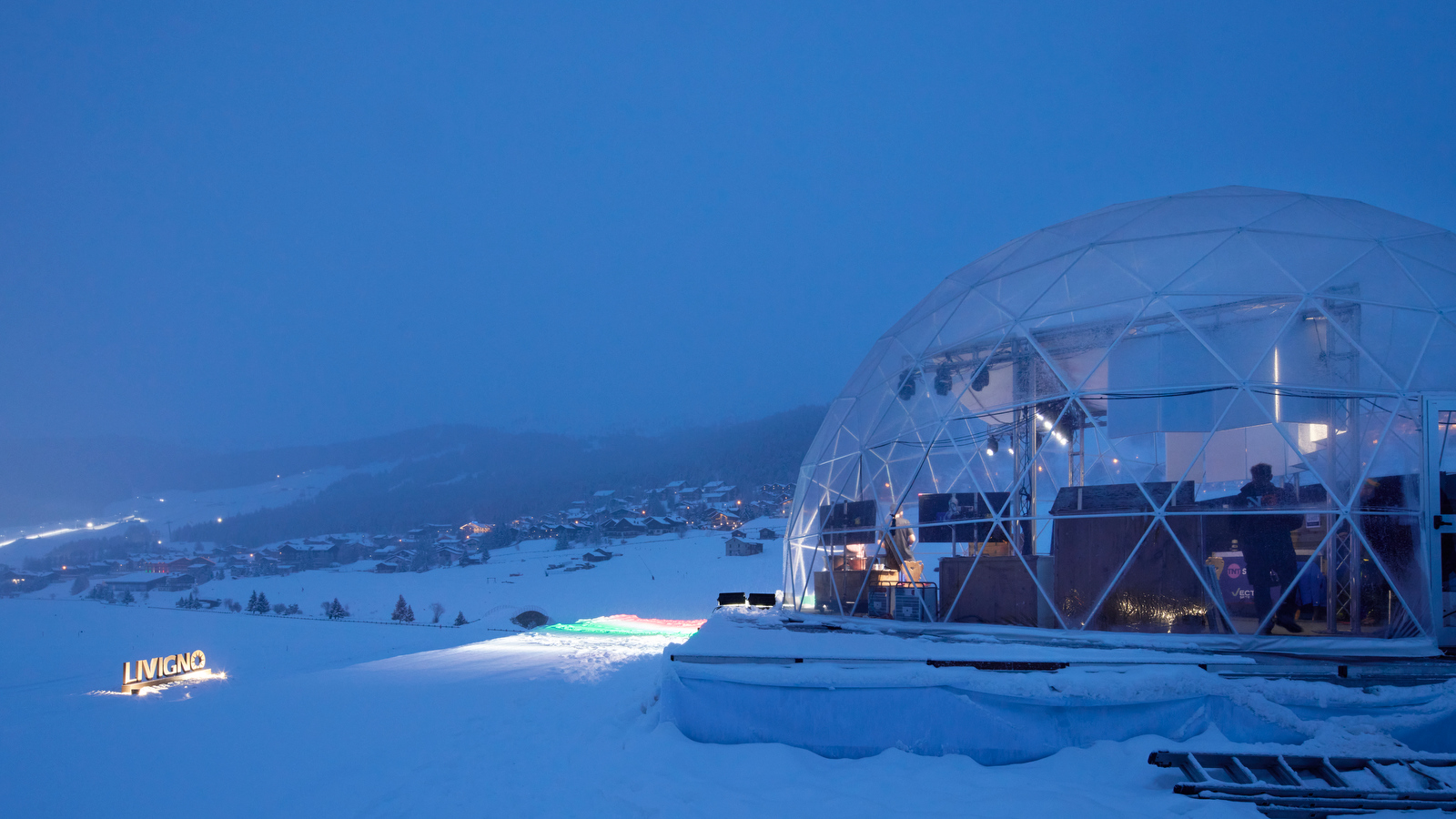
A second structure, called the Snow Dome, is located in the high-altitude town of Livigno.
The 20-foot domed studio covers roughly 1,000 square feet and offers a 360-degree view of the slopes used for freestyle skiing and snowboard events.
Remote production at scale
The studios in Italy are not self-contained production facilities. Much of the technical operation, including camera control, direction and production. is handled remotely from WBD’s facilities in home markets.
“There are 12 cameras. There are three camera operators. Many of the cameras are remotely operated from our base back in London,” Young said of WBD House. “The German studio, Norwegian studio, Polish studio and Italian studio — they’re effectively produced back in their home markets, with the talent and one producer here on site.”
WBD has 400-plus staff in Italy for the Games, supported by approximately 1,300 more working from production hubs across Europe.
Local analysis and studio shows are produced from facilities in London, Paris, Milan, Munich, Madrid, Oslo, Stockholm, Lisbon, Copenhagen, Hilversum and Warsaw.

Rather than concentrating staff at the IBC, WBD deployed reporters to every mixed zone across all six competition clusters. Mixed zones are areas where athletes and press mix as they enter or exit a venue. Young described this as a higher priority than maintaining a large centralized presence.
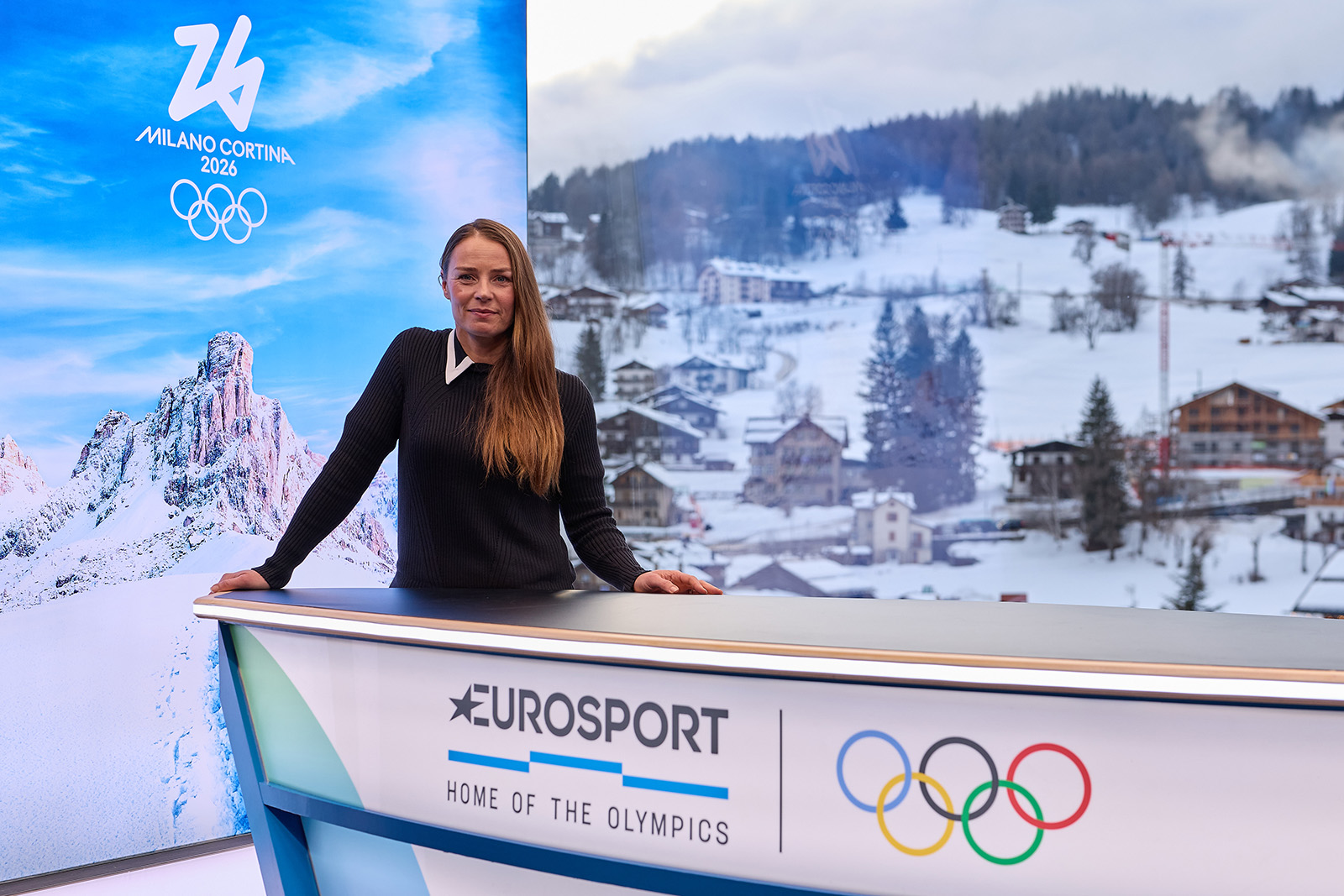
Tina Maze, double Olympic gold medallist and part of the Eurosports broadcast team.
“We have people in every mix zone of every sport all the time,” he said. “And that is more important to us than having a large footprint at the IBC.”
WBD House connects to the IBC via a fiber path from the studio to the nearby Cortina Curling Olympic Stadium, where it joins the OBS fiber network. That network links the mountain venues to the IBC, and from there, signals are sent to WBD’s facilities in London and Paris for distribution.
“Being on the OBS backbone and using their fiber gives us a level of redundancy and also resilience,” Young said. “We know that OBS sets up a very strong fiber network for every Olympic Games, and we heavily rely on that.”
The structures were designed with disassembly in mind. WBD House will be broken down after the Games, and its components returned to the Austrian company that fabricated them. Young described sustainability as a guiding factor in the studio design.
“When we pack up and leave, we want to make sure we leave the smallest impact into the environment to where we were,” he said.
Photos courtesy of WBD Sports / Getty Images

tags
2026 Winter Olympics, BK Design Projects, eurosport, Scott Young, TNT Sports Europe, Warner Bros. Discovery, WBD Sports
categories
Heroes, Olympics, Set Design, Sports Broadcasting & Production