

Al Arabiya’s new Riyadh facility puts the newsroom in the frame

Weekly insights on the technology, production and business decisions shaping media and broadcast. Free to access. Independent coverage. Unsubscribe anytime.
In Riyadh’s Diplomatic Quarter, a ceiling-mounted camera glides out of one studio, threads through a corridor, crosses a lobby and slips into the next studio without cutting away.
That single, continuous shot is one of the more visible expressions of the idea that shaped the new Al Arabiya News Channel headquarters, a 24-hour news operation should be able to move through its own building without seams.
Al Arabiya is a 24-hour Arabic-language news channel owned by MBC Group, broadcasting from Riyadh to audiences across the Middle East and North Africa.
The facility came together over roughly two and a half years, beginning with Clickspring Design’s first work in September 2023 and ending with an on-air launch in February 2026. The firm’s scope encompassed not only the three broadcast studios, but the building’s signature atrium, lobby and entry facade, creating a connected look for the broadcaster.
A shared scenic vocabulary stitches those spaces together, including layered backgrounds, perimeter swoops, tracking screens, LED accenting and pinstripes, so the building reads as one environment rather than three separate broadcast spaces.
Studio A: A volumetric corner and a building-length camera
Studio A is the largest of the three at roughly 4,000 square feet. It was built around a volumetric corner intended for augmented and virtual reality elements during live broadcasts, with an interlocked ceiling feature that ties structurally and visually into the surrounding scenic elements.
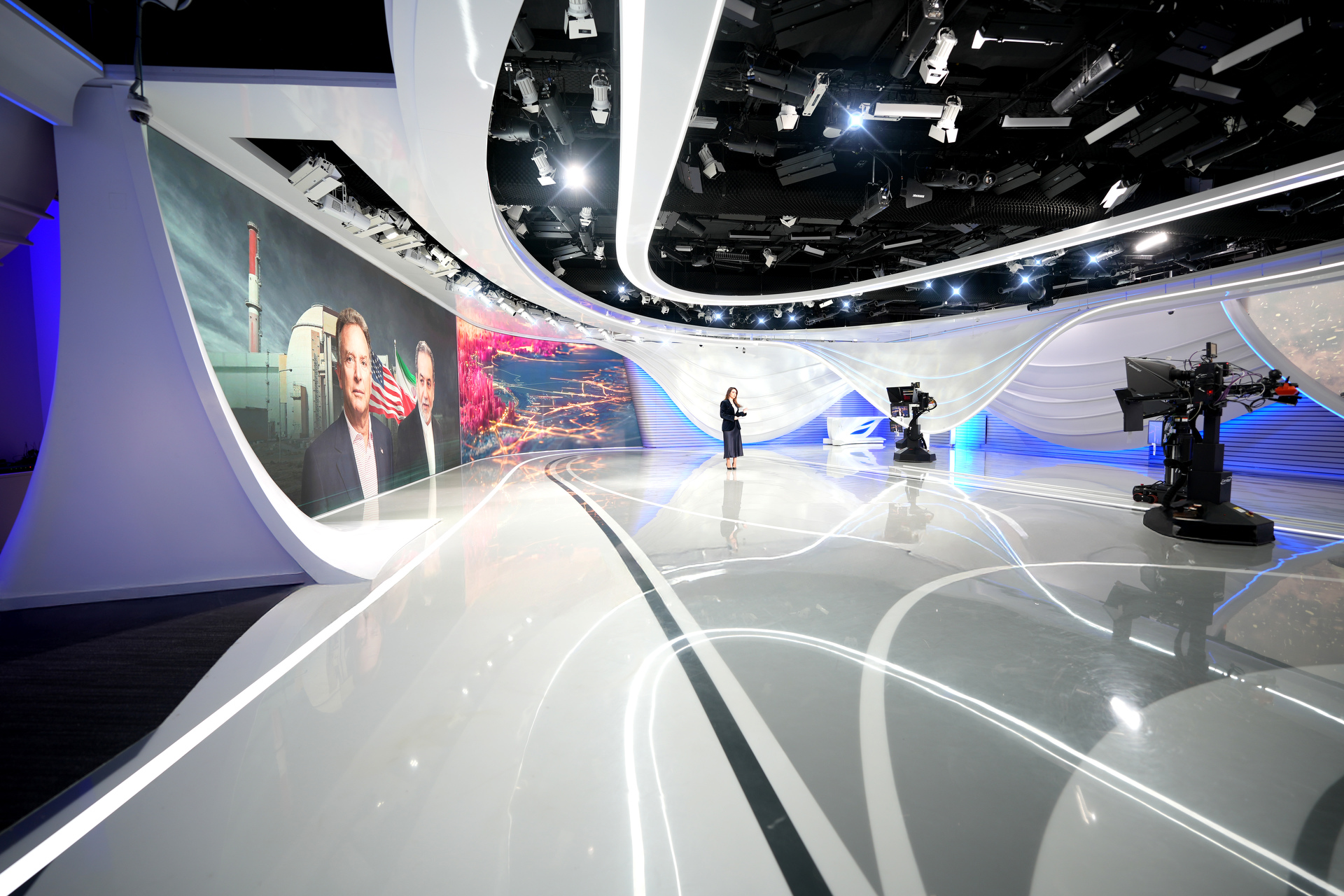
The room contains a floor-mounted tracking camera and a ceiling-mounted tracking camera that runs the length of the broadcast facility. That ceiling track is the spine of the continuous-shot system, passing through all three studios, the corridors that connect them and the lobby itself. The anchor desk is modular and splits into a smaller desk and a podium.
“The flexibility these studios give our teams is unlike anything we’ve had before, AR/VR capabilities, tracking cameras across all three studios, multiple LED environments. One space, multiple shows, broadcast-ready,” said Fahad Binbaz, head of news resources at Al Arabiya.
Studio B: Editorial in the frame
Studio B occupies 2,400 square feet and centers on a large LED vista wall and three tracking LED displays.
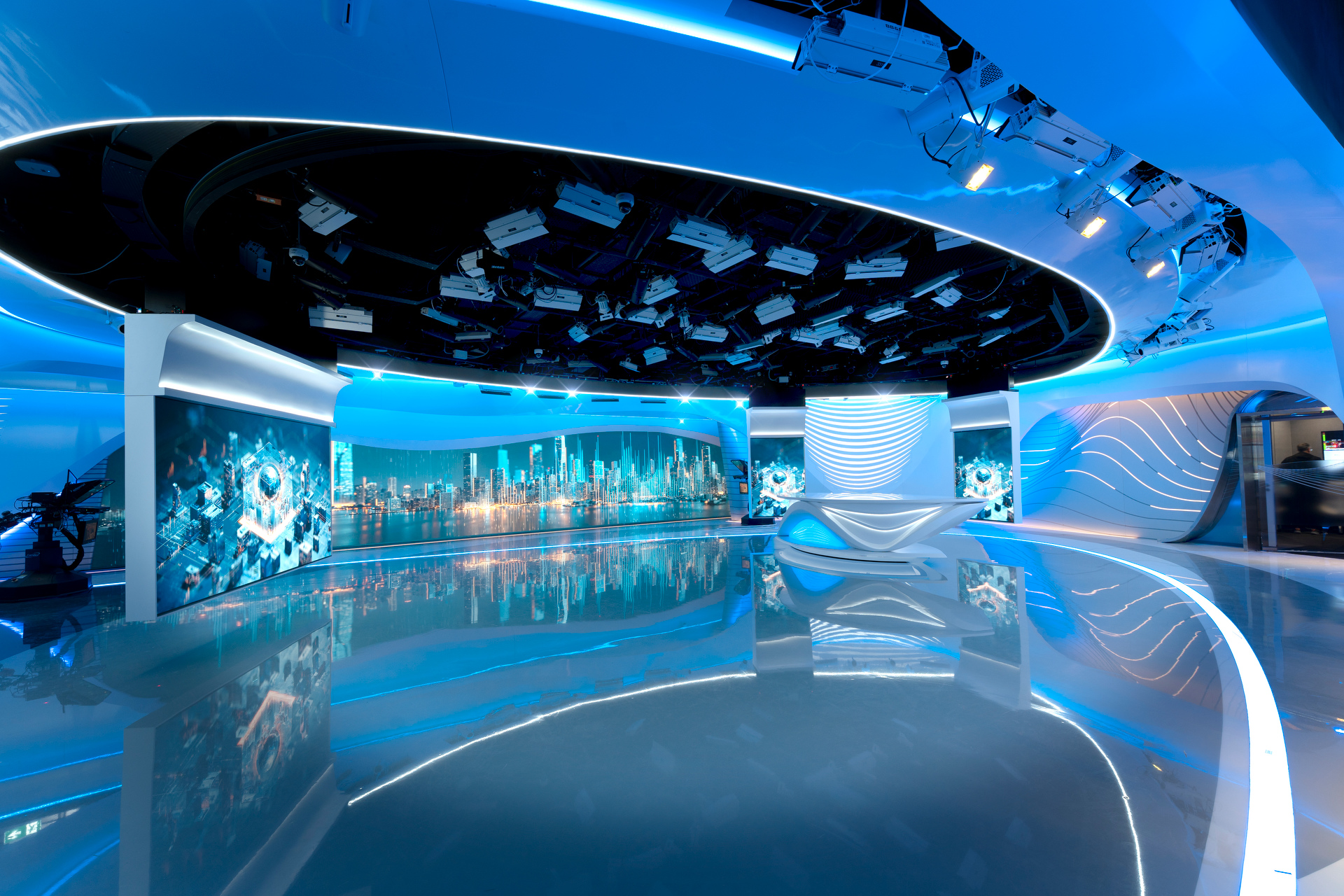
The set offers visual access to the production control room and the editorial workspace, putting the newsroom in the frame when shows call for it. The perimeter carries a secondary skin layered with lightboxes and pinstripes that echo the treatment in Studio A.
Studio C: A radial set behind the reception desk
Studio C, at 2,000 square feet, takes a radial form and sits in the open space behind the reception desk in the lobby.
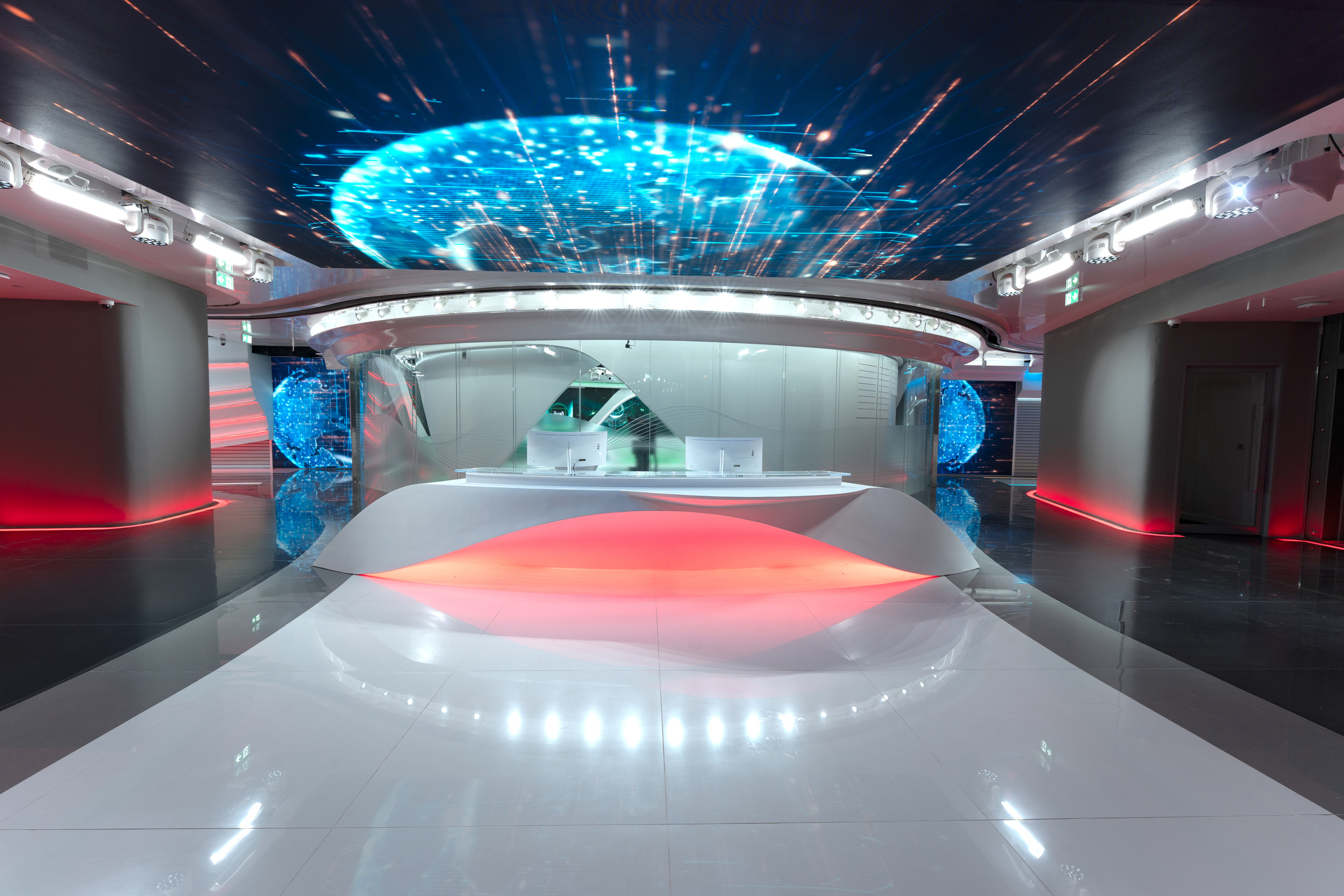
It includes a vista wall and two tracking LED walls, plus two scenic swoops that travel along the studio’s circle to produce alternate backgrounds. Depending on the show, the studio either lets visitors in the lobby see the live broadcast or closes off that view using the same tracking elements.
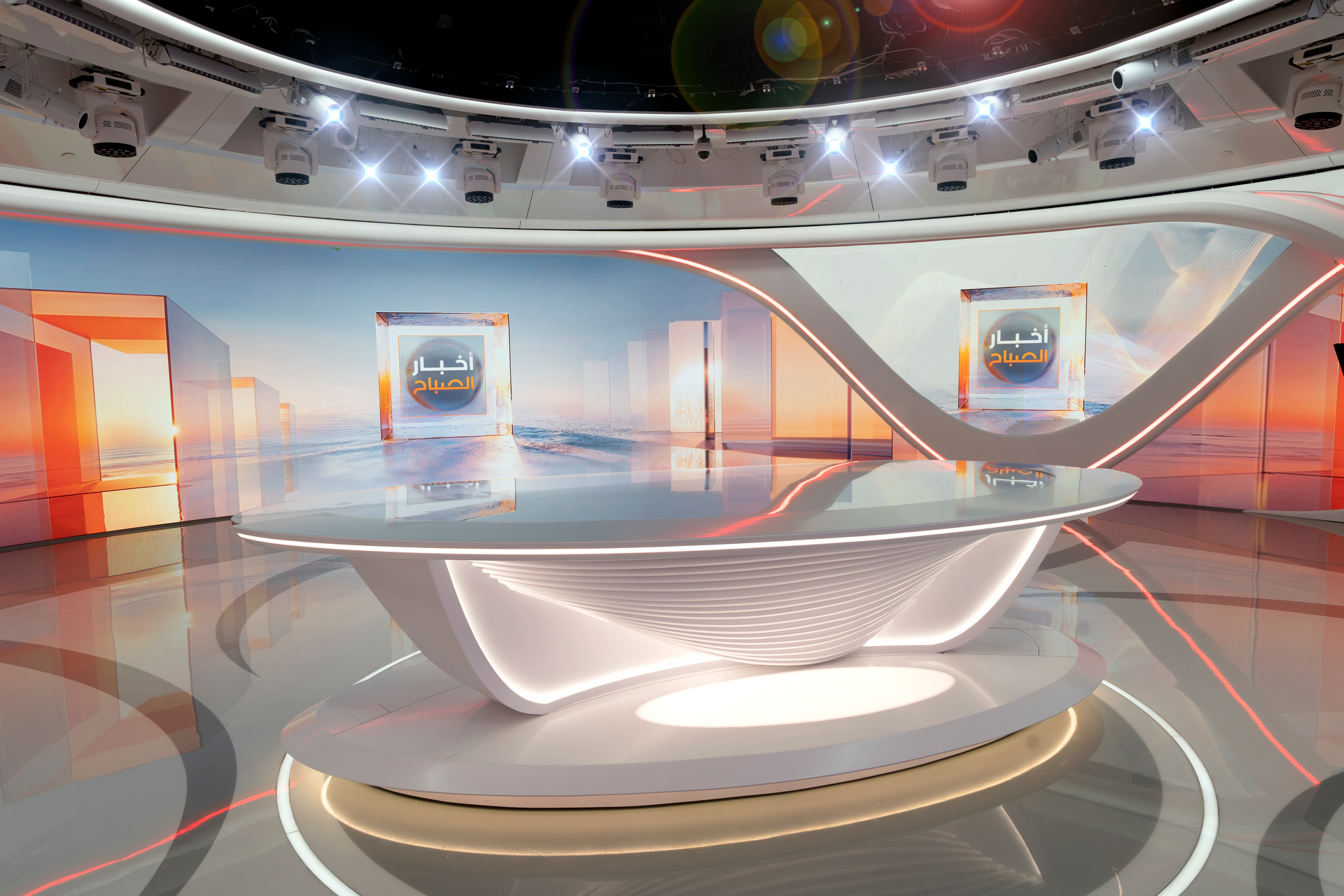
The floor-mounted and ceiling-mounted tracking cameras both serve the space. The anchor desk is double-sided, a choice meant to extend the desk’s on-air lifespan by allowing a refreshed look without rebuilding it.
“This facility is a statement both about Al Arabiya, and what Saudi media companies are capable of building. We set a standard here, and we built it ourselves,” said Mamdouh Al Muhaini, general manager at Al Arabiya.
A chandelier of screens in the atrium
The lobby and atrium pull the studios’ flowing lines and materials into the public-facing parts of the building.
The centerpiece is a chandelier built from two suspended elliptical screens that wrap a helical sculpture. The screens, supplied by AOTO Electronics, hold roughly 24 square meters of active display between them and serve as backgrounds for shooting positions on both mezzanines, as well as for exterior-facing content visible from the surrounding Diplomatic Quarter. The chandelier’s structure is made from 3D-printed components and accented with LED lighting. On the lobby floor below, a sculptural reception desk sits beneath an LED ceiling that folds toward Level 1.
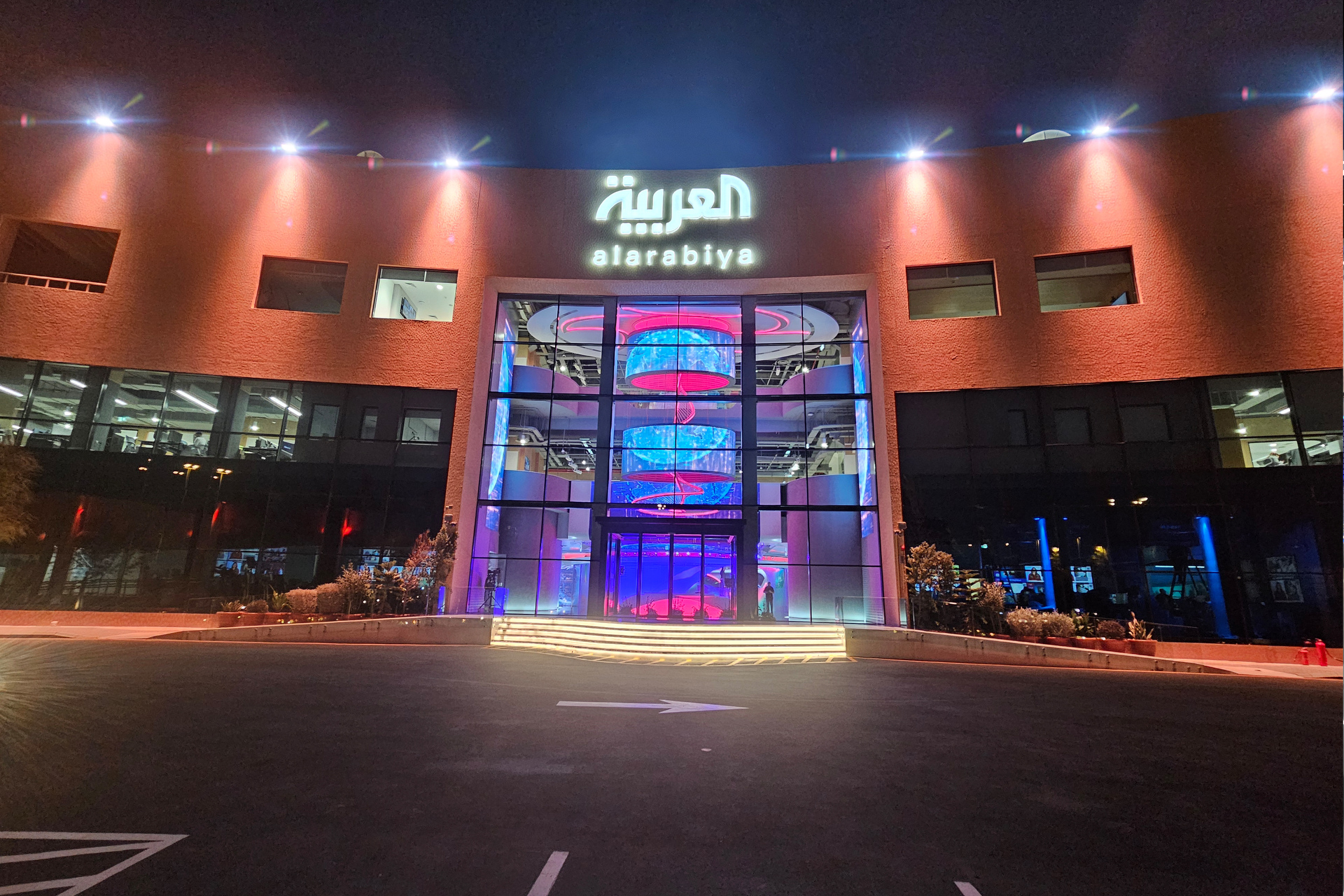
“These studios were designed to lead — every detail, every surface, every technology choice was made to set a new benchmark in how broadcast storytelling looks and feels,” said Ali Berry, director of branding and creative services at Al Arabiya.
“Delivering this on time, at this scale and technological standard was a serious undertaking and one the whole team should be proud of,” said Karim Beidas, project director on the build.
The project brought together Al Arabiya, Ali Berry, Dureid Yaghi, GETSET Lda., Qvest, AOTO Electronics, Reson8 Media and Clickspring Design.
The Clickspring staff on the project included Murat Ustuner, Matt Glaze, Emmett Aiello, Steven Dvorak, Christine de Witte, Christopher Ferguson, Mayen Ondo, Jodie Ellstrom and Antonia Ulfers.

tags
Al Arabiya, Al Arabiya News Channel, Ali Berry, Aoto, Clickspring, Clickspring Design, Get Set, MBC Group, Qvest, Reson8 Media
categories
Heroes, International Set Design, Set Design