

OBS plans smaller broadcast footprint and AI tools for Milano Cortina 2026
Weekly insights on the technology, production and business decisions shaping media and broadcast. Free to access. Independent coverage. Unsubscribe anytime.
Olympic Broadcast Services will reduce its on-site infrastructure by 25% while increasing content output for the 2026 Winter Olympics, relying on cloud distribution and virtualized production systems to serve broadcasters worldwide.
The organization plans to produce more than 6,000 hours of content for the games, six times the duration of actual competition, according to Yiannis Exarchos, CEO of Olympic Broadcast Services and executive director of Olympic Channel Services.
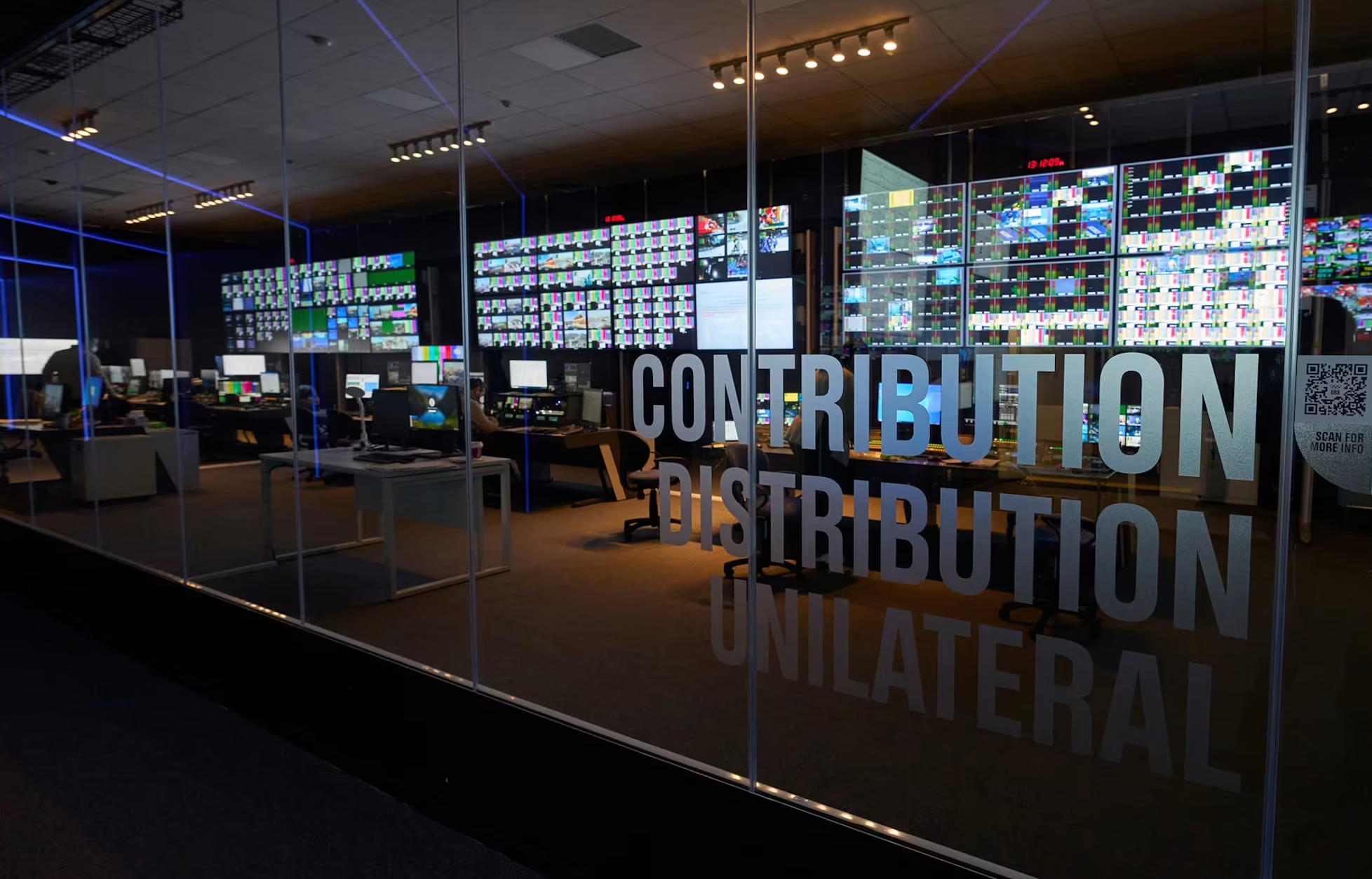
The expanded output comes as OBS reduces its International Broadcast Centre (IBC) footprint and shifts toward remote production capabilities.
“We have a team which is fully immersed into technology. We are a company, very technological, full of engineers, full of creative people. But always we need to remember that this is about storytelling,” Exarchos said during a media roundtable previewing the upcoming games. “Technology and especially emerging technologies are a huge enabler for that. But the Olympics are not necessarily around showcasing technology.”
Cloud adoption exceeds projections
OBS will transmit 65% of broadcast signals through cloud infrastructure for Milano Cortina, substantially higher than the 25% adoption rate the organization projected when it began developing cloud broadcast capabilities with Alibaba.
The shift allows broadcasters to receive content directly without maintaining large on-site facilities. The Milano Cortina IBC will consume 33% less power than the facility used for Beijing 2022, according to OBS planning documents.
“Even in Milano, we will have something like 6,000 broadcasters being present,” Exarchos said. “Why? Because they want to be close to their athletes. And this is very legitimate. Most of them need to do that. What we don’t want is that they are forced to be bringing people doing something that they could be doing at the other side of the world.”
NBCUniversal has moved half of its commentary team to Connecticut for Milano Cortina rather than sending them to Italy, utilizing remote production capabilities. The approach reflects how major broadcasters are adopting cloud-based workflows, though Exarchos noted smaller broadcasters in developing regions may lack the infrastructure to work entirely remotely.

Data overlays and automated production
OBS will deploy several viewer-facing technologies in Milano Cortina, including enhanced data visualization for curling that displays stone rotation and sweeping frequency in real time using AI analysis. The system aims to make the technical aspects of the sport more accessible to general audiences.
The organization will also expand use of 360-degree replay technology, first introduced at Paris 2024, combining it with stroboscopic effects and data overlays. The AI-powered system can generate replays within seconds, allowing directors to use them during live broadcasts.
“We believe that it makes the sport more understandable. And of course, it makes the efforts of the athletes far more impressive,” Exarchos said.
First-person view drones will provide footage throughout the games, particularly at sliding venues. The drones can operate safely in close proximity to athletes, offering perspectives not previously available in Olympic broadcasts.
OBS also plans to use AI-generated highlight production more extensively than in Paris, where the system created 100,000 customized highlight packages for different broadcasters, markets and platforms. The automated system allows broadcasters to specify sport, athlete, duration and advertising insertion preferences.
Olympic GPT launches with verified data
Olympic Channel Services will introduce Olympic GPT, an AI chatbot operating in 12 languages and drawing exclusively from verified Olympic data sources rather than general internet content. The system aims to provide accurate information about athletes, competitions and results without the hallucinations and inaccuracies common in large language models trained on unverified web content.
“The source of all this information is not random sourcing from the internet that may contain a lot of mistakes, a lot of inaccuracies and so on. This is really framed to provide very accurate, unbiased, checked information around anything Olympic,” Exarchos said.
The system pulls from the IOC’s sports data warehouse and will display official results approximately 10 minutes after competition ends, after technical delegates confirm accuracy. The delay contrasts with faster but potentially inaccurate results available from other online sources.
Olympic Channel Services developed the technology with Alibaba, which also provides cloud infrastructure for OBS broadcast distribution. Testing showed the system can handle substantial traffic, though Exarchos acknowledged no AI system achieves 100% accuracy.
NBC Sports also has its own AI for the Olympics, OLI.
Virtual production and IP workflows
OBS will use what it calls Virtual OB vans at multiple venues, replacing traditional mobile production trucks with IP-based systems that reduce compound space requirements by 50% and decrease electricity consumption and installation time.
The organization has fully transitioned to IP protocols, a shift that began several years ago when many broadcasters expressed skepticism about replacing expensive dedicated broadcast equipment with computer-based systems.

“They thought, you know, you cannot tell me that this equipment here that costs, you know, $150,000 can be done by something which costs $1,500. And yes, it cannot. But under certain conditions, you can bring it at a stage where it can,” Exarchos said.
The IP infrastructure also supports the distributed opening ceremony, which will take place simultaneously in five locations across northern Italy, including San Siro stadium in Milano and venues in Cortina, Bormio and Livigno. All locations will feature athlete parades synchronized through the connectivity network OBS is establishing between sites.
Reducing infrastructure for future games
OBS plans to further reduce its physical footprint for Los Angeles 2028, where the IBC will be approximately half the size of the Rio 2016 facility while producing more than twice the content volume. For Brisbane 2032, the organization aims to build an IBC comparable in size to a Winter Olympics facility rather than a Summer Games center.
The reductions depend on continued broadcaster adoption of remote production and virtualized workflows. OBS will provide connectivity capacity from Milano representing 70% of the city’s normal internet bandwidth, sufficient to download a 4K film in half a second, according to Exarchos.
“The vision for complete virtualization of broadcasting. To put it in plain terms, it’s what now has started being called, you know, software-enabled broadcasting, which is essentially using normal, very powerful servers and overlaying very specialized broadcast software on it,” Exarchos said.
The organization maintains that complete elimination of on-site facilities remains unlikely despite remote production advances. Olympic competitions can feature 27 simultaneous events, volumes that exceed normal broadcaster capacity even in home facilities.
“Can any broadcaster deal with 27 events at the same time in their normal operation? Not really,” Exarchos said.
Official film and mobile-first content
Olympic Channel Services will produce the official film for Milano Cortina, the first time the IOC has directly created the documentary. Italian filmmaker Chiara Messineo will direct the film, which will focus on perspectives from people who organize and deliver the games rather than solely on athletic competition.
OBS will also create a mobile-specific broadcast feed in partnership with Samsung, shot and formatted specifically for smartphone viewing rather than adapted from traditional television coverage. The feed reflects the organization’s effort to serve diverse consumption patterns across platforms.
More than 50% of Olympic viewers in Paris did not regularly follow sports, according to OBS data. Exarchos said the organization produces varied content formats to reach audiences across demographics and platforms, even as traditional television remains the primary viewing method for most audiences worldwide.

“Even though still a lot of consumption is on traditional television, even in Paris, you know, more than 80% of the consumption was actually on traditional television. However, also the consumption on digital, on social, on different platforms was also massive,” Exarchos said.
All broadcast formats will be available for Milano Cortina except 8K, which will be limited to the opening ceremony and select events.
Native production will use 4K HDR, with OBS using proprietary mapping technology to derive high-definition signals without parallel coverage.
The Milano Cortina Winter Olympics begin Feb. 6, 2026.
Photo courtesy of IOC/OBS.

tags
2026 Winter Olympics, Alibaba, hdr, Mobile Units and OB Trucks, OBS, samsung, Yiannis Exarchos
categories
Heroes, Olympics, Sports Broadcasting & Production