

The technology powering NBC’s Milan Cortina Winter Olympics coverage

Weekly insights on the technology, production and business decisions shaping media and broadcast. Free to access. Independent coverage. Unsubscribe anytime.
NBC Sports was preparing its most technically ambitious Winter Olympics production to date for the 2026 Milan Cortina Games, deploying a fully integrated, all-IP workflow designed to support remote production, immersive storytelling and multi-platform delivery.
From Feb. 6–22 for the Olympic Winter Games and March 6–15 for the Paralympics, NBCUniversal planned to deliver coverage across NBC, Peacock and its cable networks, supported by a global technology ecosystem spanning Italy, Stamford, Connecticut, and New York. The operation builds on lessons from recent Olympic cycles, with greater reliance on IP transport, centralized production and HDR workflows.
As NBC Sports prepared to present its 20th Olympic Games overall, the broadcaster assembled a roster of long-time technology partners to support cameras, graphics, networking, data integration, audio, LED displays and signal transport.
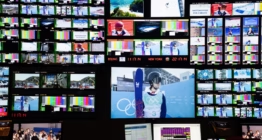
Cameras, imaging and monitoring
NBC Sports will deploy more than 100 Sony cameras across competition venues, studios and interview locations for its production of the 2026 Winter Olympics and Paralympics.
The camera fleet includes Sony HDC-series system cameras used for live competition coverage, supporting high frame rate capture and HDR production. Additional pan-tilt-zoom and cinematic cameras will be used to supplement coverage and provide specialty angles.
Camera signals will be transported using IP-based workflows, allowing feeds from venues in Italy to be routed to production facilities in the United States. Camera control and shading will be centralized, enabling remote operation as part of NBC Sports’ distributed production model.
Lenses
NBC Sports will use 115 Canon UHD broadcast lenses for its Winter Olympics coverage.
The lens deployment includes a mix of long-range and standard broadcast lenses used across outdoor and indoor venues, supporting alpine skiing, sliding sports and arena-based events. Canon will provide on-site technical support in Italy to assist with lens maintenance and performance throughout the Games.

Graphics and data presentation
NBC Sports will use Chyron graphics systems to generate live broadcast graphics throughout its coverage of the Milan Cortina Winter Olympics and Paralympics.
The Chyron Prime platform will be used to display athlete names, scores, statistics, leaderboards and event data, as well as studio analysis graphics. Graphics will be generated both on site in Italy and remotely from NBC Sports’ production facilities in the United States.
SportsMEDIA Technology (SMT) systems will be used to integrate official timing and scoring data across multiple Winter Olympic sports. SMT will supply broadcast television interfaces for events including figure skating, alpine skiing, speed skating, sliding sports, snowboard and freestyle skiing.
SMT systems will also support results data for digital platforms, including Peacock, enabling real-time updates to standings, results and contextual information.
Virtual and augmented reality
NBC Sports will incorporate virtual and augmented reality elements into its studio and analysis coverage using Ross Video’s Voyager solution with support from Rocket Surgery RSVP.
AR tools will be used primarily for analysis segments, allowing commentators to visualize courses, athlete movement and competition dynamics. Production teams will operate across Milan, Cortina and Stamford, coordinating AR workflows with camera tracking and graphics systems.
“We’re thrilled to partner with NBC Sports for the Winter Games and to showcase the combined strength of Rocket Surgery and Spidercam. With teams in Italy and Stamford, we’re ready to deliver next-level AR experiences to audiences everywhere,” said Jim Doyle, VP of creative services, Rocket Surgery.
LED video walls and studio displays
NBC Sports will use Planar LED video walls in its Milan-based studio operations, including Planar DirectLight Pro Series LED video walls in a 1.2 millimeter pixel pitch.
Fine pixel pitch LED displays will be installed across architectural features in Studio A and Studio B, supporting immersive studio environments and large-format graphics presentation. The displays will be used for live studio programming, analysis segments and integrated scenic elements.
Networking and IP transport
NBC Sports will rely on Cisco networking infrastructure to support its all-IP production workflows for the 2026 Winter Olympics and Paralympics.
The network architecture includes IP Fabric for Media at the International Broadcast Center in Milan, supporting secure transport of UHD video, audio and data between Italy and the United States. Virtualized networking technologies will be used to support flexible routing and distributed production operations.
“For Milan, NBC Network Engineering has expanded our ASR-based MPLS Segment Routed WAN to support growing traffic needs. To ensure NBC Sports can meet on-prem and hybrid cloud workflows, we leverage Cisco CrossWorks Network Controller (CNC) and WAN Automation Engine (WAE),” said Cliff Ryan, VP of network engineering, NBCUniversal. “This tooling gives NBC network engineers the ability to analyze how traffic moves across our critical backbone and provides ‘best in class’ failure analysis and capacity planning insight.”
Signal routing and orchestration
NBC Sports will use Grass Valley systems including Alchemist, Orbit and the AMPP OS to support signal routing, frame rate conversion and orchestration across its Olympic production infrastructure.
These systems will be deployed at venues in Italy and at NBC Sports’ facilities in Stamford and New York, supporting hybrid SDI and IP workflows and enabling coordination across geographically distributed production teams.
Grass Valley systems have been used in previous NBC Sports Olympic productions, supporting large-scale live event operations.
Contribution and signal transport
NBC Sports will use Appear encoding and contribution systems to support video transport from competition venues in Italy.
Appear systems will handle video compression, satellite modulation and transport stream aggregation, supporting both fiber and satellite contribution paths. The setup will allow NBC Sports to move a high volume of HDR video feeds between venues and centralized production facilities.
“NBC Sports will rely heavily on Appear’s encoding, both for exceptional HDR video quality and efficient use of international bandwidth, and upload technology for Cloud transport. We can quite simply transport more cameras and video feeds across our enterprise than previously realized,” said Darryl Jefferson, SVP, engineering and technology, NBC Sports & Olympics. “And remote production is the cornerstone of the Milan Cortina venue coverage.”
Audio equipmen
NBC Sports will deploy Audio-Technica microphones, broadcast headsets and monitoring headphones across competition venues and studio productions for the 2026 Winter Olympics and Paralympics.
The audio package includes shotgun microphones for competition capture, venue microphones for ambient sound and wireless systems for interviews and presentation areas. Broadcast headsets and headphones will be used for monitoring and communications at venues and production facilities.
Audio signals from venues will feed into NBC Sports’ centralized production workflows, supporting consistent audio quality across linear broadcasts and streaming platforms.
Audio-Technica equipment has been used in NBC Sports’ Olympic productions for more than two decades.


tags
2026 Winter Olympics, Appear, Audio-Technica, Canon, chyron, Chyron Prime, Chyron Prime CG, cisco, Cliff Ryan, Darryl Jefferson, Grass Valley, hdr, Jim Doyle, NBC Olympics, nbc sports, peacock, Planar, Rocket Surgery, Ross Video, Ross Voyager, smt, Sony
categories
Heroes, Olympics, Sports Broadcasting & Production