

France TV teleports athletes to studio for Milano Cortina coverage
Weekly insights on the technology, production and business decisions shaping media and broadcast. Free to access. Independent coverage. Unsubscribe anytime.
For the 2026 Winter Olympics in Milano Cortina, France Télévisions needed a way to bring athletes and presenters from four different competition sites into a single coherent program without spending hours shuttling people through the Italian Alps.
This is a challenge faced by many broadcasters of the Games, as the venues are scattered across the mountainous regions of Milano Cortina.
The solution involves what the broadcast calls ‘teleportation,’ built from multiple insert studios with green screens, robotic camera arms and synchronized movements.
France Télévisions has installed identical robotic camera systems in studios at Livigno, Bormio, Anterselva and Predazzo, each serving as a hub near major competition venues. These mountain studios are equipped with Arcam 10 robotic camera arms, six-axis motion control systems developed by XD Motion, now part of EVS.
The camera robotics at each location mirror the movements of an identical unit in Milan’s International Broadcast Centre, where France Télévisions operates from a 5,000 square foot production space.
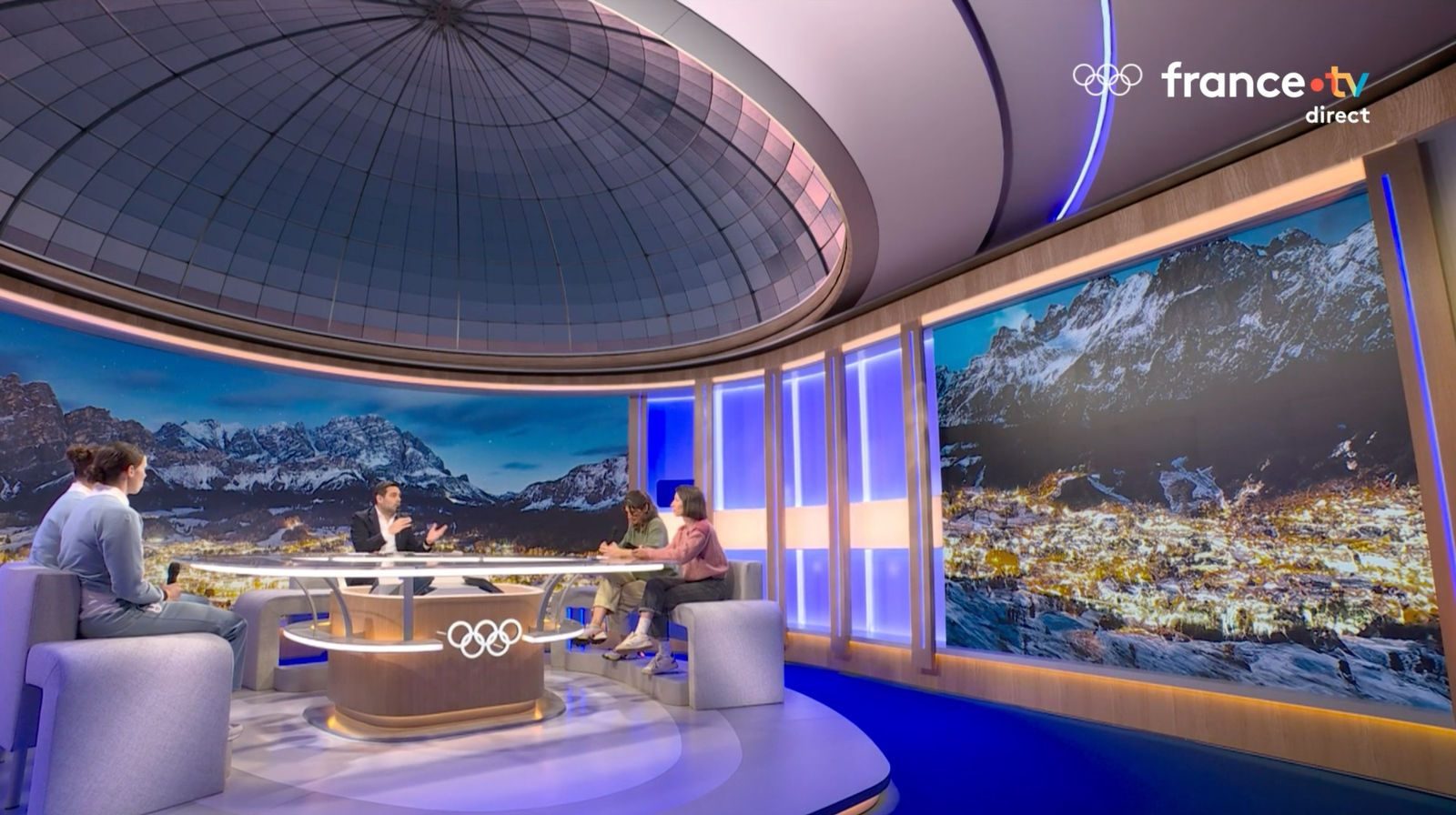
The main Milan studio combines physical set elements with extended reality set extensions powered by Zero Density and the Unreal Engine, which can then layer the remote feeds to create what appears to be a single location.
Pierre Martin, France Télévisions’ Winter Olympics team leader for Milano Cortina and senior production manager, explained that the synchronized robot movements are essential to the system. When a camera in Milan moves, the corresponding camera in Bormio or Livigno executes the same move creating the seamless effect.
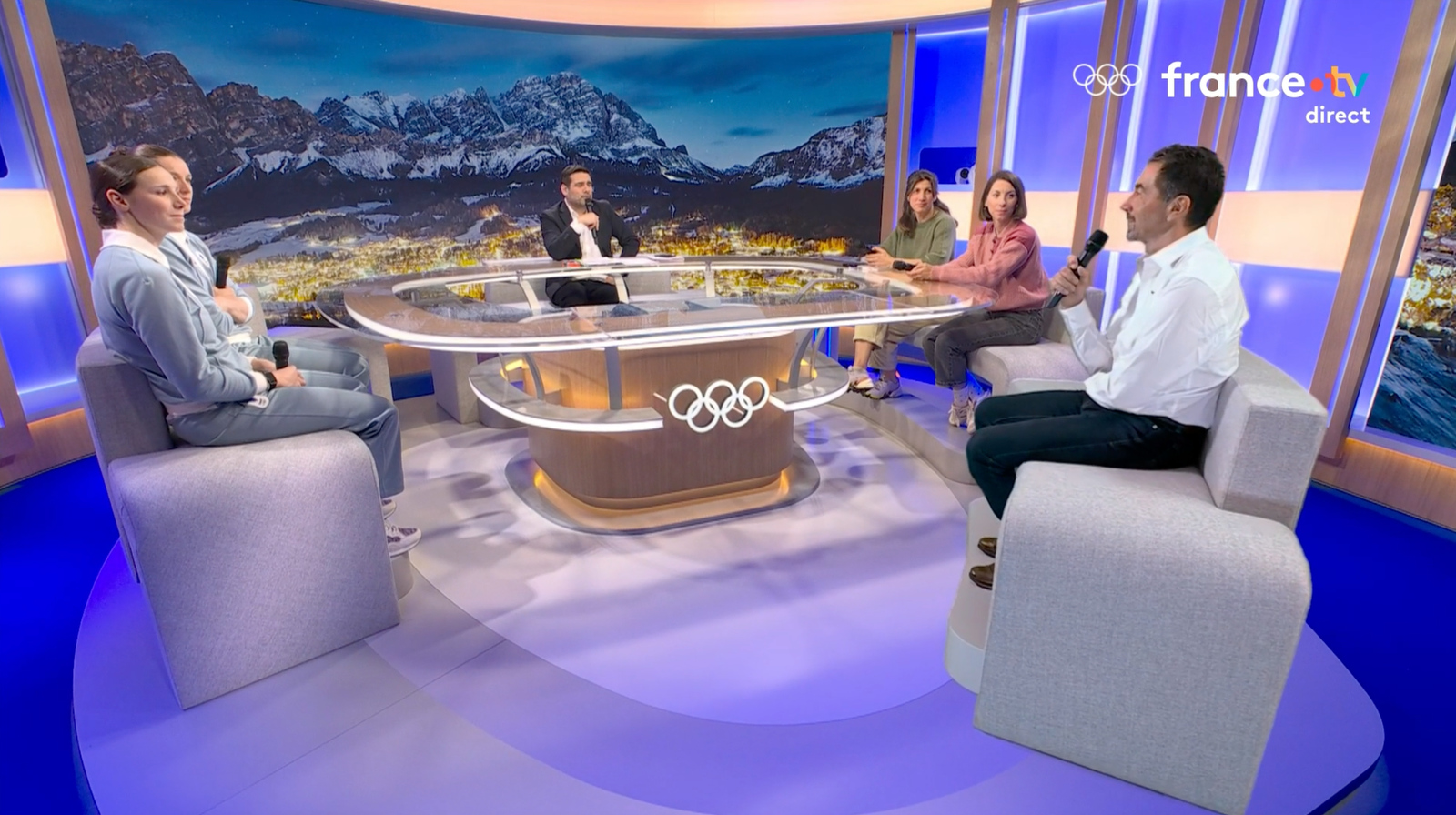
In this example, Luc Alphand (in the white shirt) joins the main studio from a remote studio.
The matching perspective makes the remote guest appear to be sitting at the same table as the studio presenters, with similar lighting and seating.

The approach allows the broadcaster to conduct interviews with athletes or remote talent shortly after a competition finishes, without requiring them to travel to Milan.
The design was conceptualized by director Anthony Forestier, with scenic design by Franck Fellemann, lighting by Herve Moreau and virtual design by Thomas Lagache.
The broadcaster worked with Videlio and XD Motion to develop the system, along with Impact Événement, Aski-da Group and FreeLens.

tags
2026 Winter Olympics, Epic Games Unreal Engine, EVS, France Télévisions, Franck Fellemann, FreeLens, Herve Moreau, Thomas Lagache, Unreal Engine, Videlio, Videlio Video Solutions, XD Motion, Zero Density, Zero Density | Virtual Studio
categories
Featured, Olympics, Set Design, Sports Set Design, Virtual Sets