Weekly insights on the technology, production and business decisions shaping media and broadcast. Free to access. Independent coverage. Unsubscribe anytime.
Since it was last completely overhauled in 2007, Studio 3A inside of 30 Rockefeller Plaza has seen numerous updates. When MSNBC decided to overhaul the space, Clickspring Design looked to the historic building for inspiration to unify the set with a flexible, cohesive look.
While two of the studio’s most impressive pieces of technology remain — the video wall in the southeast corner and the floor-to-ceiling one added in 2018 that features a curled ribbon, internally dubbed the “Kornacki Curve” after data whiz Steve Kornacki — everything surrounding them has been reimagined.
Previously, these two spaces were divided by a stack of low profile but not seamless LED panels on the south wall, which Clickspring saw as both an inspiration and a point of design contention.
On one hand, the panels seemed a bit out of place among the more high tech seamless LED tiles, but it was also a natural place for a transitional piece of scenery.
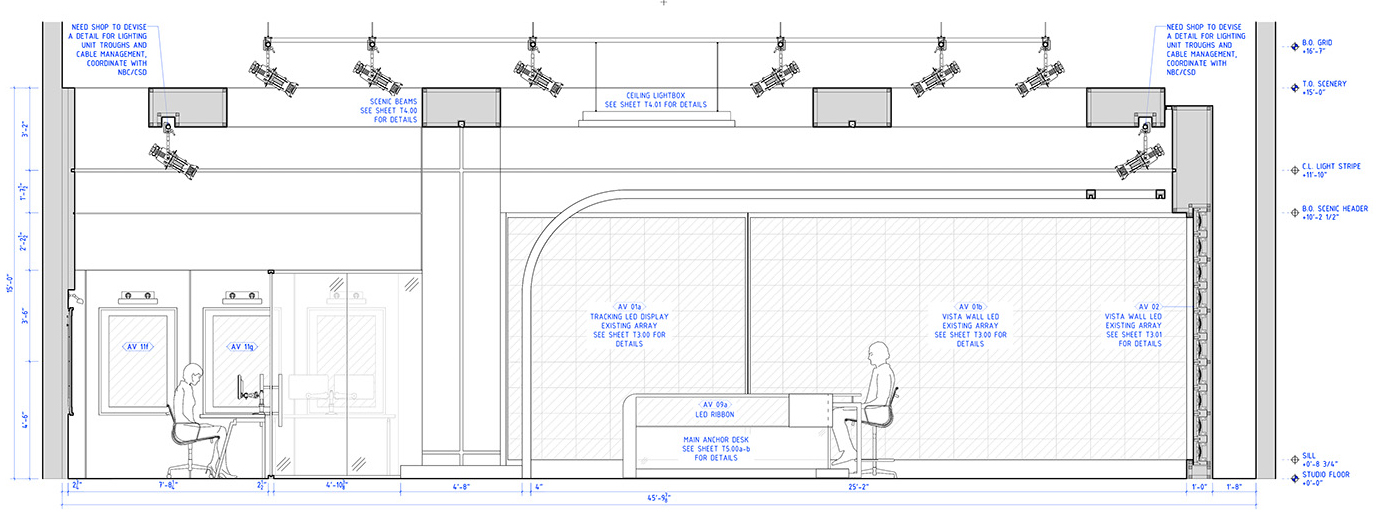
This elevation schematic, provided by Clickspring, shows the east side of Studio 3A, showcasing the ‘glazed’ hallway on the far left and the corner video wall installation on the right. Also visible is the L-shaped desk for special coverage.
There’s also a practical reason for them: a thick, structural column that holds up the building here can’t be removed, and therefore, any scenery has to work around it.
“We wanted to upgrade that but felt that connecting the two larger arrays would just be boring,” explained Clickspring’s Emmett Aiello.
The team had researched thin skeletal archways during the initial phases and wanted to find ways for the Kornacki Curve to “visually motivate” other parts of the set.
“(This) led us to the LED arch that bisects the studio. It’s a little unexpected and works really well for different kinds of shots: standups, bump shots and, of course, wide angles from the jib,” said Aiello.
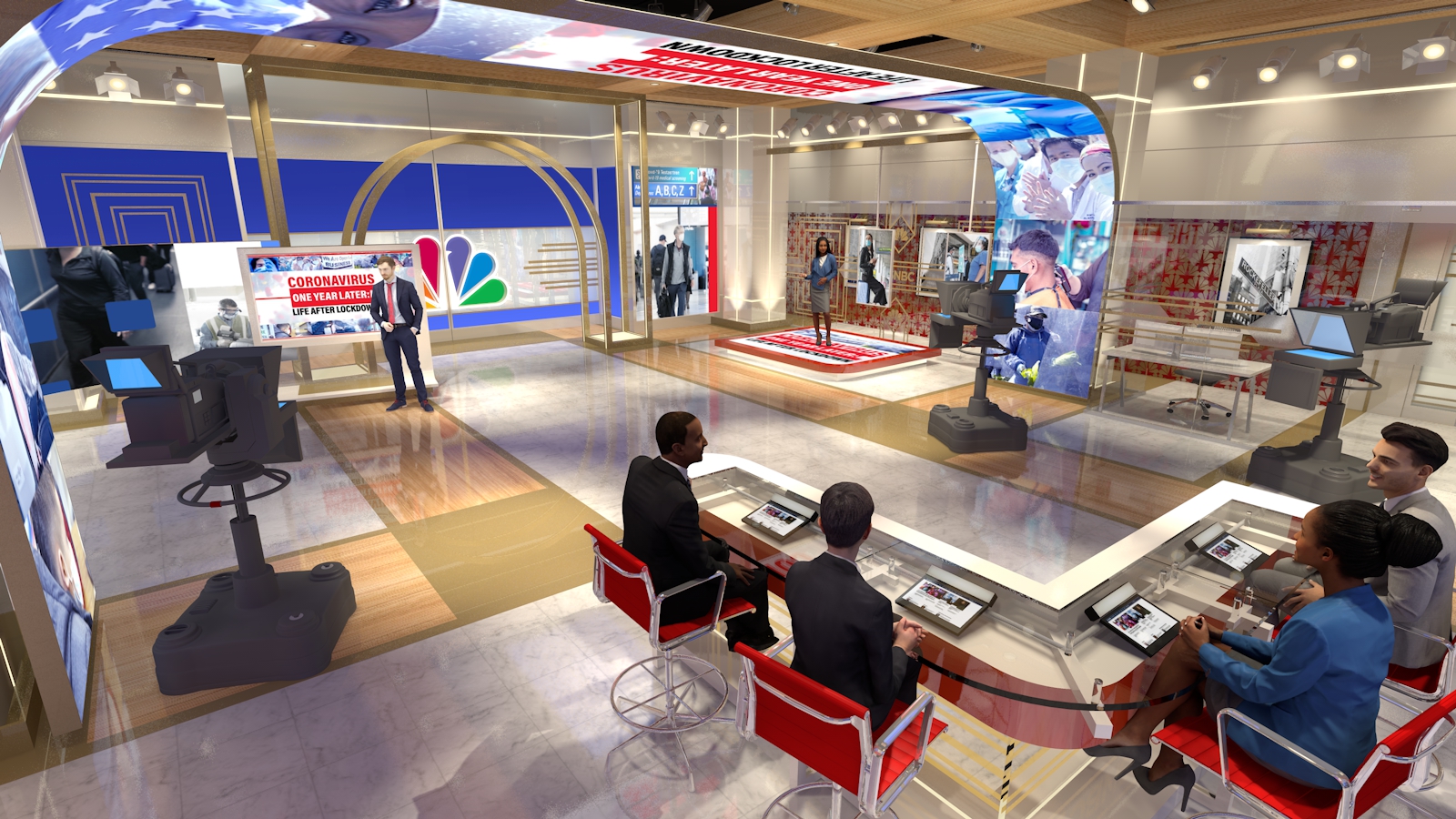
This rendering, looking west from the southeast corner, features the large LED arch.
The arch includes two legs on the south and north side of the studio, each of which serves to disguise a structural column. Both columns have been refinished with a white surface and intersecting color changing reveal lines.
It also runs above the entire space on the north-south axis and is frequently used to showcase the date and show logos in wide opening shots and bumps.
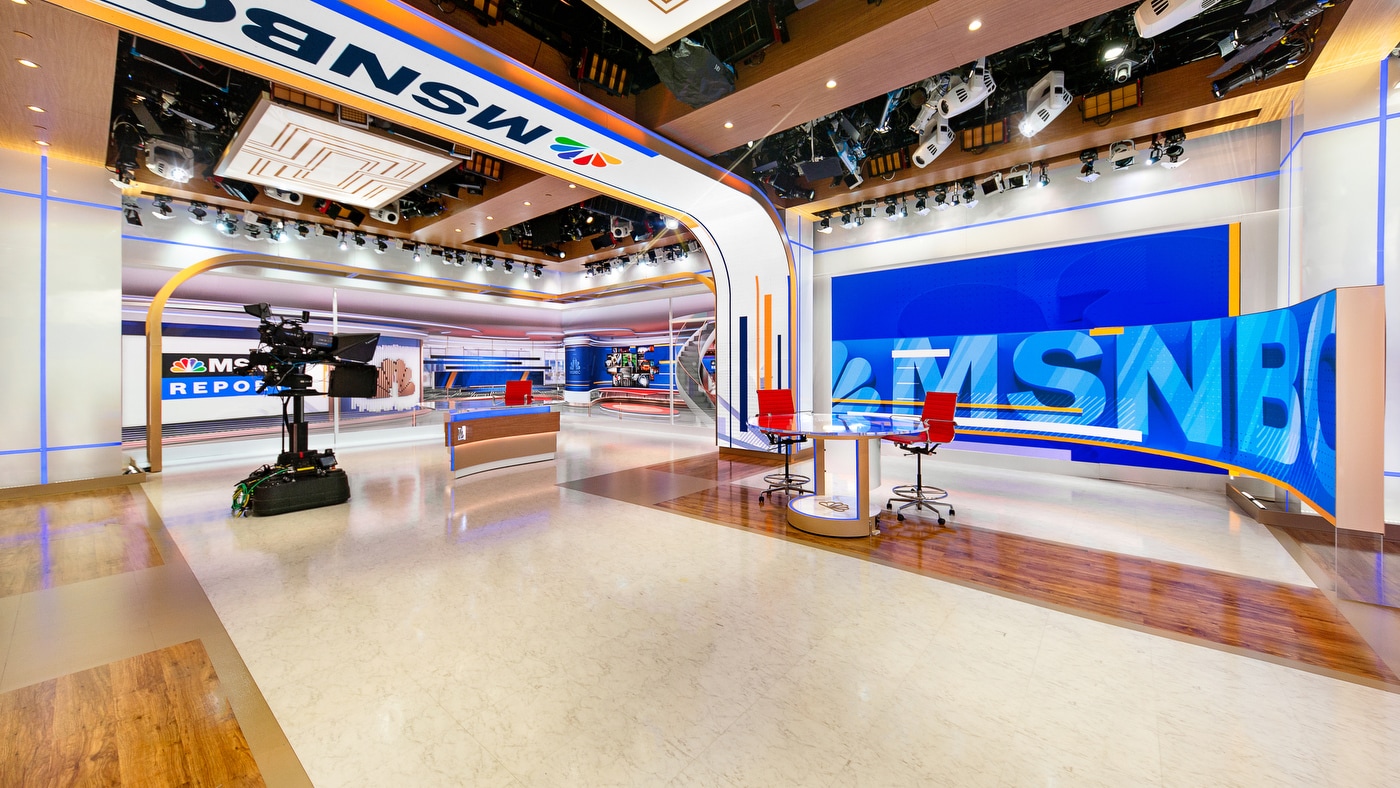
While 3A kept its 360-degree environment, its footprint changed slightly.
The biggest change was the creation of a “green box” studio along the west side of the space. This area is surrounded on three sides by chroma-key green cyc, which can remain hidden when two giant sliding partitions emblazoned with video LED panels, backlit panels and a dimensional NBC peacock are wheeled together.
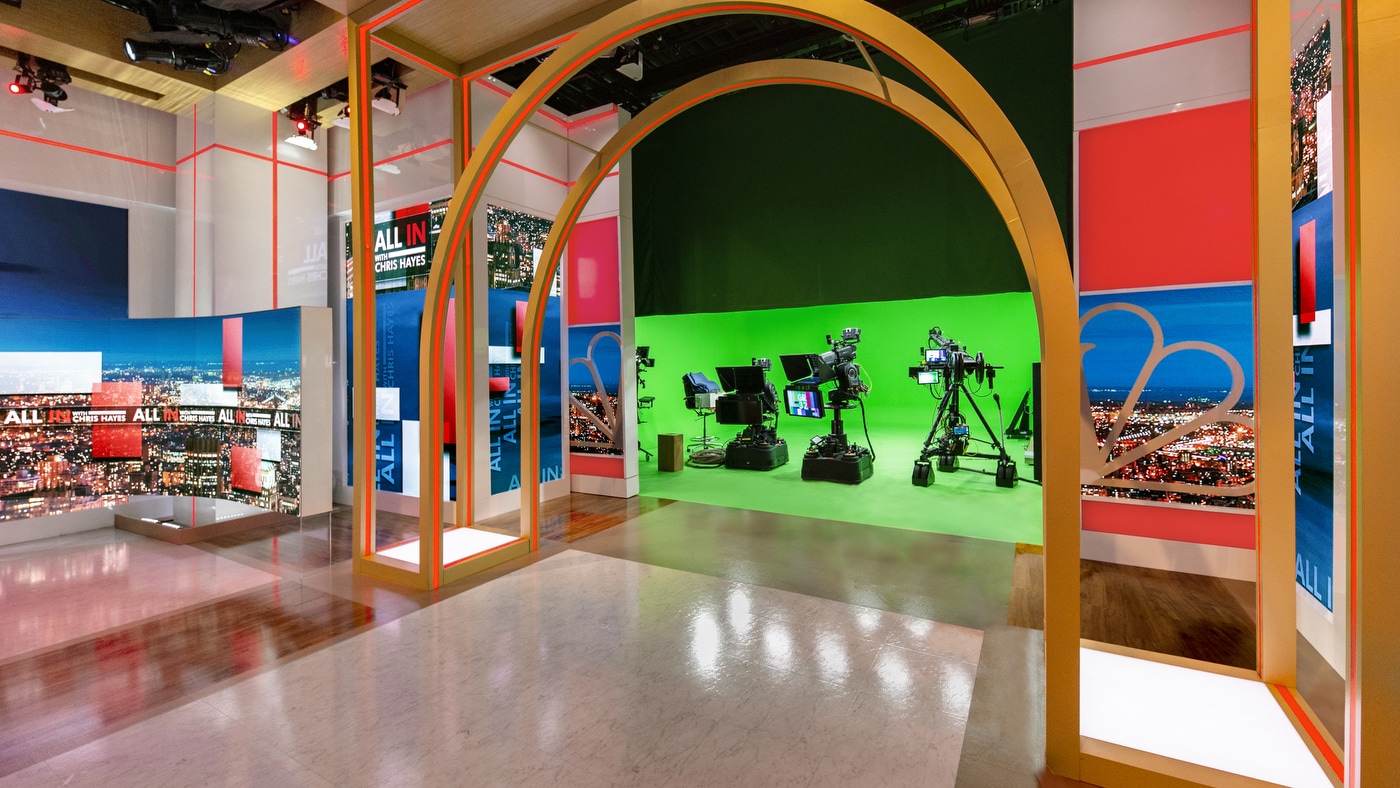
When closed, the network can feed graphics to panels in the partition and behind the peacock and change up the color of the integrated frosted panels.
On either side are two new stationary vertical LED installations that give the network additional branding opportunities that have been featured prominently in wide shots, bumps and teases, including using the floating camera “video on video” approach.
This wall is framed with what Clickspring calls a “skeletal” archway mostly finished in a light wood tone, but select sides of the structure are outfitted with color changing backlit faces.
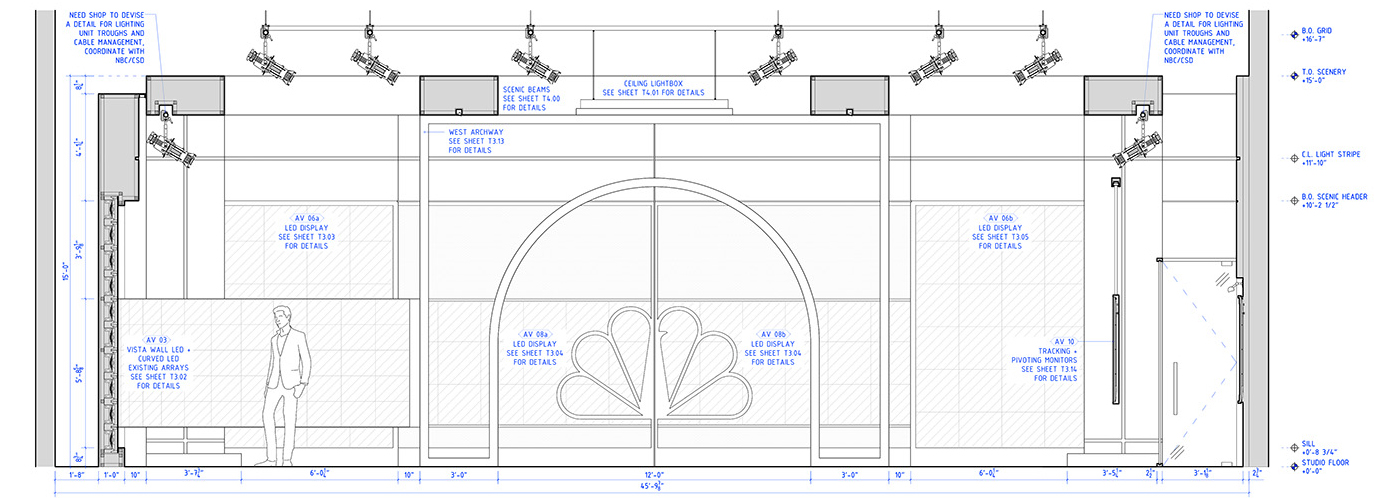
The west elevation of the space showcases the ‘Kornacki Curve’ along with the skeletal archway and sliding wall segments with the NBC peacock on it, which can roll open down the middle to provide access to the green screen space behind it.
This virtual area is roughly in the space where an ever-shrinking cluster of workstations were originally installed; at one time 3A was the primary newsroom for NBC News, but once the network renovated the fourth floor to create a larger newsroom, it relied less on the desks in this area. The coronavirus pandemic and work from home situations further reduced its use.
During the 2020 election, the network installed a large stage for augmented reality elements down the middle of this area — and the plan is for the green screen area to be used for hybrid and immersive mixed reality segments, including the ability to extend the physical scenery into the world of 3D rendering.
Meanwhile, the removal of the north wall’s backlit array of frosted glass and silver framed monitors and structural supports that once featured a practical balcony meant the main studio area gained some additional floorspace, which opened up additional space to place cameras.
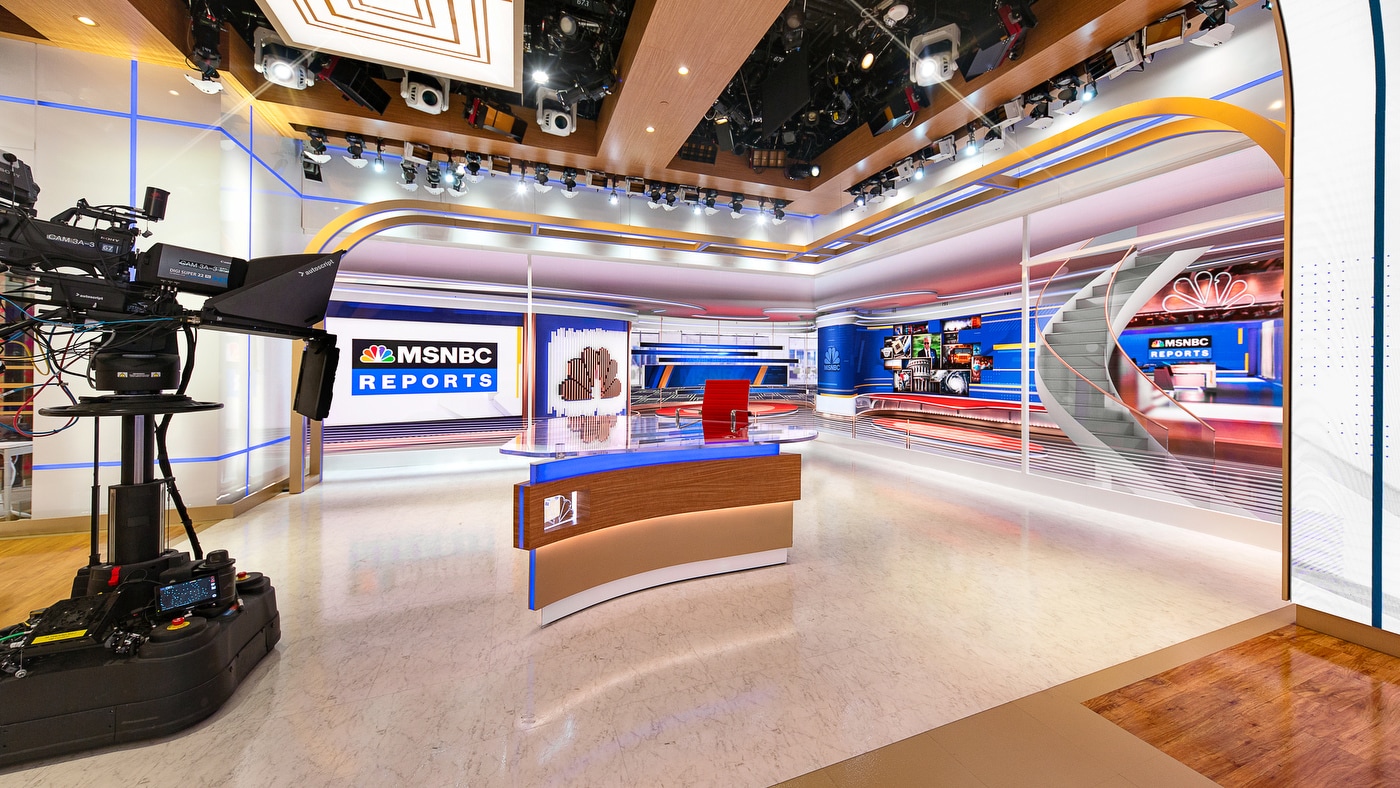
This wall now features a glazed hallway that’s lined with custom NBC peacock wallpaper and pictures that look framed, created with integrated LED panels and surrounds mimicking paper matting and a frame with an accent light fixture above.
Shooting against this wall adds depth and layering and provides a peek into what goes on behind the scenes. Guests and staffers can sometimes be seen walking through the space or sitting in the small boxed-in lounge or at the dual workstations reserved for producers.
“Clickspring and MSNBC feel that incorporating the practical into our designs only helps enhance the space in the viewer’s eyes as real, working environments,” said Aiello.
This wall also includes the primary entrance to the studio — two dramatic art deco style doors. Previously the main entry was a bit farther west toward the newsroom area, but that’s now more of a “backstage” access point that provides access behind the chroma-key cyc thanks to a sliding unit.
When closed, the new entry doors’ stylish art deco finish can serve as a striking background element behind guests and anchors.
Many of the design motifs throughout the space, as well as the recently redesigned Studio 1A, draw heavily on art deco stylings.
NBC’s 30 Rock location is iconic to the brand, prominently featured in show opens and mentioned in announces, so Clickspring looked to that era for inspiration for multiple spaces.
“We like to acknowledge and pay homage to that history, so there are obvious nods to 30 Rock’s art deco heritage throughout the set: Filleted arch forms, radiating linear patterns, and faux deco materials such as brass and marble,” notes Aiello.
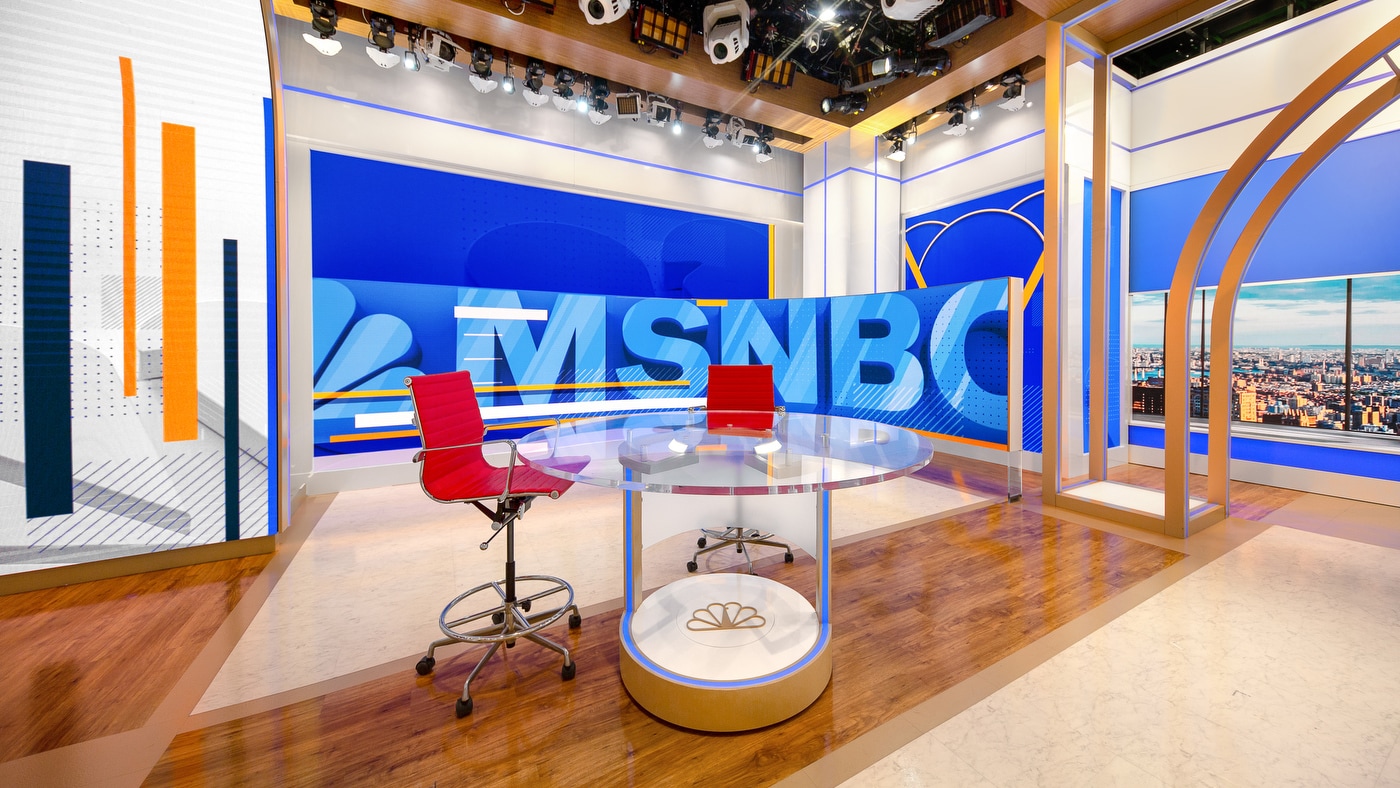
In addition to the decidedly modern video arch, two lightboxes with geometric patterns are also suspended from the ceiling, playing a key role in wide shots and being a bit reminiscent of Clickspring’s longtime practice of using lanterns in the ceilings of NBC News spaces.
Finishes such as the white high gloss found in the curved surrounds and archways in 1A are already featured in Studio 4E, which overlooks the NBC newsroom, and the former home of “Nightly,” which still stands in the space formerly designated Studio 3C.
Of course, there’s a delicate balance between creating a space that still offers some of what viewers expect in a contemporary news set and not descending into a design that’s more about the theme than storytelling.
Much like the design of Studio N1 in NBC’s Washington, D.C. bureau, the approach was to create a “legacy” space that had been updated and refurbished with new “technology and bling,” said Aiello.
That feeling was further reinforced with MSNBC’s decision to use virtual set extensions for its dayside programming, branded under “MSNBC Reports.” These designs, which were created separately from Clickspring’s work, are more modern and bridge the line between what is structurally possible and what isn’t.
Ultimately, the marriage between hard scenic and video wall graphics, whether virtual set extensions, cityscapes or branded backdrops, is really what opens up the storytelling possibilities.
Clickspring provides the digital canvas for those graphics, which are often tied directly into what’s being covered.
“We might call what we do ‘set design’, but I would describe this space as highly practical in nature rather than background scenery,” said Aiello.
Video walls, including the Kornacki Curve, are ideal for showing feeds of remote interviewees — something that’s all the more common in today’s world of broadcasting during a pandemic.
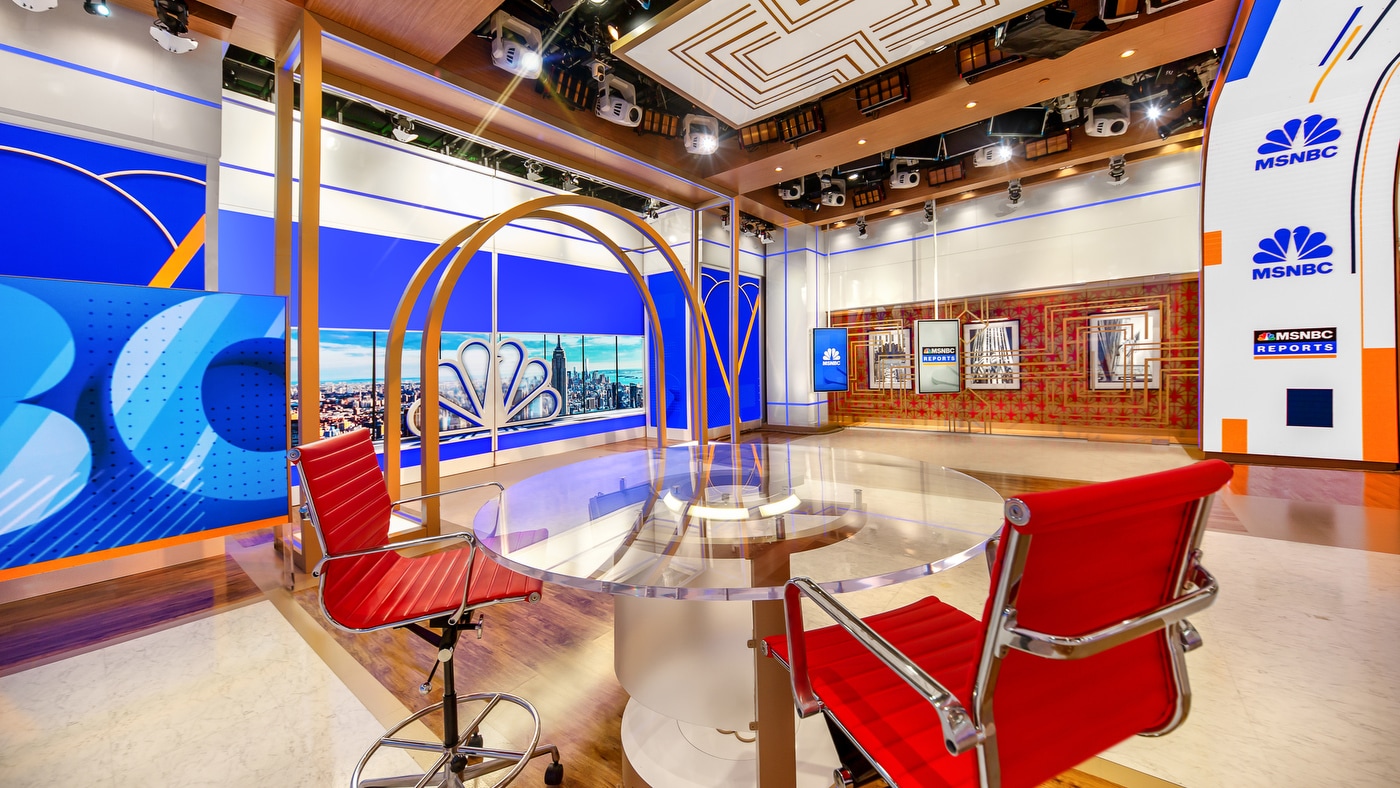
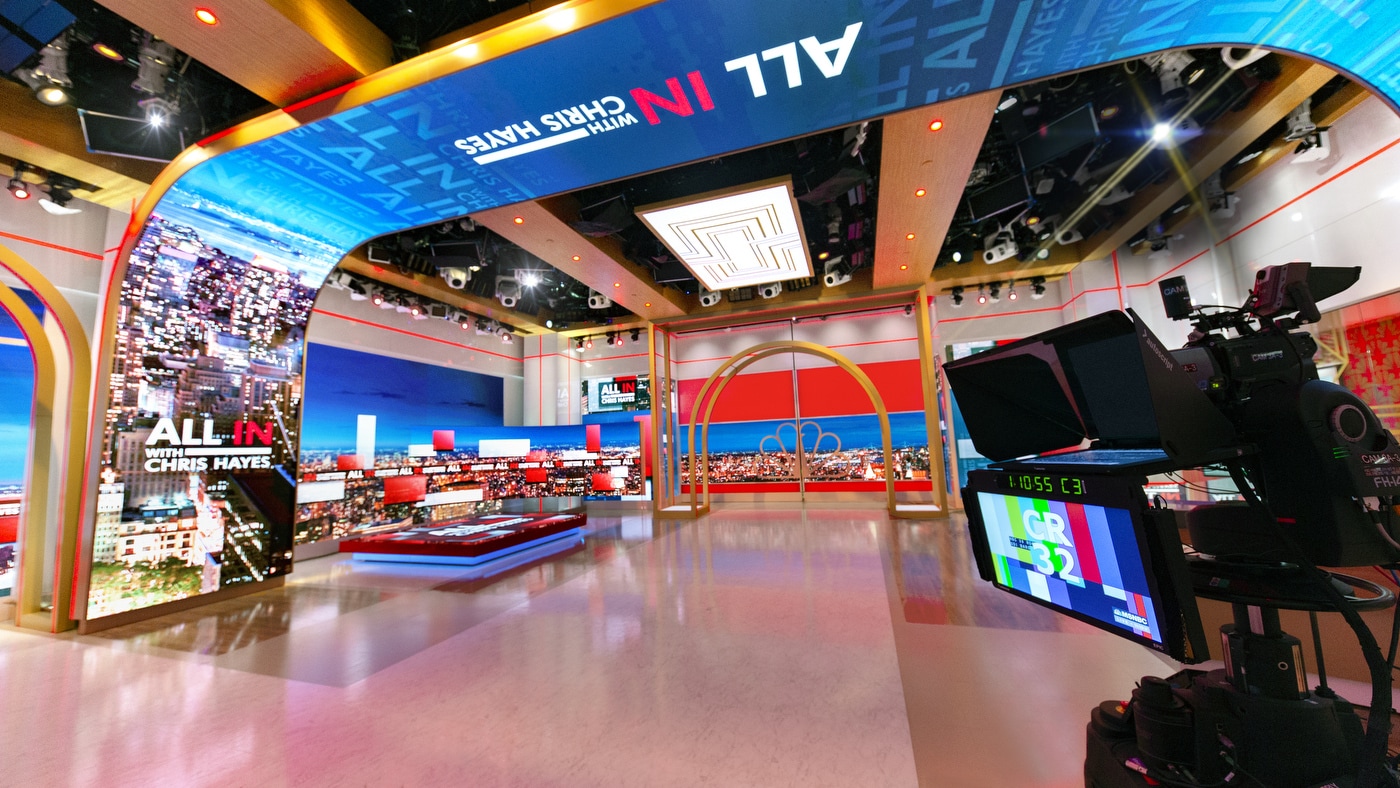
Other LED elements, including the arch, showcase more standalone OTS-style graphics, while the virtual set extensions can also work topical graphics and headlines into their virtual spaces.
Clickspring created three new anchor desks for the space — a triangular one that works as a solo desk just as well as in the round and also offers nods to both the curved elements found elsewhere and one of the peacock feathers.
There’s also a small circular desk with an open base and a larger L-shaped one fronted with LED panels geared more toward special coverage with multiple people on the set, such as during political conventions or election coverage.
Along with the existing Jack Morton-designed “Morning Joe” desk, which gives the distinct impression of a peacock feather when viewed from above or in wide shots, these desks all provide the network with multiple options for different talent and guest configurations and show formats.
Some programming is already using more than one desk at one time — following a trend at NBC and MSNBC to leave an empty anchor desk “parked” behind the one being actively used. The L-shaped, LED-fronted one is especially ideal for this because it allows the control room to feed branded video to it and double as a sort of mid-point knee wall or credenza.
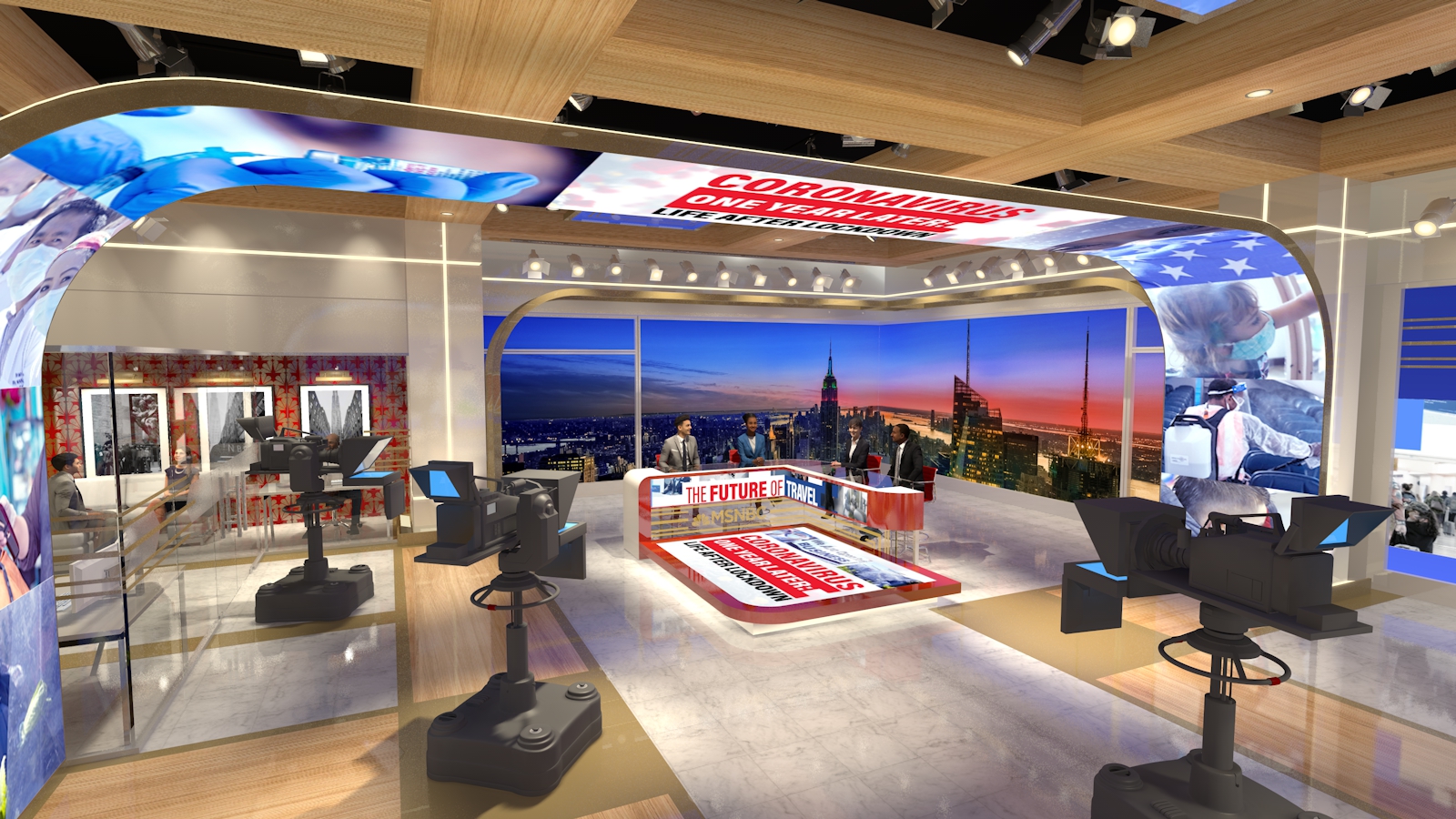
This rendering, looking toward the southeast video wall corner, shows the L-shaped anchor desk and the LED riser docked together.
There’s also a wild riser framed in bold red and outfitted with LED floor tiles that can be used in a variety of ways, including a combination with the L-shaped anchor desk.
Clickspring created all these elements to be “mixed and matched” with each other, and many can be used in more than one way. This includes the LED riser, which can be used as a “screen” for floating camera shots, placed in the background of long shots or made to serve as a platform for talent.
The studio still maintains a storage area for desks and other movable scenic elements hidden behind a secret door of sorts — a sliding wall segment on the east side of the corner video wall installation.
Project Credits
Set Design: Clickspring Design
Chief Creative Officer: Emmett Aiello
Senior Design Director: Christine de Witte
Senior Project Manager: Corey Atwood
Designers: Donna Lee, Mayen Ondo, Lauren Fremgen, and Julia Krummel
Lighting Design: NBC News
Fabrication: Mystic Scenic Studios
LED: Planar