
Comcast to spin off NBCUniversal, Sky
Weekly insights on the technology, production and business decisions shaping media and broadcast. Free to access. Independent coverage. Unsubscribe anytime.
Media and technology giant Comcast says it will spin off NBCUniversal and Sky into a new publicly traded company, a move that would reshape one of the media industry’s largest combinations of content, streaming and distribution.
“The transaction we are announcing will unlock a more entrepreneurial management approach and open up a multitude of new opportunities for each business, said CEO Brian L. Roberts, in a statement.
The deal was announced June 29, 2026.
The new company would include NBC, Telemundo, Bravo, Peacock, Universal’s film studio and theme parks, along with Sky, Comcast’s European media business.
Earlier in June, reports surfaced that Sky will acquire most of rival European broadcaster ITV, though official word of such a deal are not expected until July. It’s not clear if this deal could be affected by the Comcast-NBCU news.
Comcast framed the move as a way to give both companies more room to grow. Roberts said in a statement that the separation would “unlock a more entrepreneurial management approach and open up a multitude of new opportunities for each business.”
The planned spinoff, which requires regulatory approval, is expected to be completed in about a year.
Investors responded favorably to the announcement, with Comcast shares rising more than 20% in premarket trading June 29. The company’s stock has faced pressure in recent years as Wall Street has questioned the value of combining broadband distribution with media assets at a time when streaming-first companies such as Netflix have drawn stronger market support.

The move would leave Comcast more focused on broadband, wireless and technology services, while NBCUniversal would become a standalone media and entertainment company with one of the industry’s largest content portfolios.
The announcement follows Comcast’s January 2026 spinoff of most of its cable networks, including CNBC and MS NOW into Versant, and comes as analysts expect more consolidation across the media sector amid Paramount’s pending acquisition of Warner Bros. Discovery.
Versant will continue to operate as a separate entity.
Mike Cavanagh, Comcast’s current co-CEO, is expected to become CEO of the new NBCUniversal, which would also include Sky. Michael Angelakis, Comcast’s former chief financial officer, will return to lead the remaining Comcast business after the media assets are separated.
The Roberts family will retain control of both companies. Roberts will remain involved with each business, working with Cavanagh and Angelakis on growth opportunities, according to a memo to employees.
Future of Comcast’s logo
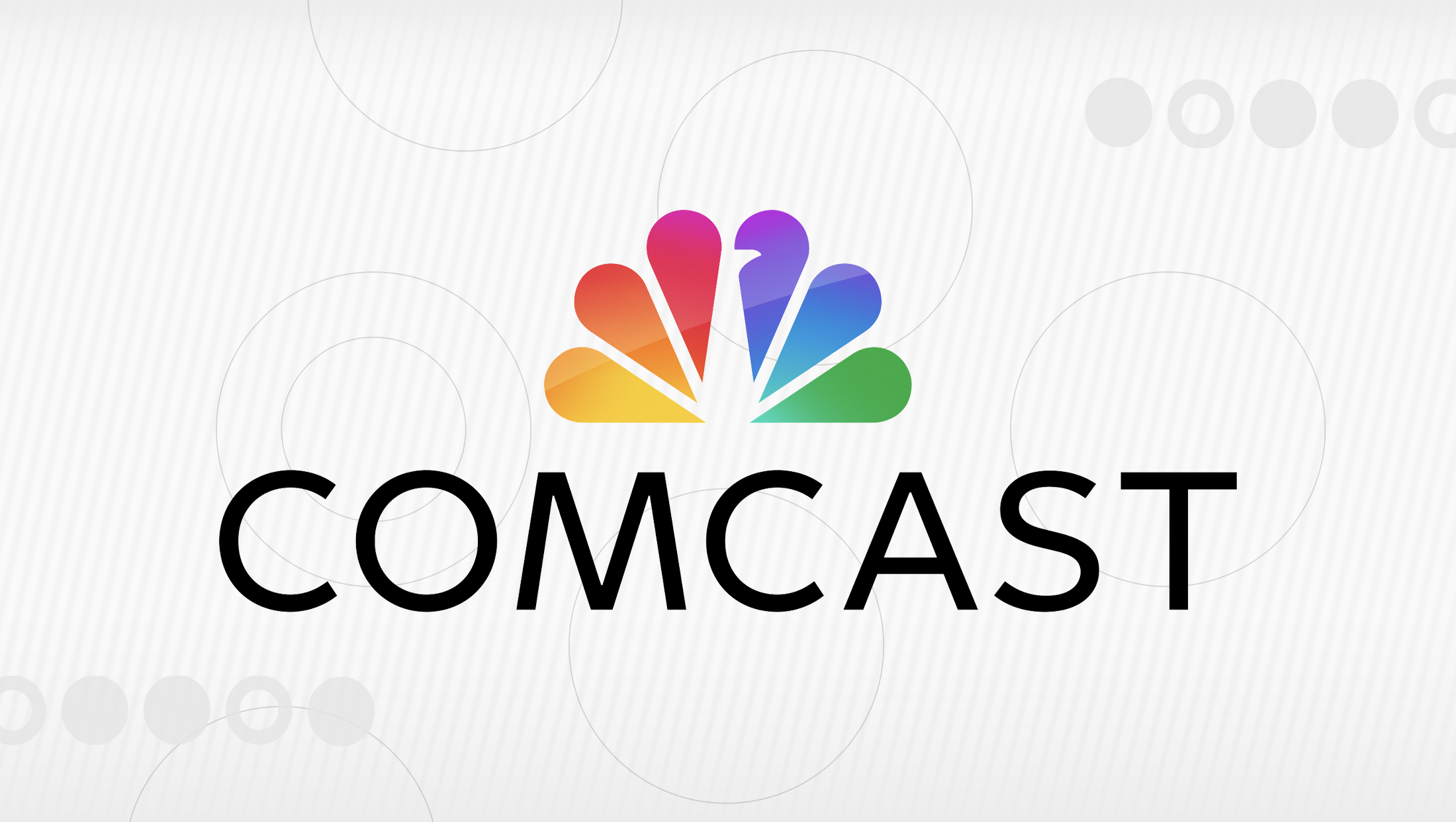
Although Comcast’s announcement did not address any branding updates, there’s the possibility the company will need a logo update once the deal completes.
The company has featured the NBC peacock icon as part of its corporate logo going back to 2013 (the original version had a different font and old version of the peacock before being updated in 2024).
With NBCU headed off into its own corporate universe, it seems likely that Comcast will need to remove the peacock reference from its logo.
This could potentially trigger an architectural change for 30 Rockefeller Plaza in New York, which serves as NBC’s headquarters. In 2015, after a yearlong process of city approvals, Comcast installed a version of its 2013 logo atop the building, replacing the “GE” letters that had remained even after GE sold off NBC.
It also renamed the building as the “Comcast Building” at the time, dropping the longtime moniker that also used the GE name (the building is also known by its address and “30 Rock”).
It was not clear how the building’s naming or signage might be handled, though one possibility would be to simply remove the “Comcast” letters and refer to the structure as the “NBC Building” or something similar.

Looking back at NBCU and Comcast corporate history
NBCUniversal’s corporate structure traces to the 2004 combination of NBC, then owned by General Electric, and Vivendi Universal Entertainment, which included Universal’s film, television and theme park assets.
The deal created NBC Universal as a broad media and entertainment company with broadcast, cable, film, television production, stations, international distribution and theme park holdings. At launch, GE owned 80% of the company, while Vivendi Universal retained a 20% stake.
The structure brought together two major media lineages. NBC had been part of RCA for decades before GE acquired RCA in 1986.
Vivendi’s ownership was temporary. As part of the 2004 transaction, Vivendi Universal had the right to monetize its remaining stake over time. That process became part of the next major ownership shift, when Comcast moved to take control of NBCUniversal.
Comcast and GE announced a joint venture in 2009 that gave Comcast a 51% controlling stake in NBCUniversal and left GE with 49%. The transaction closed in January 2011, moving NBCUniversal from GE control to Comcast control while keeping GE as a large minority owner.
Comcast completed its takeover in 2013, acquiring GE’s remaining 49% stake for about $16.7 billion. NBCUniversal also purchased properties used by the company at 30 Rockefeller Plaza in New York and CNBC’s headquarters in Englewood Cliffs, New Jersey, further severing the company’s long-standing corporate ties to GE.
Comcast traces its roots to 1963, when Ralph Roberts bought American Cable Systems, a 1,200-subscriber cable system in Tupelo, Mississippi. The company was renamed Comcast and incorporated in Pennsylvania in 1969, then went public in 1972.
The company grew through acquisitions and cable-system expansion, eventually becoming one of the country’s largest cable operators. Brian L. Roberts, Ralph Roberts’ son, joined the company full time in the early 1980s and became president in 1990, helping lead Comcast through a period of rapid consolidation in the cable industry.
A major turning point came in 2002, when Comcast completed its merger with AT&T Broadband. The deal made Comcast the largest cable company in the United States, with nearly 22 million video customers across 38 states and Washington, D.C. It also helped shift Comcast from a regional cable operator into a national communications company.
Comcast expanded further into broadband, digital video, phone service and advertising technology during the 2000s. The company launched Comcast High-Speed Internet, Video On Demand, DVR service and, later, the Xfinity brand, which became the company’s main consumer-facing name for cable, internet, phone, mobile and streaming products.

tags
Bravo, Brian Roberts, comcast, Mergers and Acquisitions, Michael Angelakis, Mike Cavanagh, NBC, NBCUniversal, NBCUniversal Telemundo Enterprises, Peacock, Sky Group, Sky Media, telemundo, universal studios, Vivendi Universal
categories
Broadcast Business News, Heroes