

How Italian architecture shaped NBC’s Milan Cortina Olympic studios
Weekly insights on the technology, production and business decisions shaping media and broadcast. Free to access. Independent coverage. Unsubscribe anytime.
With competition venues for the 2026 Winter Olympics spread across northern Italy, NBC made an early decision to keep all three of its studios in Milan rather than chase the geography. The result is a return to what the network describes as a traditional International Broadcast Centre model, a departure from the location choices of recent Games.
“We conscientiously decided that we would focus our efforts here in Milan,” said Atila Ozkaplan, vice president of production operations for Olympics at NBC Sports. “We go back to what I’d call kind of like a traditional studio model when we’re back in the IBC with two main studios.”
The setup marks a contrast with NBC’s approach in Paris, where the network operated a primetime studio inside a museum, and with the logistical complications of the Tokyo and Beijing Games. Ozkaplan described the return to an OBS-controlled environment as a relief.
“We don’t have to really go outside of the bread and butter of OBS to secure rights deals or anything with any third-party location,” Ozkaplan said. “In that sense, it was quite straightforward.”
The build timeline was not as forgiving. To avoid pulling crews away from their families over the holidays, NBC opted to begin installation in early January and had all three studios ready in less than a month ahead of rehearsals.
“Winter games are always challenging because of the holidays back home,” Ozkaplan said. “We made that decision to really condense and start the installation on Monday, January 5th, which meant they were knocking out three studios in less than a month as they prepped for rehearsals.”
Studio A: Central station for the Games
The largest of the three spaces, Studio A, serves as the primary home base for host Mike Tirico and draws its design from Milan’s Centrale train station.
“After looking at the architecture of Milan and the city itself, there’s a large train station in Milan, Centrale, and it fit right in with what we were thinking about in terms of this being a destination for people who had information or sought information about the games,” said Bryan Higginson of HD Studio, whose team handled the scenic design for the spaces.

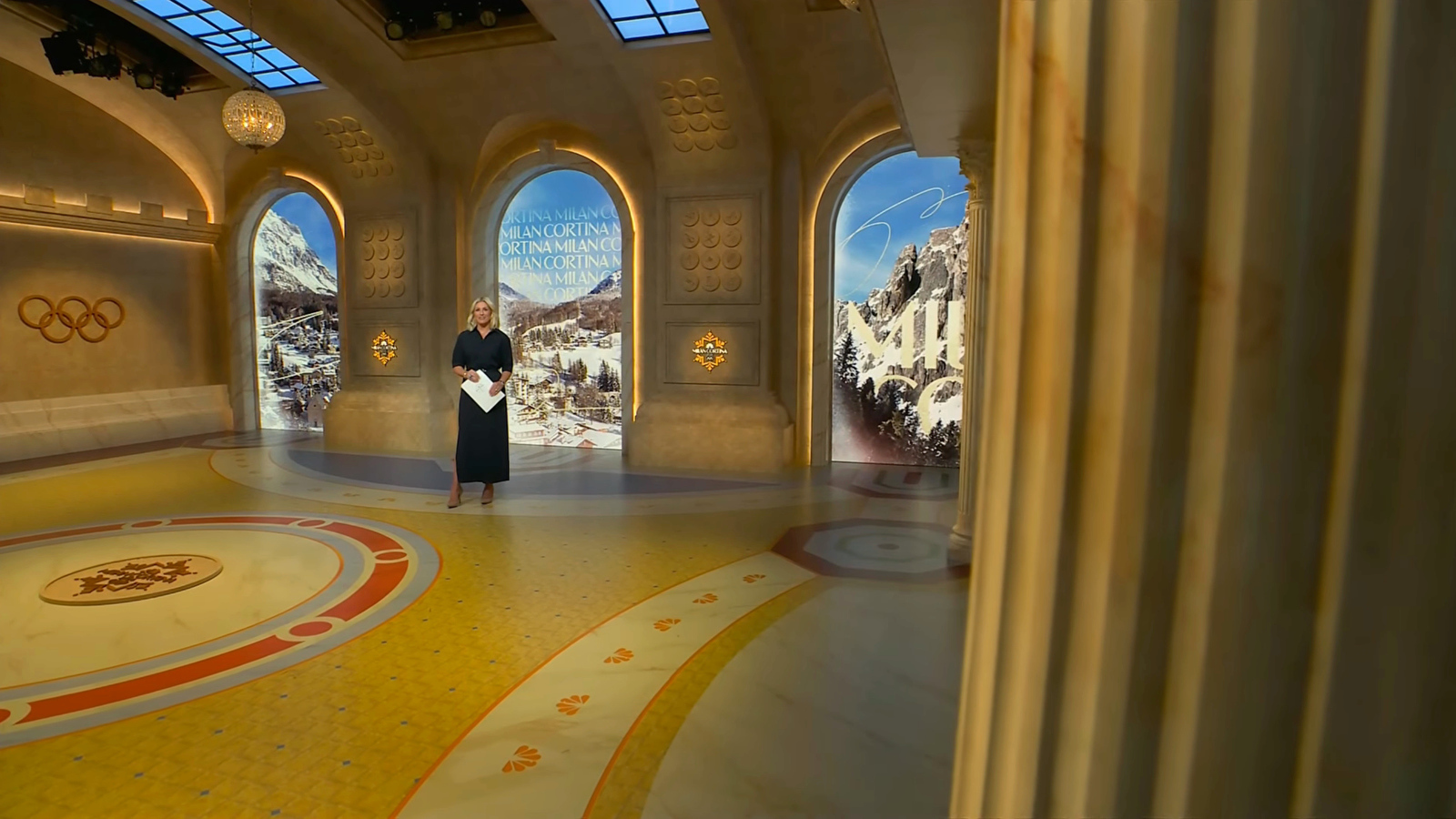
The centerpiece of the studio is a large scenic window flanked by columns, with smaller inlay windows above. To one side, an arcade – a series of arched openings common in Italian train station architecture – houses seamless LED displays that run from floor to crown with no visible bezels or edges.
Crystal chandeliers, marble finishes, inlaid Olympic pictograms and faux floor mosaics complete the space, while soft accent lighting ties the LED surfaces to the surrounding architecture.
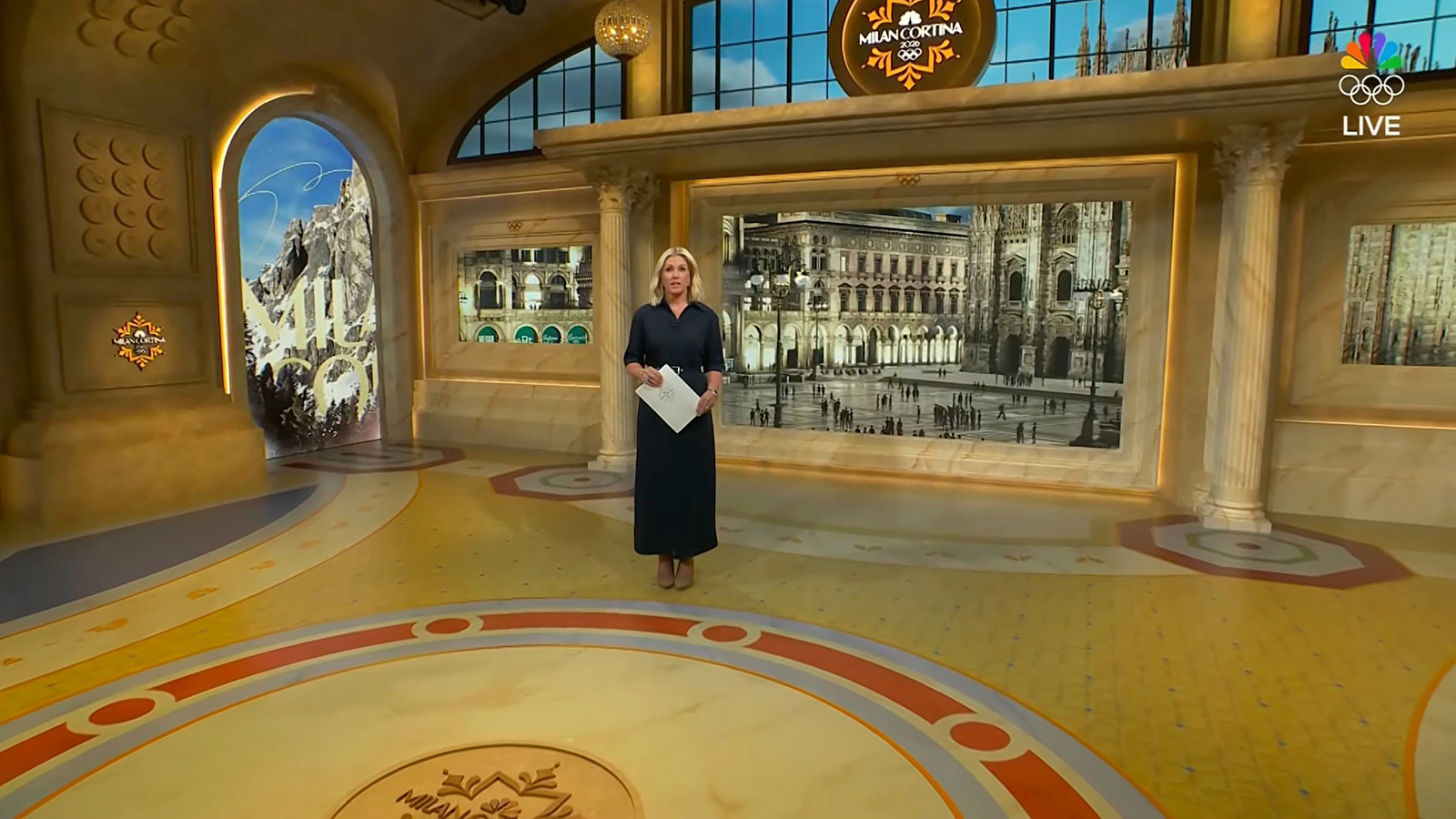
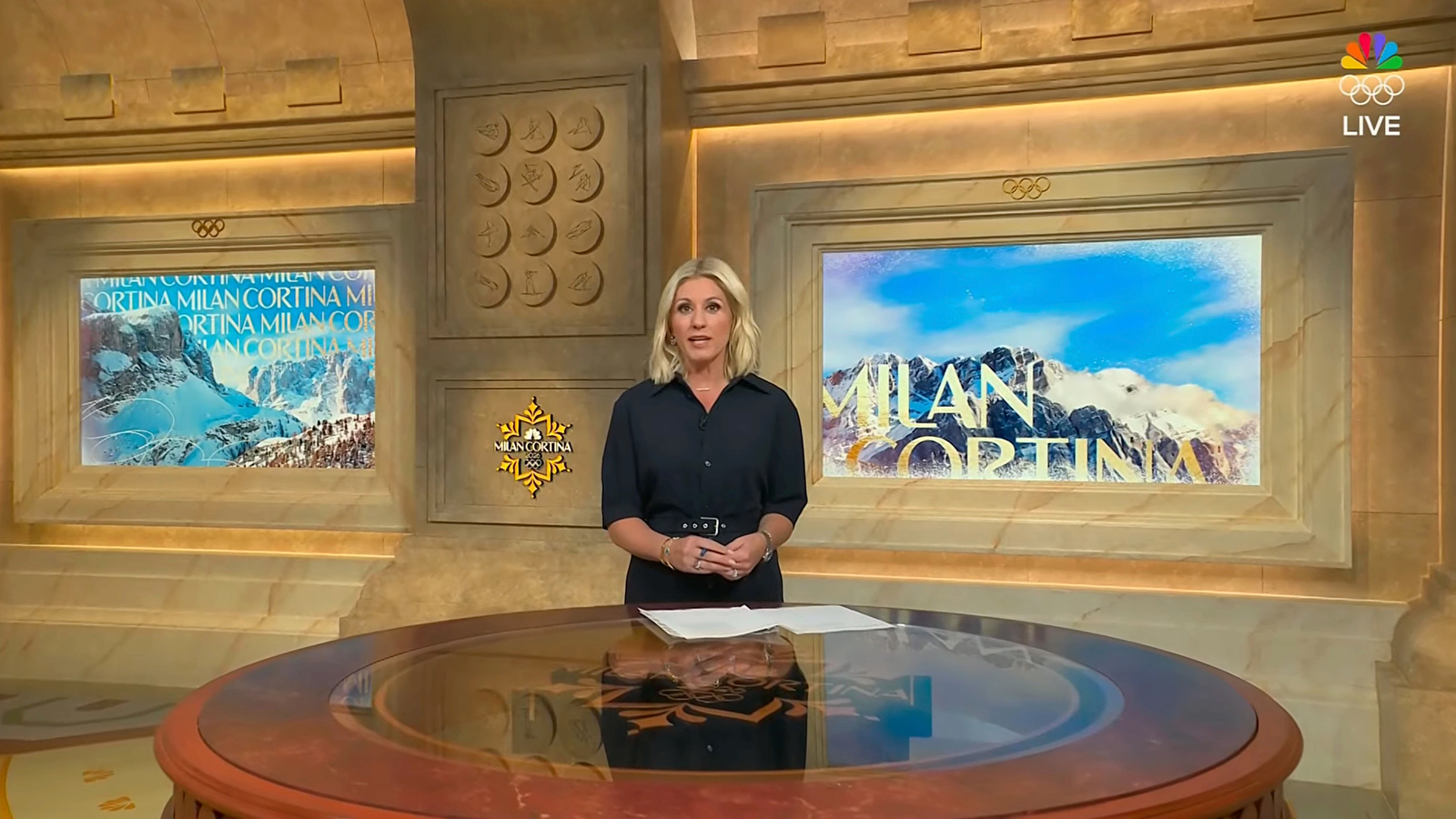
The concept frames the studio as a lounge or waiting area where people arrive and depart, all of them connected by the Olympics.
“Ultimately, we have Mike Tirico living there, and he is the guy who has all of that information to share,” Higginson said. “There’s a lot of Italian architecture in that space, but a lot of it comes from or is inspired by Centrale here in Milan.”
Studio A also houses the most notable technical addition for these Games. The main scenic window uses Planar displays driven by Ross Video’s Voyager system to create an augmented reality parallax display. With Stype camera tracking on the technocrane and Steadicam, the virtual background shifts in response to camera movement rather than remaining static, giving it the illusion of a real window.
Studio B: Mountain cabin in the IBC
The second IBC studio takes a different approach. Designed to evoke the feel of the Cortina d’Ampezzo mountain region where many of the snow sports take place, Studio B is smaller, warmer and configured for more intimate segments and interviews.
“That one is a much cozier, warmer sort of cabin feel,” Higginson said. “It’s very intimate. Great for one-on-ones. Lots of stand-ups in there. And we can do a one-on-three. We can even push to a one-on-four.”
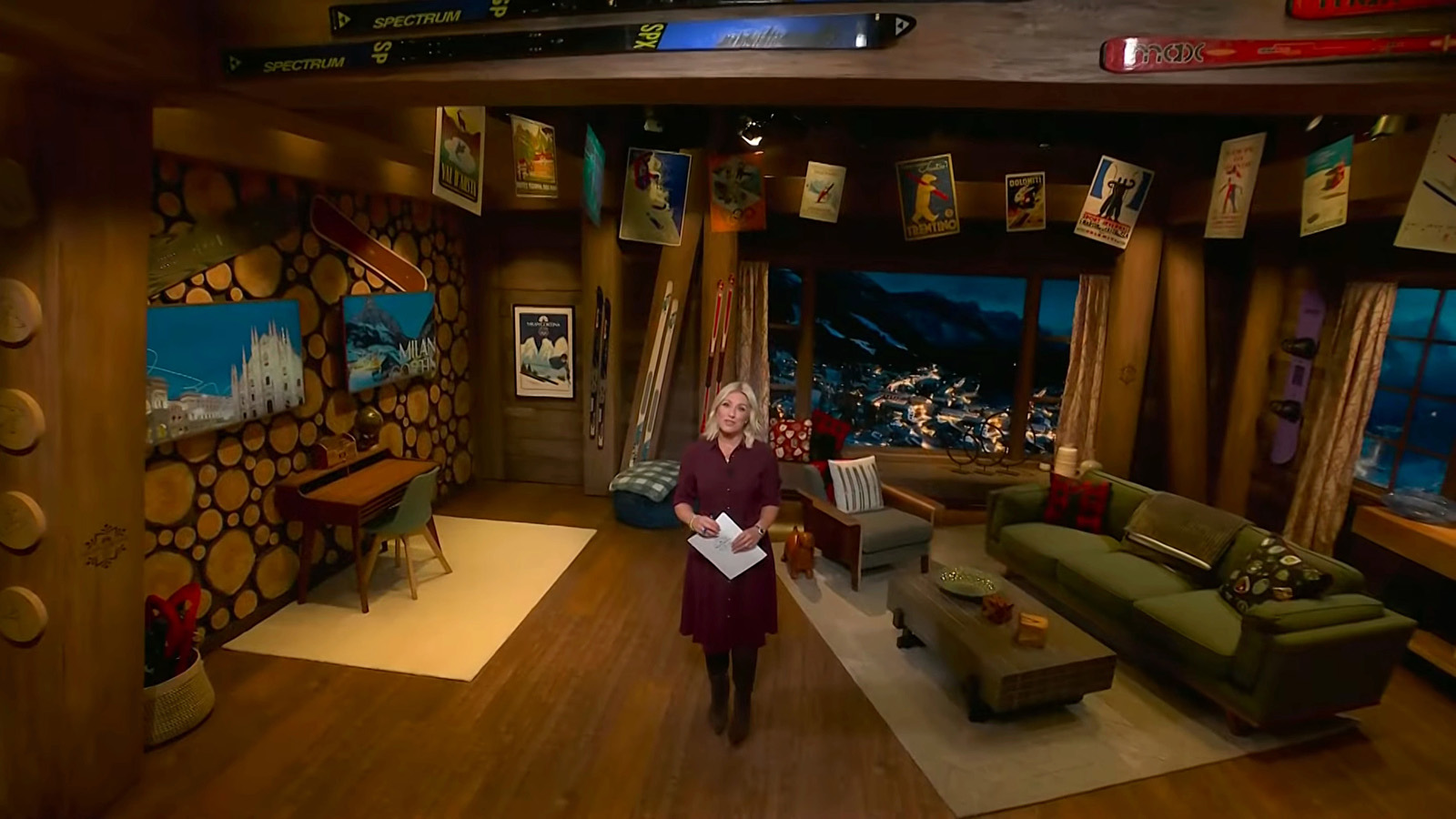
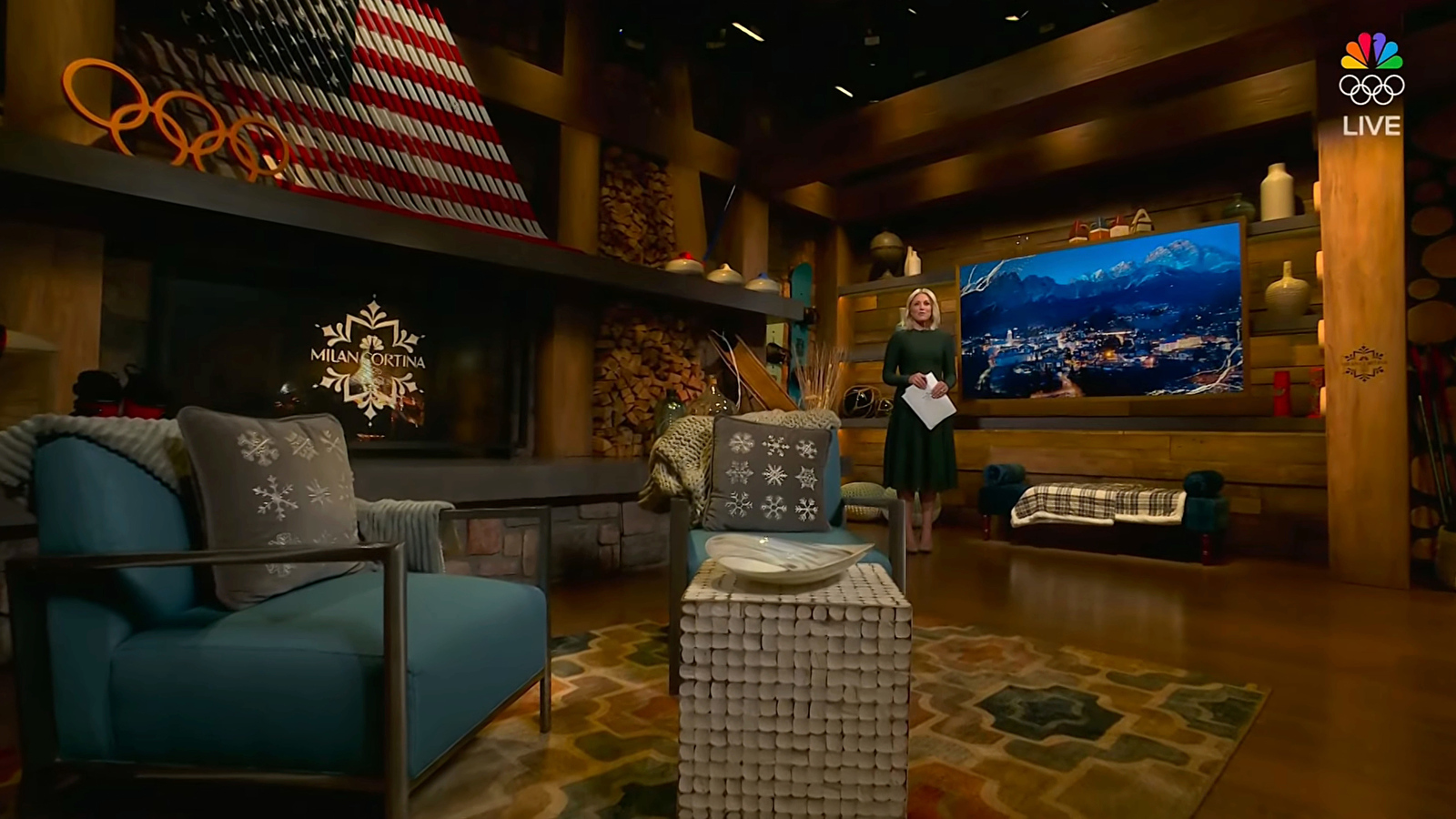
The studio features plenty of winter sports props and is intended for use during day parts that skew toward alpine, snowboard and other mountain events. Ozkaplan said programming would shift between the two IBC studios based on the competition schedule.

“If it’s a day that’s heavy with snowboard or alpine, it’s very likely that daytime and the primetime studio would be out of Studio B, which is that mountain Cortina feel,” Ozkaplan said.
Architecturally, the cabin features exposed wood beams, stacked logs and rustic windows that show a glowing alpine town below. A fireplace adds a touch of warmth to one seating area, with multiple interview areas available. Classic travel posters line the space with an American flag above the fireplace created from hockey sticks.
“We’re trying to capture the flavor of those areas, but we’re not trying to make them real spaces,” noted Higginson. “We’re not trying to fool anybody into thinking we’re literally in a real environment in Cortina or a real environment in Milan.”
Framing the Duomo at the TV tower
The third studio sits in a TV tower position overlooking the Duomo di Milano in the Piazza del Duomo, a setup Higginson compared to NBC’s Rio tower location, which offered a view of Sugarloaf Mountain.
“The bottom line with that kind of background is just get out of the way,” Higginson said. “We take full advantage of the large windows’ view of the Duomo and then accent that with architecture from the area so that we look like we belong there and we almost blend in.”
Rather than compete with the cathedral, the design uses local architectural details to frame the view.
“Hopefully, when you see the set, and you see the view, you just kind of go, oh, yeah, that all makes sense. And then it kind of just goes away, and you watch the show,” added Higginson.
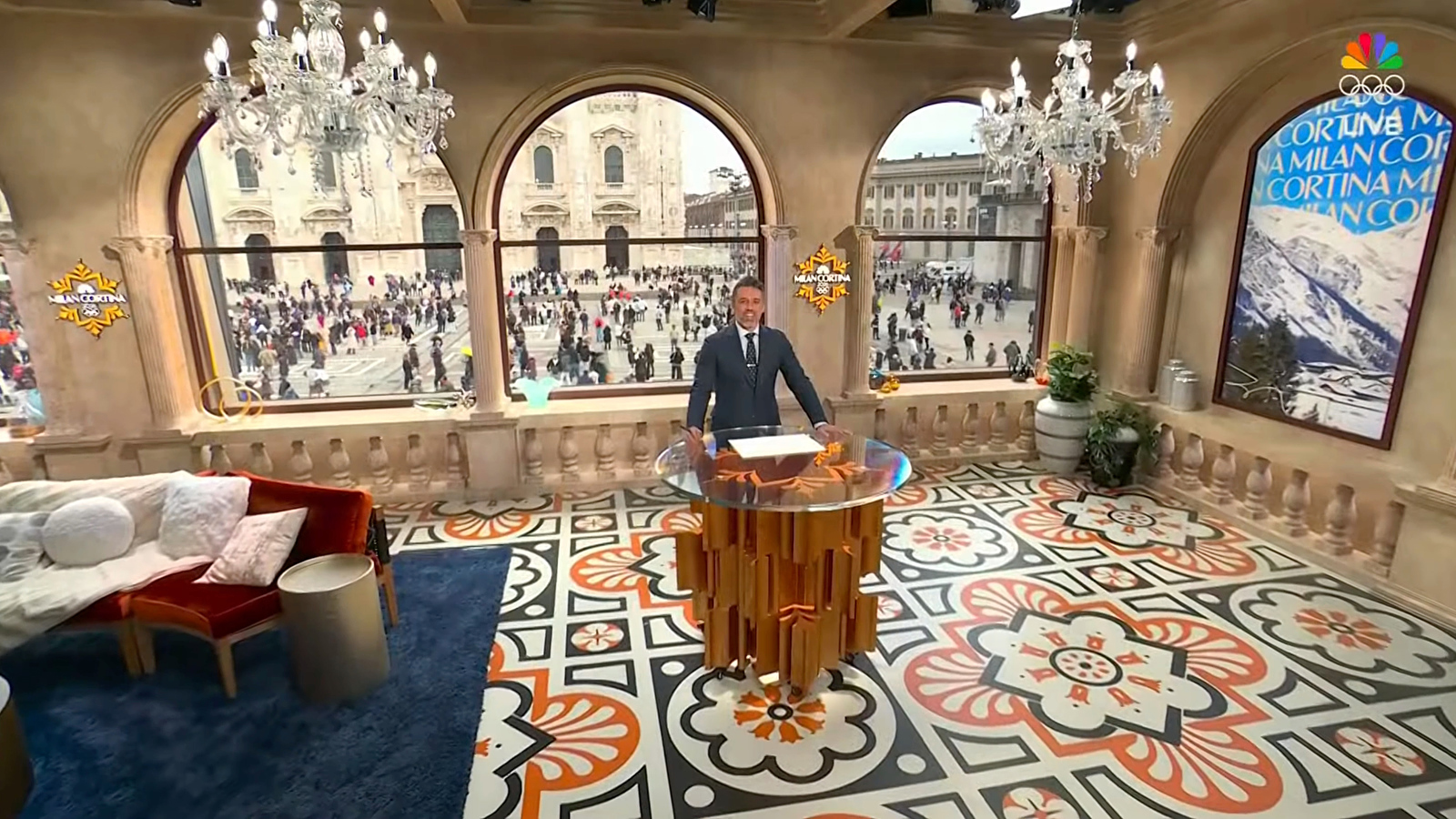
“We didn’t try to do anything clever or sneaky or fun with modern architecture and overthinking the space,” Higginson said. “We wanted to frame it, enhance it, and ultimately the space just wants to feel like we belong there. We’re in the neighborhood.”
Across all three studios, Ozkaplan said the production design serves a singular purpose.
“Everything is about the athletes… It’s about the athletes, it’s about the performance and it’s about their stories,” Ozkaplan said.
“I feel the studios just give another platform for us to share that. Whether it’s the results, whether it’s interviews with the athletes, whether it’s our graphics team integrating their performances into onscreen and the displays, it’s just another means for us to continue telling these incredible stories of these athletes that train their entire lives for what could amount to minutes or seconds, which could decide a gold medal or not.”
NBC’s production team for these Games draws on partnerships that stretch back more than a decade.
“For me, it’s been wonderful to get that group together and to have all of that historical knowledge going from Games to Games,” Ozkaplan said.
Project credits
- Set Design: HD Studio with Bryan Higgason, Sid Wichienkuer and Paul Benson
- Fabrication: Blackwalnut
- Lighting Design: The Lighting Design Group
- AV Integration: Greg Gerner Inc.
- LED Display Technology: Planar

tags
2026 Winter Olympics, Atila Ozkaplan, Blackwalnut, Bryan Higgason, Greg Gerner Inc., HD Studio, Italy, Mike Tirico, Milan, NBC Olympics, nbc sports, Paul Benson, Planar, Ross Video, Ross Voyager, Ross Voyager XR, Sid Wichienkuer, Stype, The Lighting Design Group
categories
Heroes, Olympics, Set Design, Sports Broadcasting & Production